

article
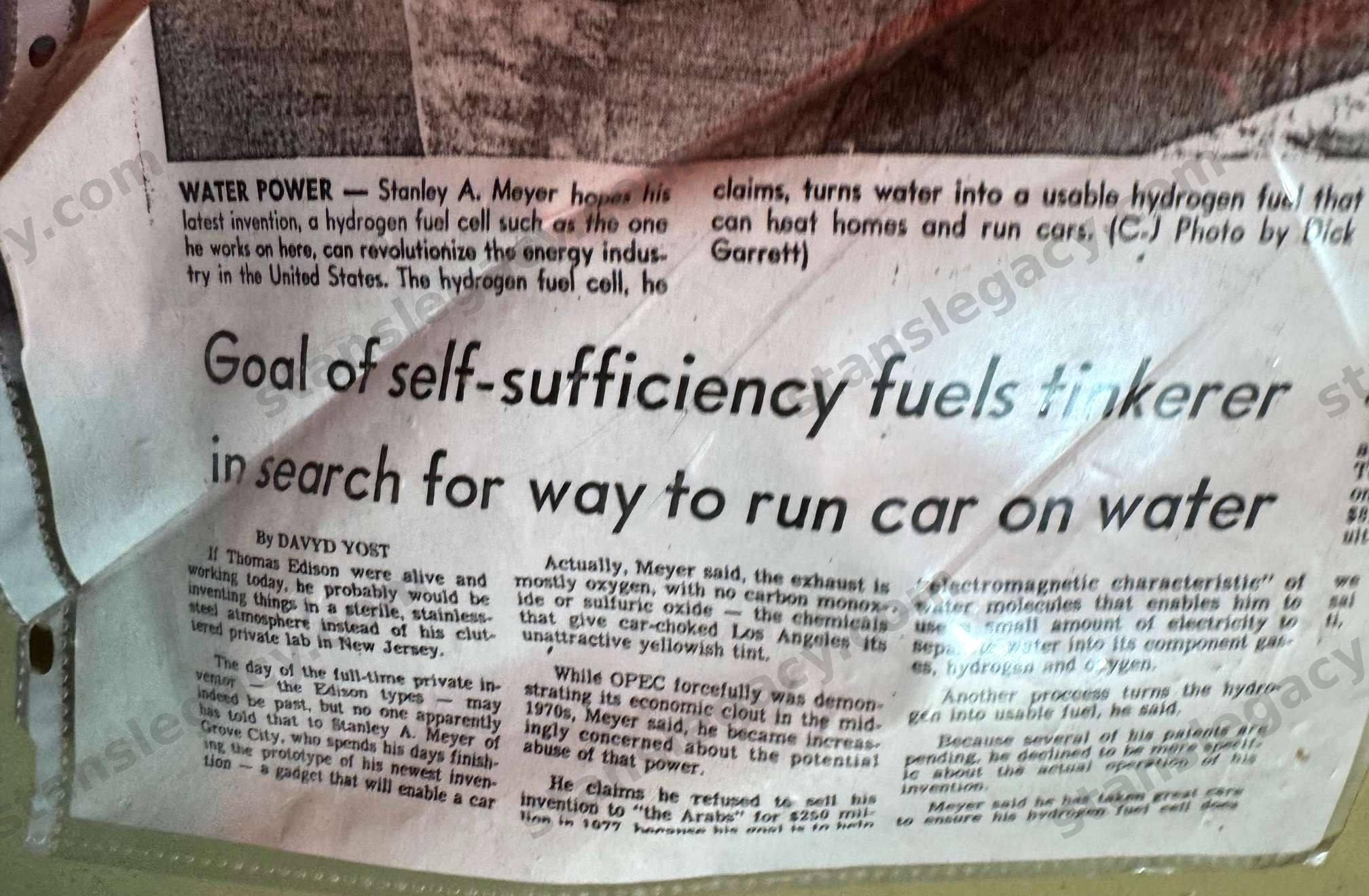
Goal of self-sufficiency fuels tinkerer in search for way to run car on water
Davyd Yost · photograph by Dick Garrett · 26 October 1981
Goal of self-sufficiency fuels tinkerer in search for way to run car on water
By Davyd Yost. Columbus Citizen-Journal, Monday 26 October 1981, page 12. Photograph by Dick Garrett. Transcribed from a photograph of the clipping: only the opening of each column is legible, and […] marks where the copy stops.
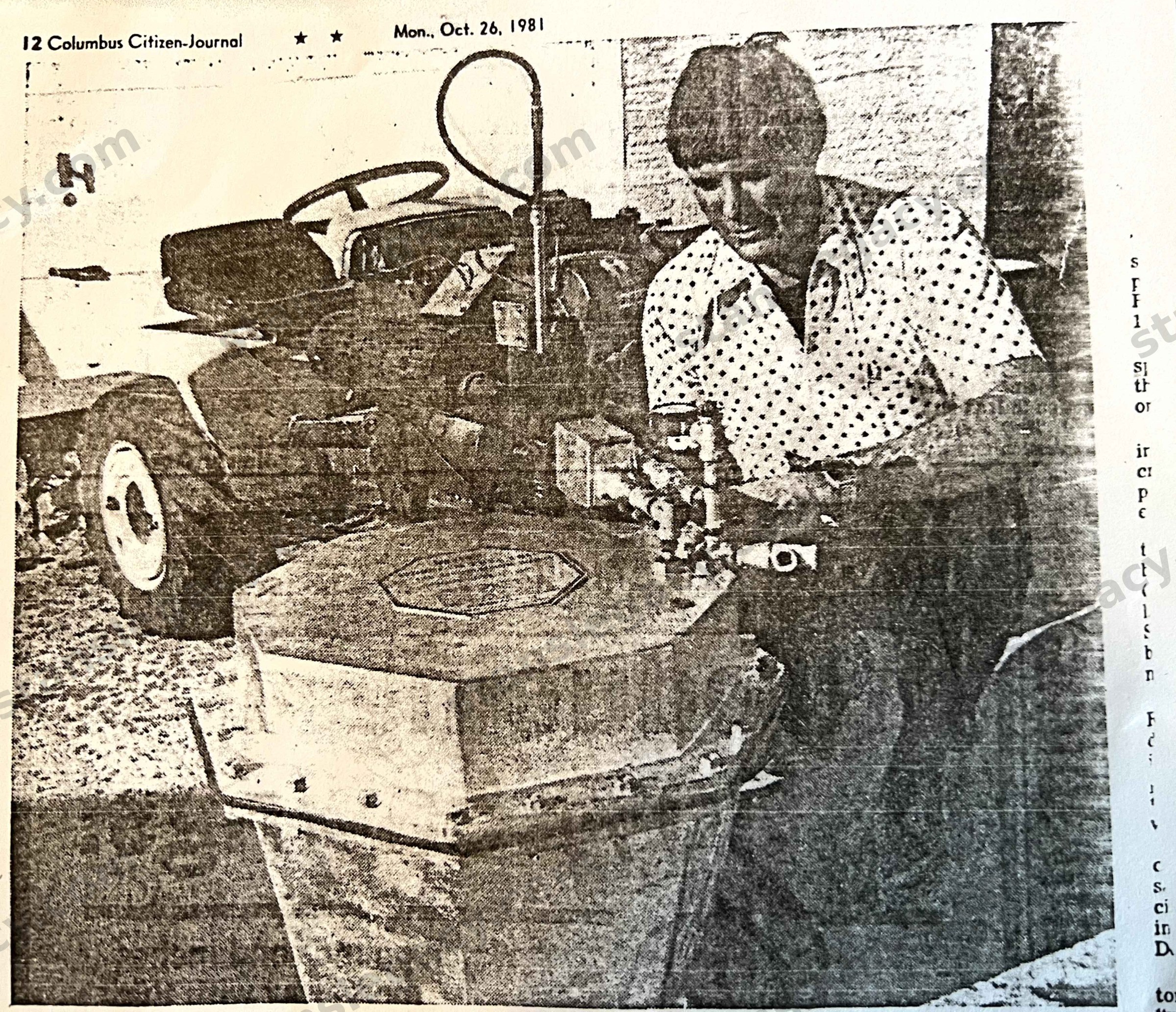
WATER POWER — Stanley A. Meyer hopes his latest invention, a hydrogen fuel cell such as the one he works on here, can revolutionize the energy industry in the United States. The hydrogen fuel cell, he claims, turns water into a usable hydrogen fuel that can heat homes and run cars. (C-J Photo by Dick Garrett)
If Thomas Edison were alive and working today, he probably would be inventing things in a sterile, stainless-steel atmosphere instead of his cluttered private lab in New Jersey.
The day of the full-time private inventor — the Edison types — may indeed be past, but no one apparently has told that to Stanley A. Meyer of Grove City, who spends his days finishing the prototype of his newest invention — a gadget that will enable a car […]
[…] Actually, Meyer said, the exhaust is mostly oxygen, with no carbon monoxide or sulfuric oxide — the chemicals that give car-choked Los Angeles its unattractive yellowish tint.
While OPEC forcefully was demonstrating its economic clout in the mid-1970s, Meyer said, he became increasingly concerned about the potential abuse of that power.
He claims he refused to sell his invention to “the Arabs” for $250 million in 1977 because his goal is to help […]
[…] “electromagnetic characteristic” of water molecules that enables him to use a small amount of electricity to separate water into its component gases, hydrogen and oxygen.
Another process turns the hydrogen into usable fuel, he said.
Because several of his patents are pending, he declined to be more specific about the actual operation of his invention.
Meyer said he has taken great care to ensure his hydrogen fuel cell does […]
What it is
The Columbus paper's own feature, with its own photographer, on the day the UPI wire story ran in Troy. The wire copy reads like this article cut down: the “tinkerer”, the “gadget” that will “enable a car” to run on water, the exhaust that is “mostly oxygen”, the “electromagnetic characteristic” of water molecules, “another process” that makes the fuel, the patents pending and the goal “to help”. The Citizen-Journal was a Scripps-Howard paper, and Scripps-Howard owned UPI at the time, so the wire story very probably came from this article.
The photograph
Meyer, in a polka-dot shirt, is working the valves on top of a large octagonal unit, which the caption calls “a hydrogen fuel cell such as the one he works on here”. A hose runs up from it. Behind is a Bolens riding tractor, which the archive's editor identified from the photograph. The visible text of the article does not mention it.
The Bolens is the engine of Charles Hughes's account. Hughes gave Meyer a room, a basement and a driveway in the 1970s, and is the only person on record who watched him run an engine on water. He describes “a single-cylinder Bolens riding mower of about twelve horsepower, with a tiller and a snow blade” that ran about ten minutes on the gas. The cell that fed it was a tank with perhaps fifty stainless tubes, a pressure gauge and a 12-volt car battery, filled from his well with the garden hose. This photograph puts a Bolens beside Meyer's hydrogen apparatus in October 1981, which matches Hughes. Whether the octagonal unit here is the tank Hughes described, the photograph cannot settle.
What it adds
- The $250 million. “He claims he refused to sell his invention to ‘the Arabs’ for $250 million in 1977.” This is the first time the story is in print. A Grove City neighbour remembered the same figure from a dinner with Stan (Charles Hughes, 2012: “the Arabs wanted to offer me $250 million”).
- 1977. The year he gives for the offer is before any patent filing the archive knows of on the hydrogen work, and in the years of the solar silo.
- The motive, in the form he would keep telling for the rest of his life: OPEC's power in the mid-1970s, and a goal of national self-sufficiency.
Still open
- The rest of the text. The clipping photographed shows only the first lines of each column. The Citizen-Journal, which closed in 1985, survives on microfilm in Columbus, and a reel of 26 October 1981 would give the whole article.
The original
Provenance
- Shelf
- Press coverage
- Page
- 12
- Byline
- Davyd Yost; photograph by Dick Garrett
- Rights
- The newspaper page is copyright its publisher and is reproduced here as a record of what was printed at the time; the archive claims nothing in it. The watermark marks the archive’s copy, not its ownership. The citation is what a reader needs to find the original.
- Caption
- Columbus Citizen-Journal, Monday 26 October 1981, page 12. First, Dick Garrett's photograph of Meyer at work on the hydrogen fuel cell, from a photocopy of the page. Second, the clipping itself, showing the caption, the headline, Davyd Yost's byline and the opening of each column.
- Citation
- Columbus Citizen-Journal, Columbus, Ohio, October 1981, pp. 12, by Davyd Yost; photograph by Dick Garrett
- Publication
- Columbus Citizen-Journal, Columbus, Ohio
- Transcription
- A photocopy of page 12, photographed and supplied by the archive's editor, and a second photograph of the clipping showing the caption, headline, byline and the opening of each column. Only what is legible in that photograph is transcribed.