

article
From transistors to semiconductors: “Birth of new technology 40 years ago”
Peter Coy, Associated Press · 3 January 1988
From transistors to semiconductors
Birth of new technology 40 years ago paved the way for modern electronics
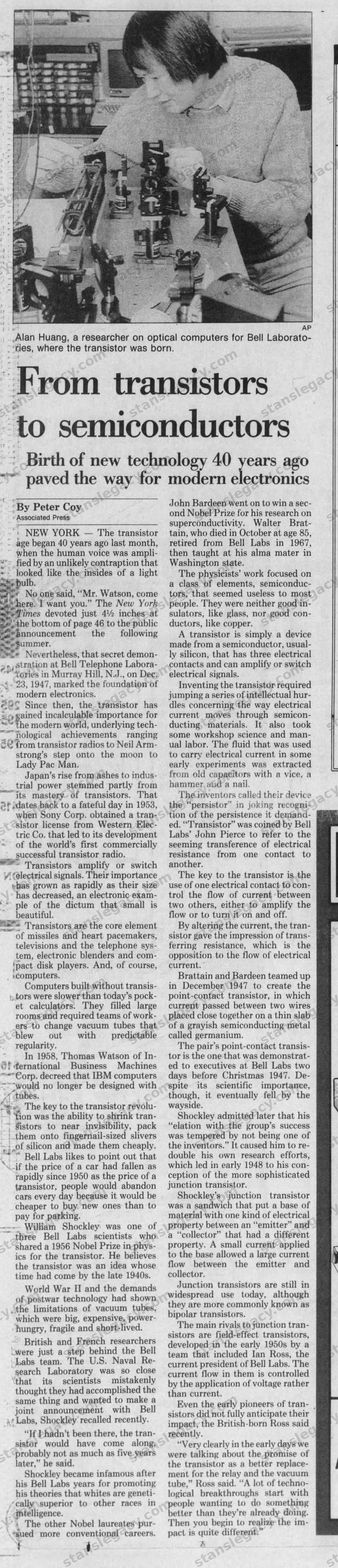
Photograph (AP): Alan Huang, a researcher on optical computers for Bell Laboratories, where the transistor was born.
NEW YORK — The transistor age began 40 years ago last month, when the human voice was amplified by an unlikely contraption that looked like the insides of a light bulb.
No one said, “Mr. Watson, come here. I want you.” The New York Times devoted just 4½ inches at the bottom of page 46 to the public announcement the following summer.
Nevertheless, that secret demonstration at Bell Telephone Laboratories in Murray Hill, N.J., on Dec. 23, 1947, marked the foundation of modern electronics.
Since then, the transistor has gained incalculable importance for the modern world, underlying technological achievements ranging from transistor radios to Neil Armstrong’s step onto the moon to Lady Pac Man.
Japan’s rise from ashes to industrial power stemmed partly from its mastery of transistors. That dates back to a fateful day in 1953, when Sony Corp. obtained a transistor license from Western Electric Co. that led to its development of the world’s first commercially successful transistor radio.
Transistors amplify or switch electrical signals. Their importance has grown as rapidly as their size has decreased, an electronic example of the dictum that small is beautiful.
Transistors are the core element of missiles and heart pacemakers, televisions and the telephone system, electronic blenders and compact disk players. And, of course, computers.
Computers built without transistors were slower than today’s pocket calculators. They filled large rooms and required teams of workers to change vacuum tubes that blew out with predictable regularity.
In 1958, Thomas Watson of International Business Machines Corp. decreed that IBM computers would no longer be designed with tubes.
The key to the transistor revolution was the ability to shrink transistors to near invisibility, pack them onto fingernail-sized slivers of silicon and made them cheaply.
Bell Labs likes to point out that if the price of a car had fallen as rapidly since 1950 as the price of a transistor, people would abandon cars every day because it would be cheaper to buy new ones than to pay for parking.
William Shockley was one of three Bell Labs scientists who shared a 1956 Nobel Prize in physics for the transistor. He believes the transistor was an idea whose time had come by the late 1940s.
World War II and the demands of postwar technology had shown the limitations of vacuum tubes, which were big, expensive, power-hungry, fragile and short-lived.
British and French researchers were just a step behind the Bell Labs team. The U.S. Naval Research Laboratory was so close that its scientists mistakenly thought they had accomplished the same thing and wanted to make a joint announcement with Bell Labs, Shockley recalled recently.
“If I hadn’t been there, the transistor would have come along, probably not as much as five years later,” he said.
Shockley became infamous after his Bell Labs years for promoting his theories that whites are genetically superior to other races in intelligence.
The other Nobel laureates pursued more conventional careers. John Bardeen went on to win a second Nobel Prize for his research on superconductivity. Walter Brattain, who died in October at age 85, retired from Bell Labs in 1967, then taught at his alma mater in Washington state.
The physicists’ work focused on a class of elements, semiconductors, that seemed useless to most people. They were neither good insulators, like glass, nor good conductors, like copper.
A transistor is simply a device made from a semiconductor, usually silicon, that has three electrical contacts and can amplify or switch electrical signals.
Inventing the transistor required jumping a series of intellectual hurdles concerning the way electrical current moves through semiconducting materials. It also took some workshop science and manual labor. The fluid that was used to carry electrical current in some early experiments was extracted from old capacitors with a vice, a hammer and a nail.
The inventors called their device the “persistor” in joking recognition of the persistence it demanded. “Transistor” was coined by Bell Labs’ John Pierce to refer to the seeming transference of electrical resistance from one contact to another.
The key to the transistor is the use of one electrical contact to control the flow of current between two others, either to amplify the flow or to turn it on and off.
By altering the current, the transistor gave the impression of transferring resistance, which is the opposition to the flow of electrical current.
Brattain and Bardeen teamed up in December 1947 to create the point-contact transistor, in which current passed between two wires placed close together on a thin slab of a grayish semiconducting metal called germanium.
The pair’s point-contact transistor is the one that was demonstrated to executives at Bell Labs two days before Christmas 1947. Despite its scientific importance, though, it eventually fell by the wayside.
Shockley admitted later that his “elation with the group’s success was tempered by not being one of the inventors.” It caused him to redouble his own research efforts, which led in early 1948 to his conception of the more sophisticated junction transistor.
Shockley’s junction transistor was a sandwich that put a base of material with one kind of electrical property between an “emitter” and a “collector” that had a different property. A small current applied to the base allowed a large current flow between the emitter and collector.
Junction transistors are still in widespread use today, although they are more commonly known as bipolar transistors.
The main rivals to junction transistors are field-effect transistors, developed in the early 1950s by a team that included Ian Ross, the current president of Bell Labs. The current flow in them is controlled by the application of voltage rather than current.
Even the early pioneers of transistors did not fully anticipate their impact, the British-born Ross said recently.
“Very clearly in the early days we were talking about the promise of the transistor as a better replacement for the relay and the vacuum tube,” Ross said. “A lot of technological breakthroughs start with people wanting to do something better than they’re already doing. Then you begin to realize the impact is quite different.”
The original

Provenance
- Shelf
- Press coverage
- Page
- Austin American-Statesman, Sunday 3 January 1988, page G11
- Byline
- Peter Coy, Associated Press
- Rights
- The newspaper page is copyright its publisher and is reproduced here as a record of what was printed at the time; the archive claims nothing in it. The watermark marks the archive’s copy, not its ownership. The citation is what a reader needs to find the original.
- Caption
- Austin American-Statesman, Sunday 3 January 1988, page G11: the article as printed, and the page's folio line. The same AP story ran in other papers.
- Citation
- Associated Press, January 1988, pp. Austin American-Statesman, Sunday 3 January 1988, page G11, by Peter Coy, Associated Press
- Publication
- Associated Press
- Transcription
- Transcribed from a scan of the printed page, supplied by the archive’s editor. The text is the wire copy as this paper printed it.