

article
Speculative Interpretation of Over Unity Experiments Involving Water Electrolysis (Bockris, 1996)
29 September 2026
John O'M. Bockris, the Texas A&M electrochemist, reviewed five claims of more energy out of water than electrolysis should give, in "Speculative Interpretation of Over Unity Experiments Involving Water Electrolysis", Infinite Energy no. 10, September–October 1996, pages 61 to 62. Meyer is the second of the five, after Brown's gas and before AquaFuel, the Graneaus' water explosions and the Correas' discharge tubes. The issue is on the Internet Archive, from New Energy Times's collection of Mallove's magazine.
Bockris was not a fringe figure. He was one of the founders of modern electrochemistry, and his name on a speculation about Meyer counted for something in 1996. What he wrote is closer to a doubt than an endorsement.
What he says about Meyer
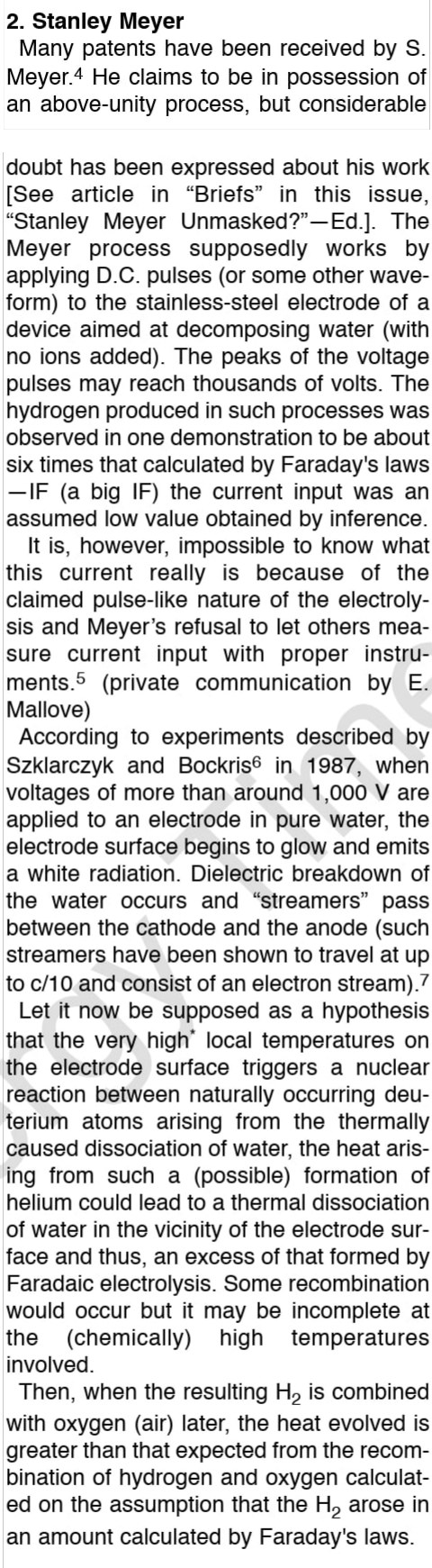
"Many patents have been received by S. Meyer. He claims to be in possession of an above-unity process, but considerable doubt has been expressed about his work … The Meyer process supposedly works by applying D.C. pulses (or some other waveform) to the stainless-steel electrode of a device aimed at decomposing water (with no ions added). The peaks of the voltage pulses may reach thousands of volts. The hydrogen produced in such processes was observed in one demonstration to be about six times that calculated by Faraday's laws —IF (a big IF) the current input was an assumed low value obtained by inference.
It is, however, impossible to know what this current really is because of the claimed pulse-like nature of the electrolysis and Meyer's refusal to let others measure current input with proper instruments. (private communication by E. Mallove)"
The rest of the section is Bockris's own idea, not a claim about Meyer's cell: above about 1,000 volts an electrode in pure water glows and the water breaks down, and he supposes that the hot spots might set off a reaction between the deuterium naturally present in water, whose heat would split more water than Faraday's laws allow. He is candid about it: the suggestions "rest upon poorly defined facts and use an extremely novel theory not yet accepted by the nuclear community."
His sources
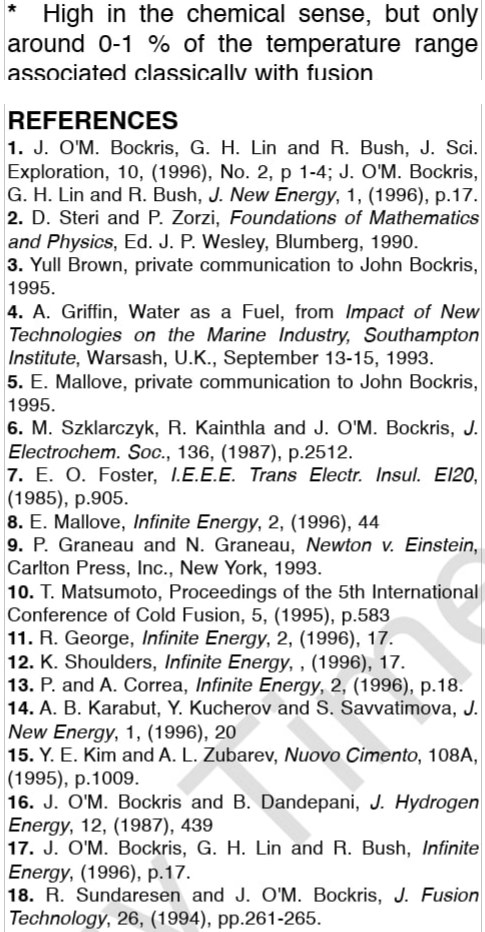
Two of the eighteen references are for Meyer:
- Reference 4, for the patents: A. Griffin, "Water as a Fuel", Impact of New Technologies on the Marine Industry, Southampton Institute, Warsash, 13 to 15 September 1993. That is the admiral's paper, which the archive holds: Water as Fuel.
- Reference 5, for the refused measurement: Eugene Mallove, private communication to Bockris, 1995. Mallove had watched a demonstration at Grove City in 1993 and asked to test the input and output ever since; his public request, and Meyer's answer about patent rights, are on tape at Denver in 1997, from 55:38.
Where the "six times" figure comes from, Bockris does not say. It is not in Griffin's paper, which puts ordinary electrolysis at about three times the energy of the hydrogen it releases and gives no Faraday ratio for Meyer's cell.
"Stanley Meyer Unmasked?"
The editor's note in the middle of the section, "[See article in 'Briefs' in this issue, 'Stanley Meyer Unmasked?'—Ed.]", points to nothing. The Briefs of issue 10, pages 57 and 58, carry Takahashi, Galtech, "matrimonial fusion", the New York Times, Schwinger, tritium and herbal petrol, and no Meyer; the archive has also searched the text of issues 9, 11 and 12. The brief was announced and never printed, or cut after the cross-reference was set.
Where else it went
New Energy News abstracted the paper in February 1997, under a review of the whole issue, with the five headings, Meyer's among them. Section 4, on Peter and Neal Graneau's explosions in water, is the work Gary Johnson was replicating when Meyer's 1994 news release cited him (Johnson's letter).
Provenance
- Shelf
- Reference Library
- File
- database/content/pages/bockris-1996-over-unity-water-electrolysis.json
- Rights
- John O'M. Bockris, 'Speculative Interpretation of Over Unity Experiments Involving Water Electrolysis', Infinite Energy no. 10 (vol. 2), September–October 1996, pp. 61–62, © Infinite Energy; the page images are from the New Energy Times archive copy on the Internet Archive, whose watermark they carry. The section on Meyer and the references are shown for comment; the rest of the paper is summarised.