

letter
Technical writing skills: Gary Johnson on the Water Fuel Cell papers
Dr Gary L. Johnson, Johnson Energy Corporation, Manhattan, Kansas · 1 January 1995
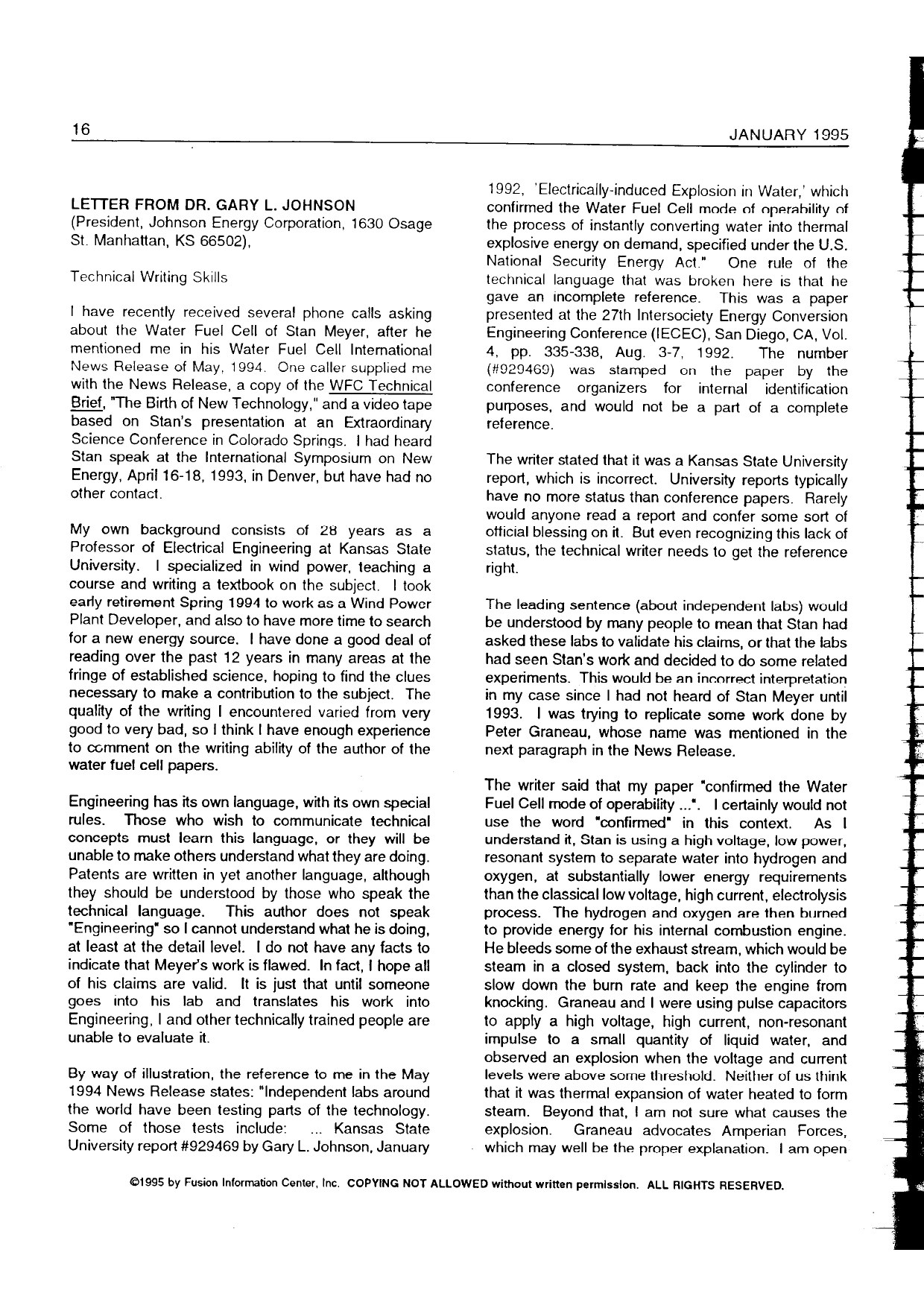
Letter from Dr. Gary L. Johnson
(President, Johnson Energy Corporation, 1630 Osage St. Manhattan, KS 66502)
Technical Writing Skills
I have recently received several phone calls asking about the Water Fuel Cell of Stan Meyer, after he mentioned me in his Water Fuel Cell International News Release of May, 1994. One caller supplied me with the News Release, a copy of the WFC Technical Brief, "The Birth of New Technology," and a video tape based on Stan's presentation at an Extraordinary Science Conference in Colorado Springs. I had heard Stan speak at the International Symposium on New Energy, April 16-18, 1993, in Denver, but have had no other contact.
My own background consists of 28 years as a Professor of Electrical Engineering at Kansas State University. I specialized in wind power, teaching a course and writing a textbook on the subject. I took early retirement Spring 1994 to work as a Wind Power Plant Developer, and also to have more time to search for a new energy source. I have done a good deal of reading over the past 12 years in many areas at the fringe of established science, hoping to find the clues necessary to make a contribution to the subject. The quality of the writing I encountered varied from very good to very bad, so I think I have enough experience to comment on the writing ability of the author of the water fuel cell papers.
Engineering has its own language, with its own special rules. Those who wish to communicate technical concepts must learn this language, or they will be unable to make others understand what they are doing. Patents are written in yet another language, although they should be understood by those who speak the technical language. This author does not speak "Engineering" so I cannot understand what he is doing, at least at the detail level. I do not have any facts to indicate that Meyer's work is flawed. In fact, I hope all of his claims are valid. It is just that until someone goes into his lab and translates his work into Engineering, I and other technically trained people are unable to evaluate it.
By way of illustration, the reference to me in the May 1994 News Release states: "Independent labs around the world have been testing parts of the technology. Some of those tests include: ... Kansas State University report #929469 by Gary L. Johnson, January 1992, 'Electrically-induced Explosion in Water,' which confirmed the Water Fuel Cell mode of operability of the process of instantly converting water into thermal explosive energy on demand, specified under the U.S. National Security Energy Act." One rule of the technical language that was broken here is that he gave an incomplete reference. This was a paper presented at the 27th Intersociety Energy Conversion Engineering Conference (IECEC), San Diego, CA, Vol. 4, pp. 335-338, Aug. 3-7, 1992. The number (#929469) was stamped on the paper by the conference organizers for internal identification purposes, and would not be a part of a complete reference.
The writer stated that it was a Kansas State University report, which is incorrect. University reports typically have no more status than conference papers. Rarely would anyone read a report and confer some sort of official blessing on it. But even recognizing this lack of status, the technical writer needs to get the reference right.
The leading sentence (about independent labs) would be understood by many people to mean that Stan had asked these labs to validate his claims, or that the labs had seen Stan's work and decided to do some related experiments. This would be an incorrect interpretation in my case since I had not heard of Stan Meyer until 1993. I was trying to replicate some work done by Peter Graneau, whose name was mentioned in the next paragraph in the News Release.
The writer said that my paper "confirmed the Water Fuel Cell mode of operability ...". I certainly would not use the word "confirmed" in this context. As I understand it, Stan is using a high voltage, low power, resonant system to separate water into hydrogen and oxygen, at substantially lower energy requirements than the classical low voltage, high current, electrolysis process. The hydrogen and oxygen are then burned to provide energy for his internal combustion engine. He bleeds some of the exhaust stream, which would be steam in a closed system, back into the cylinder to slow down the burn rate and keep the engine from knocking. Graneau and I were using pulse capacitors to apply a high voltage, high current, non-resonant impulse to a small quantity of liquid water, and observed an explosion when the voltage and current levels were above some threshold. Neither of us think that it was thermal expansion of water heated to form steam. Beyond that, I am not sure what causes the explosion. Graneau advocates Amperian Forces, which may well be the proper explanation. I am open to other explanations, including Meyer's. But the only thing I "confirmed" was that water will explode when a high voltage is applied.
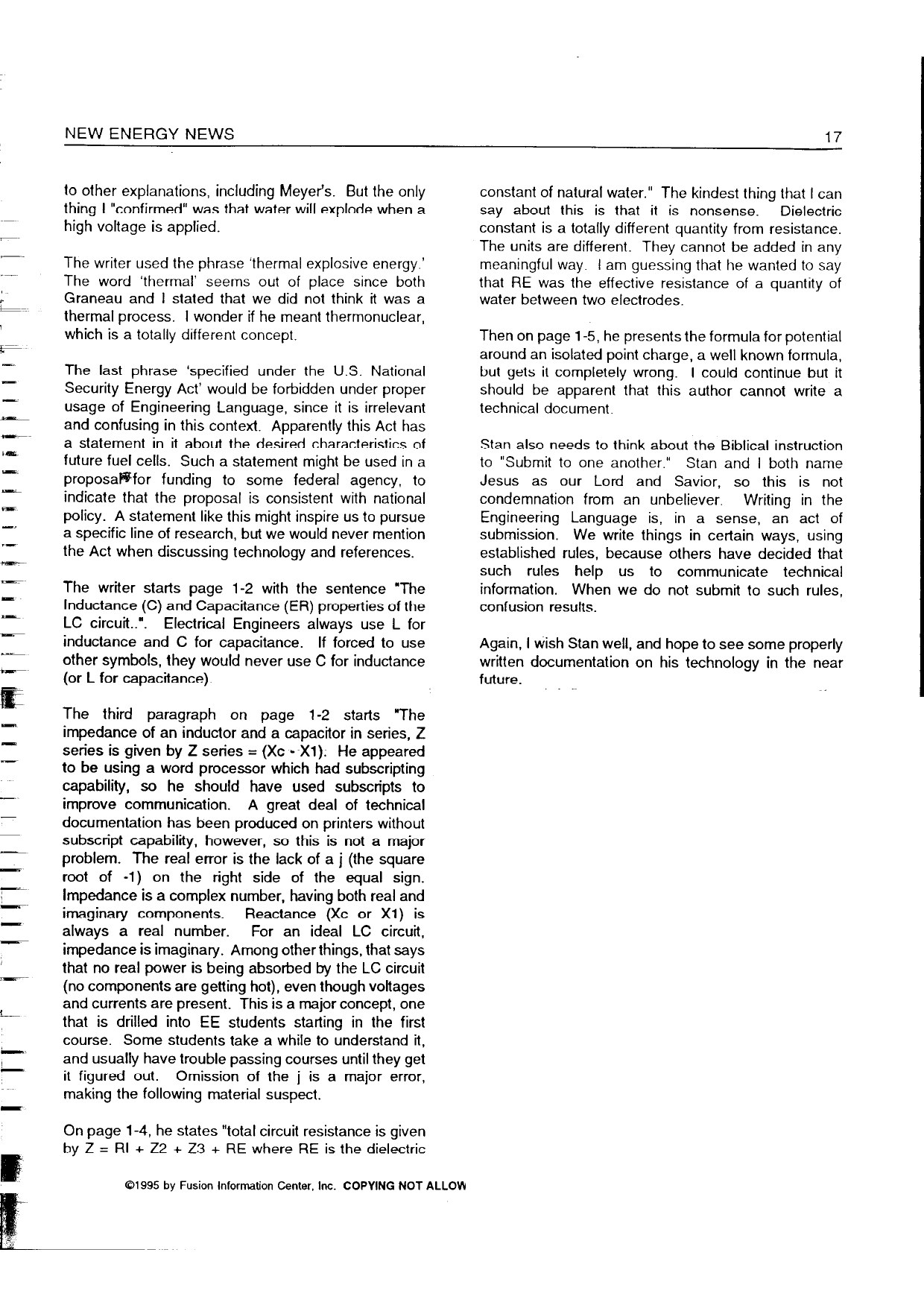
The writer used the phrase 'thermal explosive energy.' The word 'thermal' seems out of place since both Graneau and I stated that we did not think it was a thermal process. I wonder if he meant thermonuclear, which is a totally different concept.
The last phrase 'specified under the U.S. National Security Energy Act' would be forbidden under proper usage of Engineering Language, since it is irrelevant and confusing in this context. Apparently this Act has a statement in it about the desired characteristics of future fuel cells. Such a statement might be used in a proposal for funding to some federal agency, to indicate that the proposal is consistent with national policy. A statement like this might inspire us to pursue a specific line of research, but we would never mention the Act when discussing technology and references.
The writer starts page 1-2 with the sentence "The Inductance (C) and Capacitance (ER) properties of the LC circuit..". Electrical Engineers always use L for inductance and C for capacitance. If forced to use other symbols, they would never use C for inductance (or L for capacitance).
The third paragraph on page 1-2 starts "The impedance of an inductor and a capacitor in series, Z series is given by Z series = (Xc - X1). He appeared to be using a word processor which had subscripting capability, so he should have used subscripts to improve communication. A great deal of technical documentation has been produced on printers without subscript capability, however, so this is not a major problem. The real error is the lack of a j (the square root of -1) on the right side of the equal sign. Impedance is a complex number, having both real and imaginary components. Reactance (Xc or X1) is always a real number. For an ideal LC circuit, impedance is imaginary. Among other things, that says that no real power is being absorbed by the LC circuit (no components are getting hot), even though voltages and currents are present. This is a major concept, one that is drilled into EE students starting in the first course. Some students take a while to understand it, and usually have trouble passing courses until they get it figured out. Omission of the j is a major error, making the following material suspect.
On page 1-4, he states "total circuit resistance is given by Z = R1 + Z2 + Z3 + RE where RE is the dielectric constant of natural water." The kindest thing that I can say about this is that it is nonsense. Dielectric constant is a totally different quantity from resistance. The units are different. They cannot be added in any meaningful way. I am guessing that he wanted to say that RE was the effective resistance of a quantity of water between two electrodes.
Then on page 1-5, he presents the formula for potential around an isolated point charge, a well known formula, but gets it completely wrong. I could continue but it should be apparent that this author cannot write a technical document.
Stan also needs to think about the Biblical instruction to "Submit to one another." Stan and I both name Jesus as our Lord and Savior, so this is not condemnation from an unbeliever. Writing in the Engineering Language is, in a sense, an act of submission. We write things in certain ways, using established rules, because others have decided that such rules help us to communicate technical information. When we do not submit to such rules, confusion results.
Again, I wish Stan well, and hope to see some properly written documentation on his technology in the near future.
About this letter
Johnson's paper is in the archive: Meyer bound it into his 1995 International Independent Test-Evaluation Report as Electrically induced explosions in water, under the same number, 929469, that Johnson says was only the conference's filing stamp. He was replicating Peter Graneau's water-arc explosions, and his letter is the clearest statement in print of what that work did and did not show about the Water Fuel Cell.
The equations he picks out can be checked against the Brief itself, which the archive has typed: The equations of The Birth of New Technology. Page 1-2 does give Zseries = (Xc − Xl) with no j, and page 1-4 does add R1, Z2, Z3 and RE, "the dielectric constant of natural water". The archive's copy of the Brief has the point-charge formula on page 1-6, not 1-5. The tape he was sent was probably of the talk Meyer gave in Colorado Springs in 1991 (Colorado Springs, 1991).
No law is called the "U.S. National Security Energy Act"; the nearest title is the Energy Security Act of 1980. Toby Grotz answered this letter in June 1995 (Grotz on the SAFE visit).
The original
Provenance
- Shelf
- Correspondence
- Page
- 16–17
- Issue
- Volume 2, number 9
- Byline
- Dr Gary L. Johnson, Johnson Energy Corporation, Manhattan, Kansas
- Patent office record
- newenergytimes.com →
- Rights
- New Energy News is copyright 1995 by the Fusion Information Center, Inc., Salt Lake City. The archive reproduces only the item about Meyer, as a record of what was printed at the time, and claims nothing in it; the whole issue is in the Center's archive at New Energy Times, linked above.
- Caption
- New Energy News, January 1995, pages 16 and 17; the letter that follows it on page 17 is left out.
- Citation
- New Energy News, Salt Lake City, Volume 2, number 9, January 1995, pp. 16–17, by Dr Gary L. Johnson, Johnson Energy Corporation, Manhattan, Kansas
- Publication
- New Energy News, Salt Lake City
- Transcription
- OCR of the New Energy Times copy of the issue, read against the page images.