

article
Stanley Meyer's and Walter Jenkins's water cars
The editors of the NET-Journal (Adolf and Inge Schneider), reporting Ulf Dahlström's talk · 1 November 2018
The NET-Journal, the Swiss and German quarterly of the free-energy scene edited by Adolf and Inge Schneider, reported its own congress at Königstein in its November/December 2018 number. Fourteen pages cover thirteen talks. One section, on pages 14 and 15, is Ulf Dahlström's talk on Stan and on Walter Jenkins, and that section is translated here in full, with the German after it. The rest of the report is the publisher's and is cited, not reproduced; the whole is at the source link.
Translation
Stanley Meyer's and Walter Jenkins's water cars
In Ulf Dahlström from Sweden the organisers had secured a speaker who worked with Stanley Meyer for a long time and knows Walter Jenkins personally. Ulf gave a look into his personal photo archive, which shows him with Stanley Meyer and Rick Schneider. He had himself driven Stanley Meyer's water car. How refined and complicated this engine was is clear from a film of 1992 which Ulf played, in which Stanley explained how it worked. One saw complicated dashboard instruments and, among other things, an injector for injecting water into the engine, the so-called "steel resonator". Ulf reported that Stanley Meyer was granted 42 patents for his water engine. Andreas Puharich had developed a water engine fifteen years before Stanley Meyer, which could also be used for heating.
Caption: Ulf Dahlström gave a look into his photo and film archive on the work with Stanley Meyer and his water engine.
Caption: A connoisseur of the scene around Stanley Meyer and Walter Jenkins: Ulf Dahlström, who lived thirty years in the USA and lives today in Sweden.
Shortly before his death, Stanley Meyer told Ulf that he had brought water into another state. The hydrogen Stanley produced yielded two and a half times as much energy as petrol and was therefore well suited to aircraft engines too. He also pursued other projects, such as a nuclear process without radiation. Ulf expressed the opinion that Stanley Meyer was got out of the way by the oil lobby because he was a thorn in its side. But there are others who carried on, for example Walter Jenkins. He developed a process for running electricity generators of up to 20 hp (14.9 kW) on a fuel mixture of 5% petrol and 95% water. He needs only a little more than 4 W for it! With that both stationary sets and road vehicles can be run, their range being four to five times greater than petrol cars'. With his patented H2 Global process every internal combustion engine runs clean on water-based energy. The detailed patent text explains how it is possible to break the covalent bonds of the H2 and O of the water molecules, or at least to ease the separation of the water's constituents. In his process Jenkins uses magnetic and electric fields of a particular frequency to excite the atomised liquid particles of 1 to 5 micrometres.
In the combustion process Jenkins also uses high-plasma spark plugs after the theories of Nikola Tesla. In doing so he also uses a new engine management to generate the ignition sparks. The fuel mist is ignited not only at the start of a cylinder stroke but is also exposed to a prolonged spark while the piston moves downward, and the spark is additionally pulsed several times. The H2O process technology, built into a black box, cuts fuel costs drastically. At the same time the output is raised, and carbon and other toxic emissions are almost completely eliminated.
Caption: Walter Jenkins is well on the way to market with his H2 Global project.
The speaker also dealt with what happens in an HHO unit, that is in the electrolytic process, and where the surplus energy comes from. For this he presented ideas of Moray B. King. Walter Jenkins has written a book about his H2 Global process, which comes out in October 2018.
Where does the energy come from?
Ulf Dahlström reported that Moray King speaks of Ohmasa gas, of zero-point energy, vortex, energy clusters, transmutation and sonoluminescence. Adolf Schneider added that in these concepts plasmoids evidently arise, ions are produced, and vortices, a resonant frequency and electromagnetic fields are generated.
Inge Schneider asked when Walter Jenkins's technology would be available to buy. It was evidently usable not only in cars but also stationary. Ulf answered that these were components for fitting into cars. At present Walter Jenkins was selling licences. Thorsten Ludwig objected that at a free-energy conference Jenkins had spoken of a needed investment of 100 million USD. To that Uwe could only answer that he expected marketing in two to three years. Contact through the editors.
Notes on the translation
"Steel resonator" is the journal's term; Stan's own is the steam resonator, and the injector and the resonator are two devices. The 42 patents and the two-and-a-half-times figure are Stan's claims as Dahlström repeated them, not the journal's checking. "Uwe", answering the last question, is presumably a slip for Ulf. Andreas Puharich is the journal's spelling of Andrija Puharich. The German words in the section are the journal's, and the section is reproduced under the terms the publisher itself applied by putting the same text on its blog; the page images below are for checking the translation.
The German text
Stanley Meyers und Walter Jenkins Wasserautos
Mit Ulf Dahlström aus Schweden hatte der Veranstalter einen Referenten gewinnen können, der lange mit Stanley Meyer zusammen arbeitete und Walter Jenkins persönlich kennt. Ulf gab Einblick in sein persönliches Fotoarchiv, welches ihn mit Stanley Meyer und Rick Schneider zeigt. Er sei selber mit dem Wasserauto von Stanley Meyer gefahren. Wie ausgefeilt und kompliziert dieser Motor war, geht aus einem Film von 1992 hervor, den Ulf abspielte und wo Stanley die Funktion erklärte. Man sah komplizierte Bordinstrumente und u.a. einen Injektor zur Einspritzung von Wasser in den Motor, den sog. "Steel Resonator". Ulf informierte darüber, dass Stanley Meyer für seinen Wassermotor 42 Patente erteilt erhielt. Andreas Puharich hatte fünfzehn Jahre vor Stanley Meyer einen Wassermotor entwickelt, der auch als Heizung zu verwenden war.
Kurz vor seinem Tod sagte Stanley Meyer zu Ulf, er habe Wasser in einen anderen Zustand gebracht. Der Wasserstoff, den Stanley erzeugte, ergab zweieinhalb Mal so viel Energie wie Benzin und war daher auch für Flugzeugmotoren gut geeignet. Er verfolgte auch andere Projekte wie einen nuklearen Prozess ohne Strahlung. Ulf drückte die Meinung aus, dass Stanley Meyer von der Ölloby aus dem Weg geräumt wurde, weil er ihr ein Dorn im Auge war. Doch es gibt andere, die weiter machten, zum Beispiel Walter Jenkins. Dieser entwickelte ein Verfahren, um mit einer Treibstoff-Mischung aus 5% Benzin und 95% Wasser Stromgeneratoren von bis zu 20 PS (14,9 kW) zu betreiben. Er benötigt dazu nur wenig mehr als 4 W! Damit lassen sich sowohl stationäre Aggregate als auch Strassenfahrzeuge betreiben, wobei deren Reichweite um das 4- bis 5fache höher ist als bei Benzinautos. Mit seinem patentierten H2-Global-Prozess läuft jeder Verbrennungsmotor sauber mit wasserbasierter Energie. Im ausführlichen Patenttext wird erklärt, wie es möglich ist, die kovalenten Bindungen von H2 und O der Wassermoleküle aufzubrechen oder zumindest die Auftrennung der Wasserbestandteile zu erleichtern. Jenkins setzt bei seinem Verfahren magnetische und elektrische Felder mit bestimmter Frequenz ein, um die vernebelten Flüssigkeitsteilchen von 1-5 Mikrometer anzuregen.
Beim Verbrennungsprozess verwendet Jenkins auch Hochplasma-Zündkerzen nach Theorien von Nikola Tesla. Dabei nutzt er auch ein neues Motormanagement zur Erzeugung der Zündfunken. Der Treibstoffnebel wird nicht nur zu Beginn eines Zylindertaktes gezündet, sondern auch einem verlängerten Zündfunken ausgesetzt, während sich der Kolben nach unten bewegt. Dabei wird der Zündfunke zusätzlich mehrfach gepulst. Die H2O-Prozess-Technik, die in einer Black-Box eingebaut ist, senkt die Kraftstoffkosten drastisch. Gleichzeitig wird die Leistung gesteigert, und Kohlenstoff- und andere toxische Emissionen werden fast vollständig eliminiert.
Der Referent befasste sich auch damit, was in einer HHO-Einheit resp. im elektrolytischen Prozess passiert und woher die überschüssige Energie kommt. Er präsentierte dazu Ideen von Moray B. King. Walter Jenkins hat über sein H2-Global-Verfahren ein Buch geschrieben, welches im Oktober 2018 herauskommt.
Woher kommt die Energie?
Ulf Dahlström informierte, dass Moray King vom Ohmasa-Gas spreche, von Zero-Point-Energie, Vortex, Energy-Clustern, Transmutation und Sonolumineszenz. Adolf Schneider ergänzte, dass bei diesen Konzepten offensichtlich Plasmaoide entstehen, Ionen werden erzeugt, es werden Wirbel, eine Resonanzfrequenz, elektromagnetische Felder generiert.
Inge Schneider fragte, wann die Technologie von Walter Jenkins käuflich erwerbbar sei. Sie sei ja offenbar nicht nur in Autos, sondern auch stationär einzusetzen. Ulf antwortete, dass es sich um Komponenten zum Einbauen in Autos handle. Derzeit würde Walter Jenkins Lizenzen verkaufen. Thorsten Ludwig wandte ein, dass Jenkins an einer Freie-Energie-Konferenz von benötigten Investments von 100 Mio USD sprach. Darauf konnte Uwe nur antworten, dass er mit einer Vermarktung in zwei bis drei Jahren rechne. Kontakt über die Redaktion.
See Ulf Dahlström: three years with Stan for what he has said elsewhere, and the register.
The original
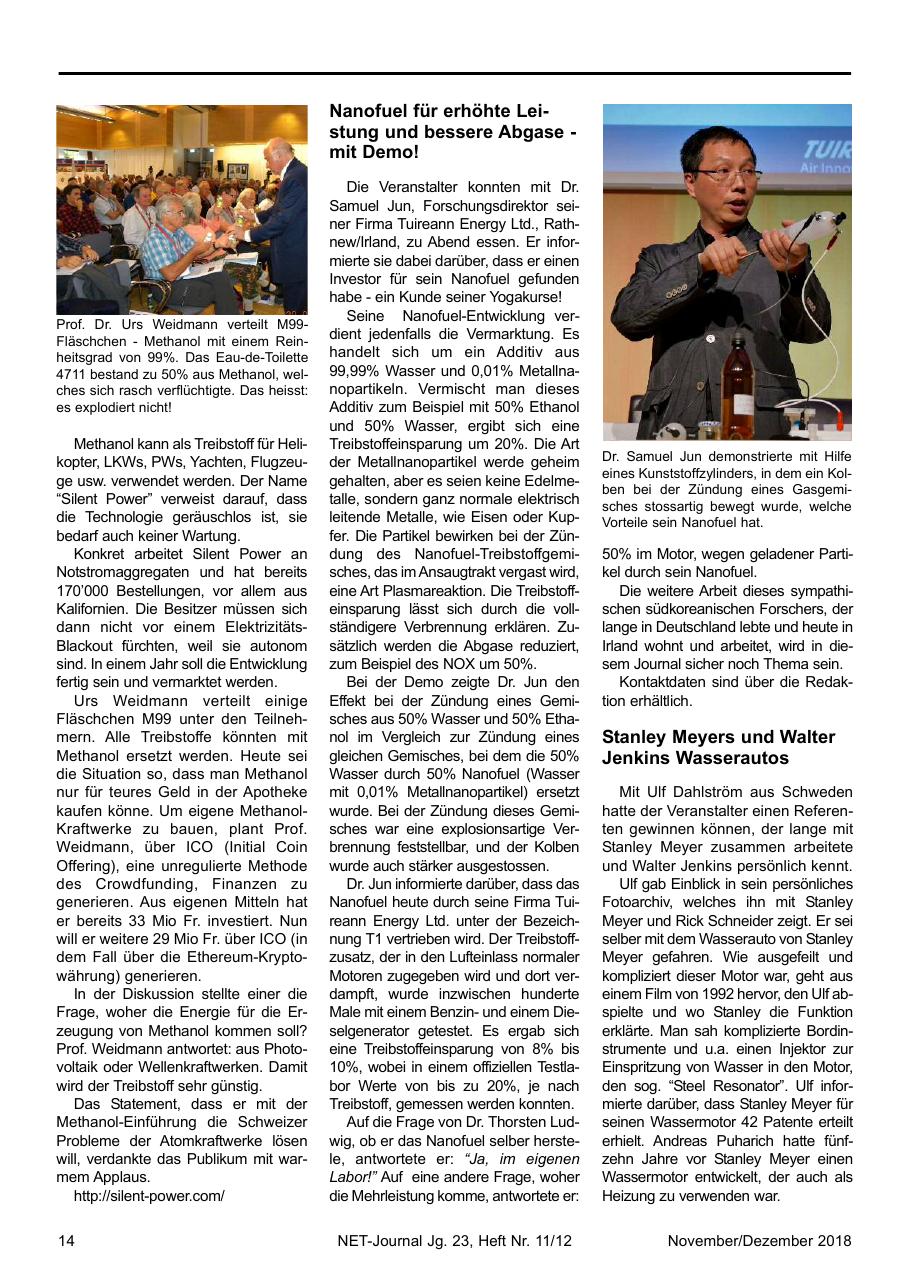
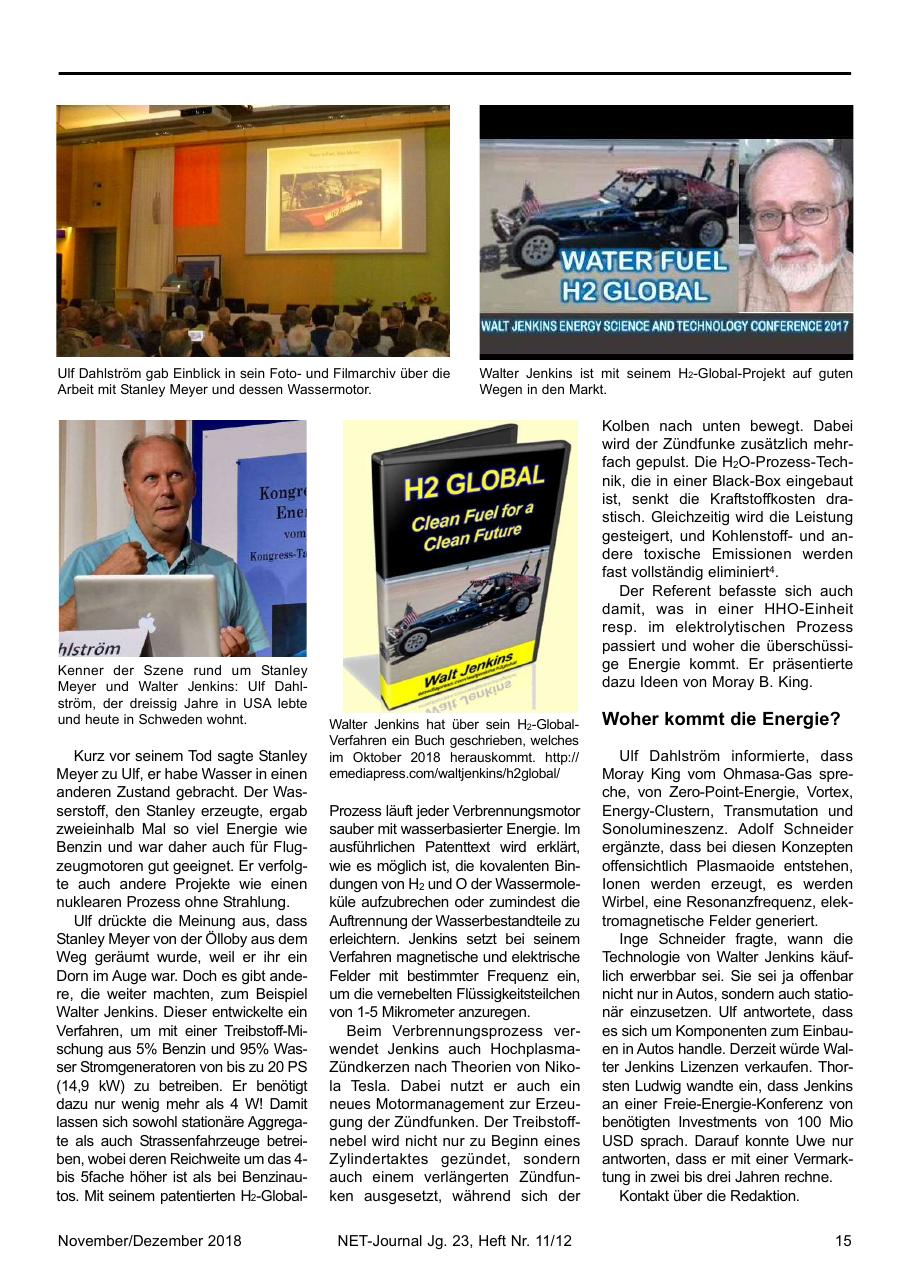
Provenance
- Shelf
- Press coverage
- Page
- 14–15 (report pages 10–23)
- Issue
- Jahrgang 23, Heft Nr. 11/12, November/Dezember 2018, in the report "Bahnbrechender Kongress vom 29./30. September 2018 im KTC Königstein/DE"
- Byline
- The editors of the NET-Journal (Adolf and Inge Schneider), reporting Ulf Dahlström's talk
- Patent office record
- gehtanders.de →
- Rights
- NET-Journal, 2018, in copyright. The one section that concerns Stan is reproduced and translated as a record of testimony about him; the publisher has put the same text on its own website without charge. The rest of the fourteen-page report is cited, not copied.
- Caption
- Page 14 and 15 of the November/December 2018 number, where the section begins at the foot of the right-hand column and continues over the page.
- Citation
- NET-Journal, Jahrgang 23, Heft Nr. 11/12, November/Dezember 2018, in the report "Bahnbrechender Kongress vom 29./30. September 2018 im KTC Königstein/DE", November 2018, pp. 14–15 (report pages 10–23), by The editors of the NET-Journal (Adolf and Inge Schneider), reporting Ulf Dahlström's talk
- Publication
- NET-Journal
- Transcription
- The publisher's own PDF of the report, hosted on its blog gehtanders.de; the section text is also published there as a blog post.