

article
Ulf Dahlström: three years with Stan
7 September 2026
Jim Miller's list of visitors to the Broadway lab has one undated line, "Ulf Dahlstrom Rick Schnieder visit lab", and nothing else. They were not visitors. Ulf Dahlström is a Swede who lived thirty years in the United States, and by his own account "worked with Stan for three years, end of the 80s, beginning of the 90s". He has told the story on tape three times since, in Denmark, Germany and the Netherlands, and nobody had put those tellings beside the archive until now.
Who he is
Dahlström is a lecturer on the free-energy circuit, on what he calls zero-point or radiant energy, and his talks are histories of the field, from Tesla and Moray onward, with Stan as the chapter he can speak to first-hand. He lived three years in New Zealand as well as thirty in America, which is why he is sometimes remembered as a New Zealander, and now lives in Sweden. He knows Walter Jenkins, whose H2 Global process he presented in Germany, and it was through a hydrogen researcher, Theo Almeida-Murphy, that the NET-Journal found him.
The three recordings:
- Open Mind conference, Denmark, 2014. "The History of Free Energy." On YouTube, 82 minutes.
- Bahnbrechende Energietechnologien congress, Königstein, 29 and 30 September 2018. Organised by Adolf and Inge Schneider of the NET-Journal. The talk was filmed for the congress DVD and is on the Das geht anders channel; the journal's report is in NET-Journal 11/12 2018, pages 10 to 23, his section on pages 14 and 15, translated in full in the press shelf, and the preview announcing him is in the September issue. The blog post that carries his photographs is here.
- GlobalBEM, 2020. "History of Breakthrough Energy Technology." On YouTube, the Stan section from 34:10.
What he says
From the 2020 talk, in his words as the captions have them:
"Stan Meyer, it's a guy I worked with for three years in the end of the 80s, beginning of the 90s, for about three years, and he's pretty famous for running a car on water, but he's done a lot of other things as well."
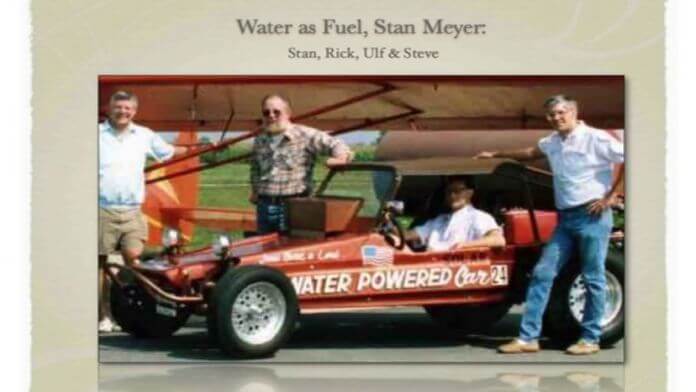
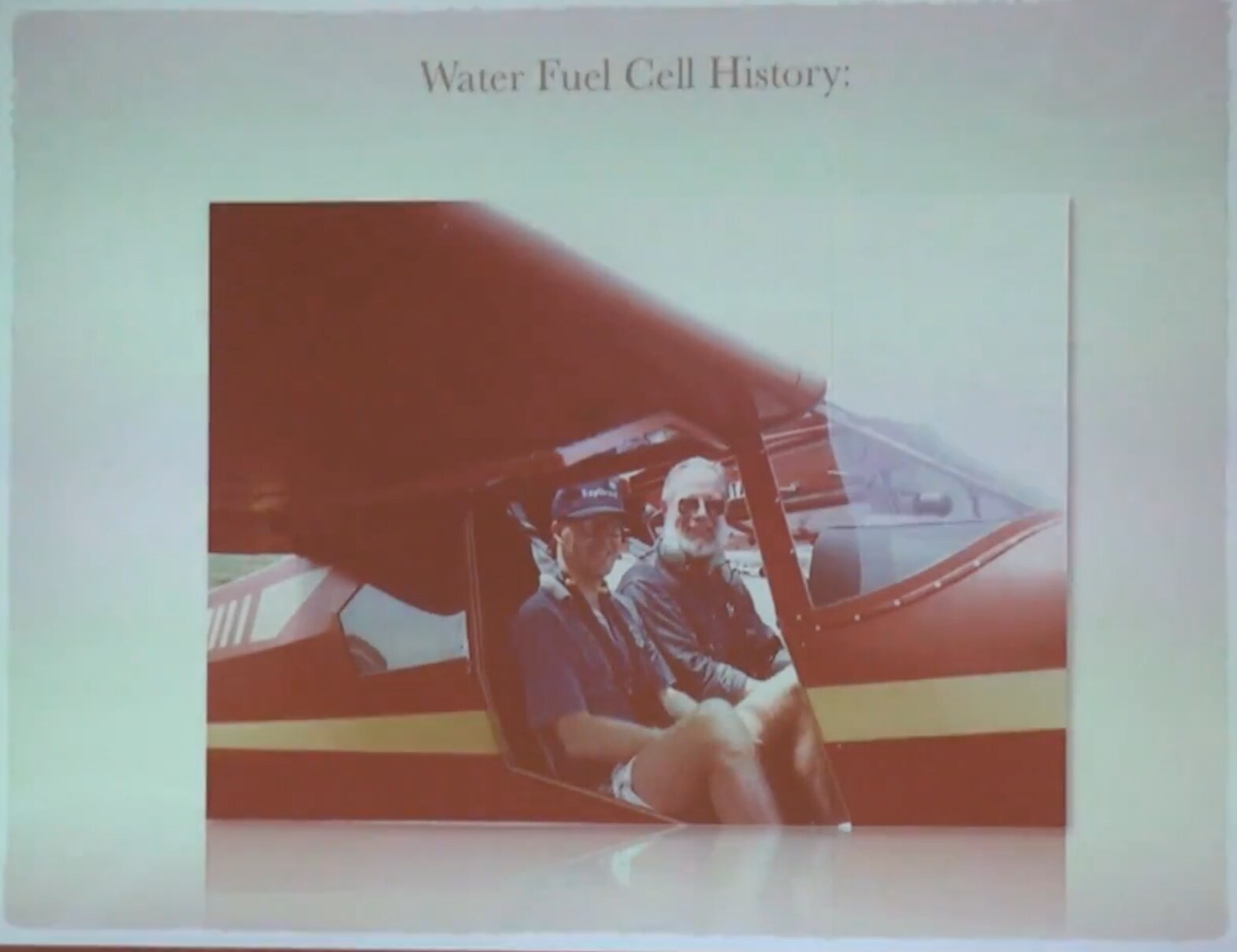
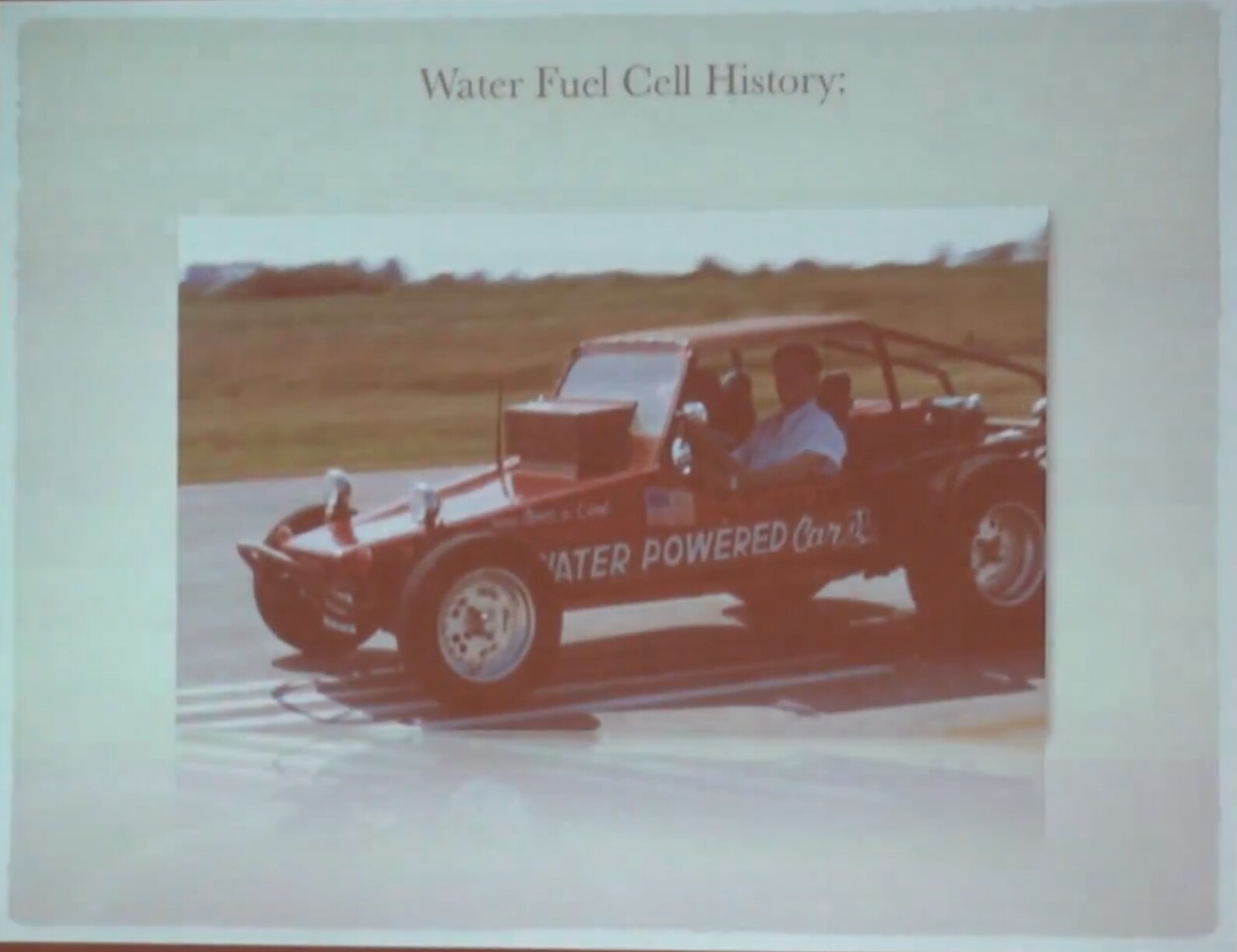
"That's me in the car there, that's Stan Meyer on the left, that's Steve Meyer, his twin brother, on the right, and Rick Schneider is in the military. We had our airstrip in Ohio they were using for testing their airplane. There is an Alaskan Bushmaster that belonged to Rick and had in a rotary engine from a car on it. They were also trying to retrofit it to run on water."
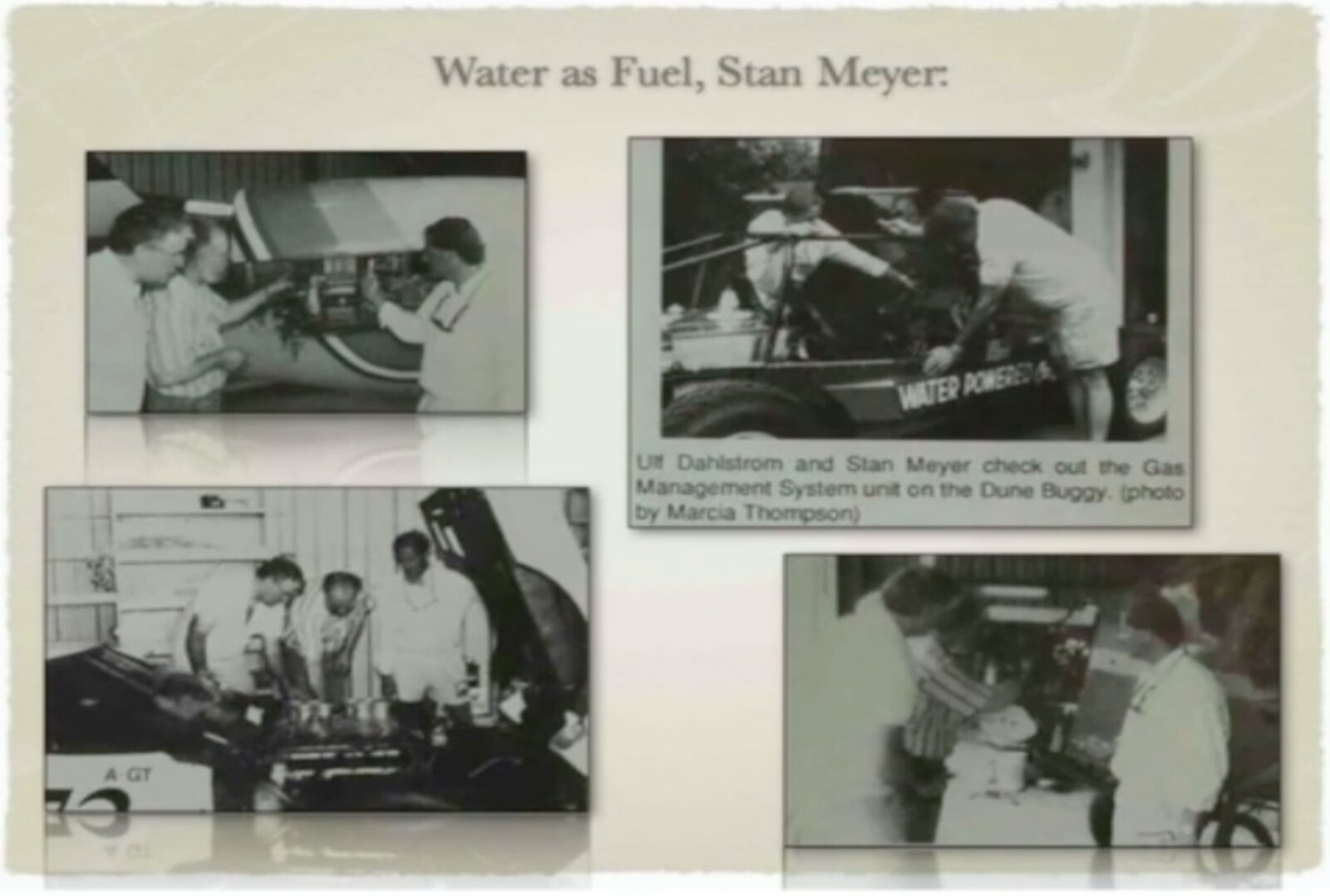
"We also have an Aero Commander, which is like a Learjet, which is more simple to retrofit because of the injectors, it's already in the airplane. There's the car. We also had a stock Corvette that we were trying to retrofit. And there's the rotary engine from the airplane."
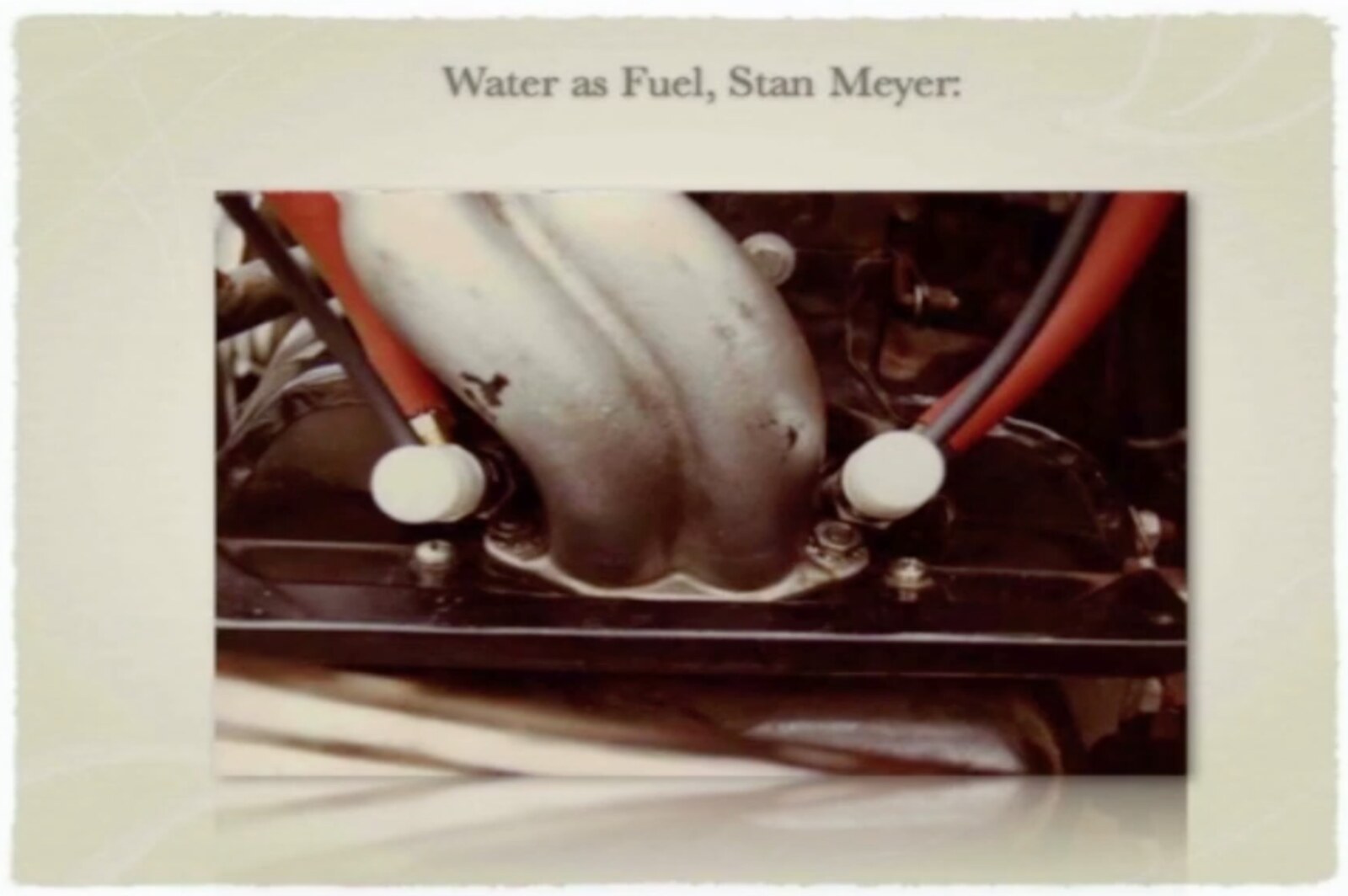
On the cell, the injector and the EPG he gives the standard account, the water molecule as a dielectric bounced between the plates by flipping the voltage, the voltage intensifier circuit doing it "without using almost any current", the aim of having "the whole process happening in the injector itself so you're not having explosive stored hydrogen in the car". On the EPG: a hollow doughnut with a magnetic gas made at room temperature, first stirred by an electric motor, later excited by a light source, inducing current in the winding, "and he was saying he got three-phase electricity out of that". And on what Stan was doing at the end:
"This was the last thing Stan was working on. There was a home heating system, and he was just in the process of going into the market with that when he passed on."
From the NET-Journal's report of Königstein, translated:
Ulf gave a look into his personal photo archive, which shows him with Stanley Meyer and Rick Schneider. He had himself driven Stanley Meyer's water car. How refined and complicated this engine was is clear from a film of 1992 that Ulf played, in which Stanley explained how it worked. One saw complicated instruments and, among other things, an injector for injecting water into the engine, the so-called "steel resonator". Ulf reported that Stanley Meyer was granted 42 patents for his water engine.
Shortly before his death, Stanley Meyer told Ulf that he had brought water into another state. The hydrogen Stanley produced gave two and a half times as much energy as petrol and was therefore well suited to aircraft engines. He also pursued other projects, such as a nuclear process without radiation. Ulf expressed the view that Stanley Meyer was removed by the oil lobby because he was a thorn in its side.
What to make of it
Four things here are new to the archive. The photographs: the four slides above, from a collection nobody outside his talks has seen. The airstrip: no other source has Stan's aircraft work happening at a field Dahlström and Schneider had the use of, with a Bushmaster and an Aero Commander on it, and it puts flesh on the aviation claims in the memos. The Corvette: a second road vehicle under conversion, never mentioned elsewhere. And the 1992 film of Stan explaining the engine, which Dahlström still holds and which may or may not be the 1992 interview the archive already knows.
Stan's own slides confirm the airfield. At the Global Sciences Congress in 1992 he ran through them: "This is the world's fastest Corvette. It broke the 271 mile an hour speed record. We're taking the water fuel injector technology, hooking it up to it ... This shows where we're hooking up to an Alaskan Bushmaster in order to break the aviation history and run it on water," and after it the jet commander. Global Sciences Congress 1992, 40:47 The Corvette, the Bushmaster and the Aero Commander are Dahlström's three aircraft-and-car projects, in Stan's mouth, three years before Dahlström told it.
Two cautions. Dahlström's figures, 42 patents and two and a half times the energy of petrol, are Stan's claims repeated, not measurements; the patent count in the archive's own index is the check. And the photograph the German blog labels "Ulf Dahlström and Stanley Meyer with the water car", a blue buggy among palm trees with a solar panel, is not Stan's car at all but the H4GAS experimental buggy of Walter Jenkins's circle, so it should not be reused as a Meyer picture.
Dahlström is living, reachable through the NET-Journal or GlobalBEM, and holds a photo and film archive of the years the record is thinnest on. He is on the register of the people who knew Stan, near the top.
Provenance
- Shelf
- Stan Meyer Publications
- File
- database/content/pages/ulf-dahlstrom-three-years-with-stan.json
- Rights
- Written for the archive from Ulf Dahlström's talks of 2014, 2018 and 2020 and the NET-Journal's report of the Königstein congress. The photographs are Dahlström's own, from his personal archive, as he showed them on slides in those talks; they are reproduced here from the films of the talks.