

article
raum & zeit 44/90: Stan Meyer's water-cell technology
9 September 2026
"Stan Meyers Wasser-Zellen-Technik", by Hans-Joachim Ehlers, Munich, in the section Alternative Energien, under the running head Wasser-Zelle. raum & zeit issue 44, 1990, pages 84 to 88. The scan the old site carried: the issue and the article.
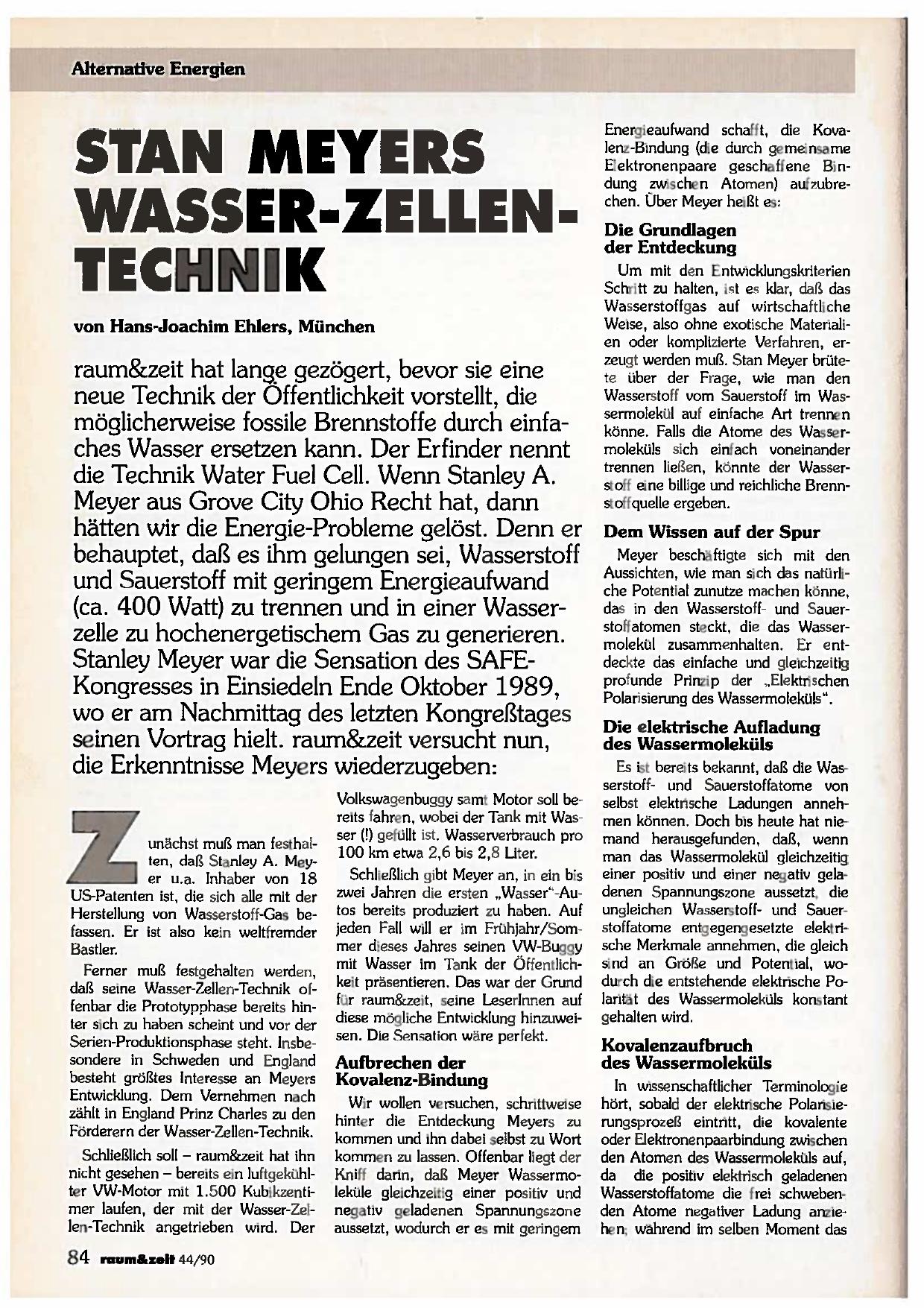
This is the article that put the water fuel cell in front of a German readership, written by the magazine's own editor after Meyer spoke at the SAFE congress at Einsiedeln on the afternoon of the last day, at the end of October 1989. Ehlers had reported that congress himself in the previous issue. He opens by saying the magazine had hesitated a long time before putting the technology before the public, and he sets out the claim plainly: that Meyer of Grove City, Ohio, separates hydrogen and oxygen at a small energy cost, about four hundred watts, and makes a high-energy gas of them in a water cell. If Meyer is right, he writes, the energy problem is solved.
What the magazine reported
The reportage is Ehlers's own and is the part of the article that exists nowhere else in the archive.
- Eighteen US patents, all concerned with producing hydrogen gas. Ehlers uses the count to make a point about standing: this is not, he says, an unworldly tinkerer. The Deräker article of the following year counts twenty-five granted between 1981 and 1990.
- Past the prototype, before series production, with the greatest interest coming from Sweden and England. He adds a piece of hearsay he marks as hearsay: that in England Prince Charles was said to be among the supporters of the technology.
- An air-cooled 1500cc Volkswagen engine said to be running on the technology, with the buggy and engine said to run with water in the tank, at a consumption of about 2.6 to 2.8 litres per hundred kilometres. Ehlers is careful here and interrupts his own sentence to say the magazine had not seen it.
- A timetable. Meyer told them the first water cars would be built within one to two years, and that he meant to show the buggy publicly in the spring or summer of 1990. That, Ehlers writes, was the reason to alert readers to the development now.
The technical middle, and where to read it properly
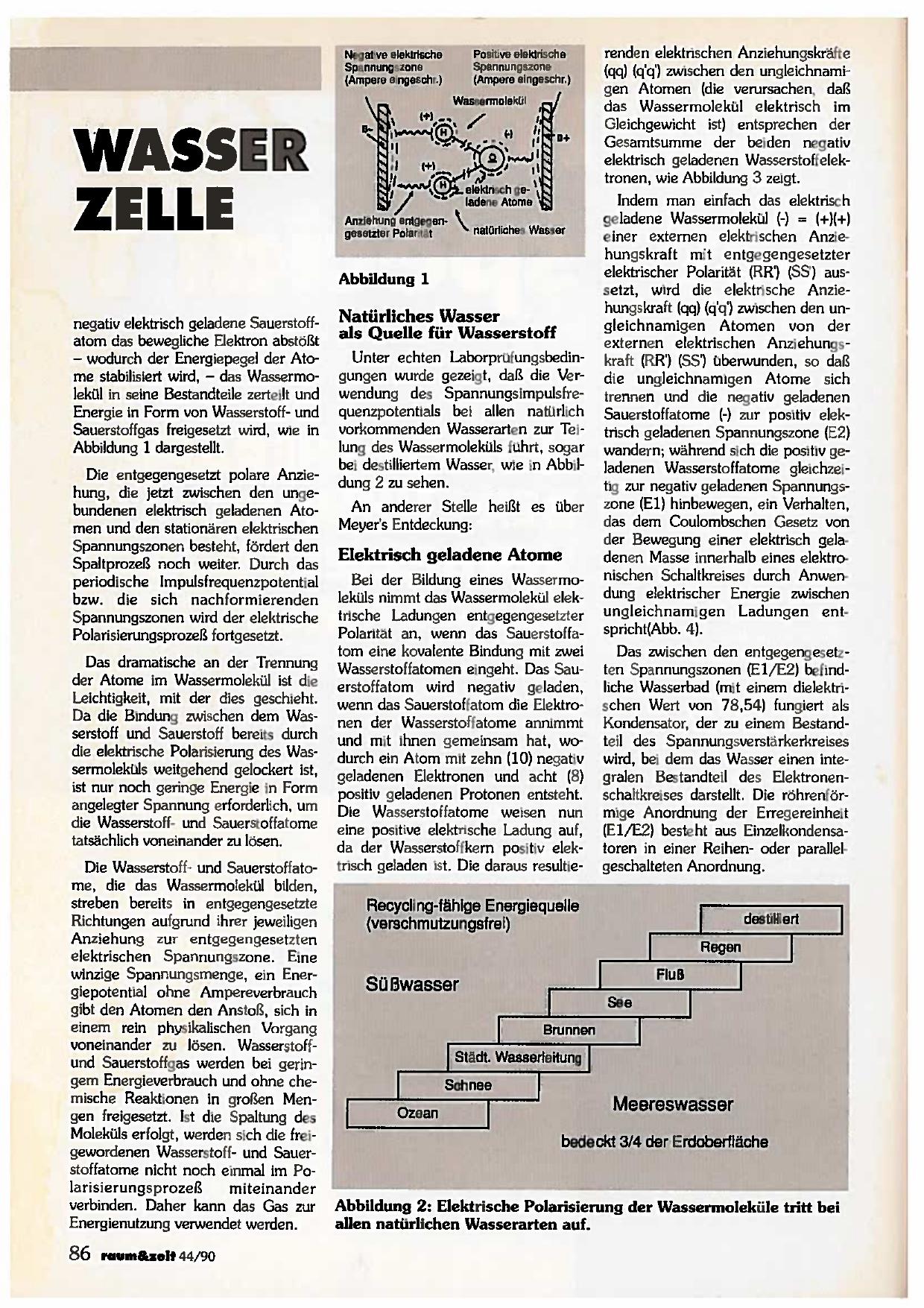
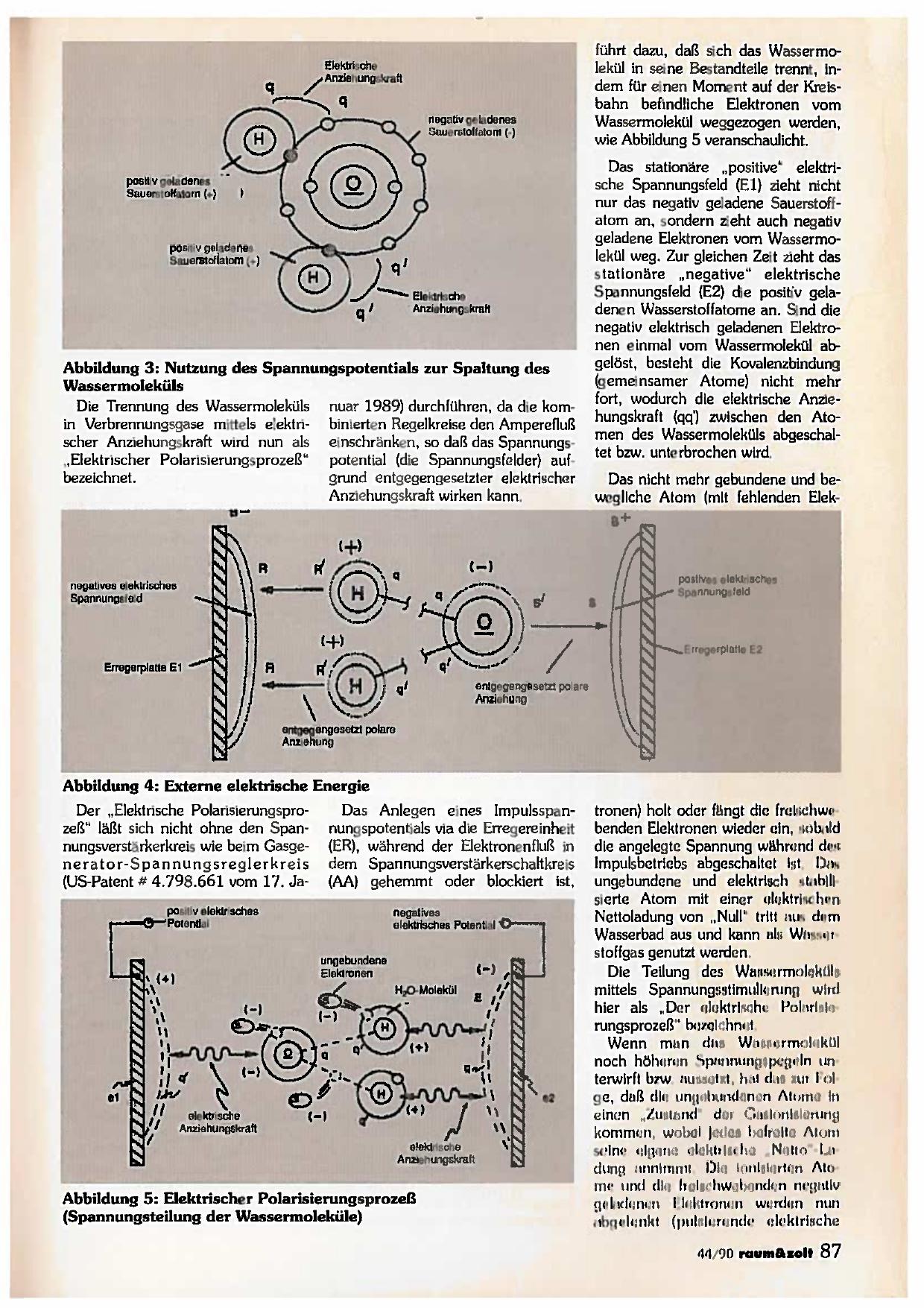
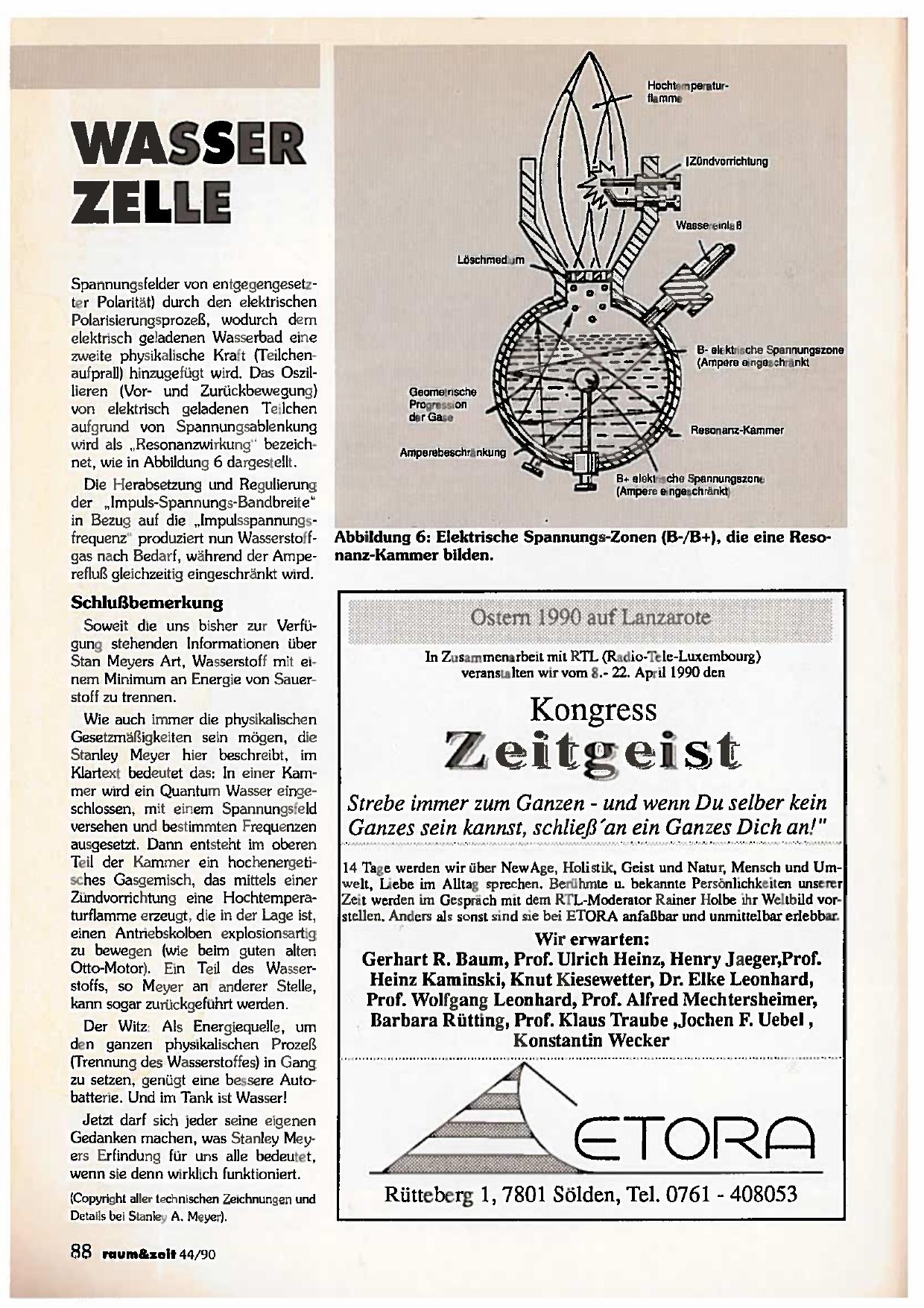
Having set the scene, Ehlers hands over: he says he will go step by step behind the discovery and let Meyer speak for himself. Everything from that point is Meyer's own exposition rendered into German, under headings that translate his: the basis of the discovery, on the trail of the knowledge, the electrical charging of the water molecule, the breaking of the covalent bond, and then the electrical polarisation process itself, the stationary positive and negative voltage fields E1 and E2 that pull the electrons away and switch off the attraction between the atoms, the second physical force of particle impact added to the charged water bath, the oscillation of charged particles under voltage deflection that he calls the resonance effect, and finally the regulation of pulse-voltage bandwidth against pulse-voltage frequency to make hydrogen on demand while the amp flow stays restricted. Figure 6 is captioned as the electrical voltage zones B− and B+, amps restricted, forming a resonance chamber.
The magazine states the position itself, in a line at the foot of the last page: the copyright in all the technical drawings and details rests with Stanley A. Meyer. So the technical half of this article is a German translation of documents the archive already holds in Meyer's own English, in better condition and in full. A reader who wants that material should go to it directly rather than through a translation of a translation:
- The Birth of New Technology, the Technical Brief, which is the source these headings follow.
- Propagating electrical stress, for the voltage potential across the molecule and the restriction of amps.
- Resonant action, for the water bath, the ejected electrons and the chain the article calls the resonance effect.
- The voltage intensifier circuit, for the pulse train whose width and frequency the closing paragraphs describe.
How Ehlers ends
He closes by putting it in plain language for a reader who is not an engineer, and the paraphrase is his own rather than Meyer's: a quantity of water shut in a chamber, given a voltage field, exposed to certain frequencies; a high-energy gas mixture forms in the upper part of the chamber; an ignition device makes a high-temperature flame from it, and the flame drives a piston explosively, as he puts it, like the good old Otto engine. Part of the hydrogen, he notes Meyer saying elsewhere, can even be returned. The joke of the thing, he writes, is that the energy source needed to set the whole physical process going is a decent car battery — and in the tank there is water. He leaves the reader to make of it what they will, if it really works.
The facing column of the last page carries the magazine's advertisement for a fortnight's congress on Lanzarote that April, run with Radio-Tele-Luxembourg under the title Zeitgeist, which is a fair picture of the company the water fuel cell was keeping in print in 1990.
The article belongs to raum & zeit, which Ehlers Verlag still publishes. This page is the citation, the reporting it carries, and where to read the technical material in the original; the scan the archive holds is linked at the top and its pages are below.
The pages
Provenance
- Shelf
- Stan Meyer Publications
- Chapter
- German Edition
- File
- database/content/pages/raum-zeit-44-1990-stan-meyers-water-cell-technology.json
- Rights
- raum & zeit is published by Ehlers Verlag and the article is in copyright. The archive holds the scan the old site carried, shows its pages and catalogues the article by citation and summary; the text is not transcribed. Identified and dated from the scan's own page footers and by-lines, September 2026.