

patent · US4182398A
Crosslinked crystalline polymer and methods for cooling and heating
8 January 1980
Text
Page 1scan →
United States Patent (19)
Salyer et al.
(54) crosslinked crystalline polymer
And methods for cooling and
Heating
75 Inventors: Ival O. Salyer; Ruth A. Botham, both of Dayton; George L. Ball, I, West
Carrollton, all of Ohio (73) Assignee: The United States of America as represented by the United States
Department of Energy, Washington, (51) int. C.’.............................................. F28D 21/00 52) U.S. C. ........................................ 165/1; 126/400;
2,846,421 8/1958 Pollock ........................ 165/104 S X 2,873,352 2/1959 Franco ................................... 219/46 2,888,424 5/1959 Precopio et al. ...................... 260/41 3,013,104 12/1961 Young .......... 65/104 S X 3,567,697 3/1971 Bates et al. .......................... 260/78.4 3,646,155 2/1972 Scott .............................. 260/23 HX
3,780,262 12/1973 Rudd .................................... 219/341 3,923,947 12/1975 Cook ... ... 261/141 4,063,546 12/1977 Schmid ............................ 126/400 X
Other publications
Kaelbleet al, DH Crystalline Polymers as Heat Storage
Materials . . . Systems, Polymer Engineering and Sci
Primary Examiner-Albert W. Davis, Jr.
Attorney, Agent, or Firm-R. V. Lupo; StephenD.
Hamel; Bruce Stevens
The invention relates to crystalline polyethylene pieces having optimum crosslinking for use in storage and recovery of heat, and it further relates to methods for storage and recovery of heat using crystalline polymer pieces having optimum crosslinking for these uses.
Crystalline polymer pieces are described which retain at least 70% of the heat of fusion of the uncrosslinked crystalline polymer and yet are sufficiently crosslinked for the pieces not to stick together upon being cycled above and below the melting point of said polymer, preferably at least 80% of the heat of fusion with no substantial sticking together.
14 Claims, 2 Drawing Figures
Drawings
Page 2drawing sheetscan →
Page 3drawing sheetscan →
Page 4scan →
which would have inefficient heat transfer characteris
CROSSLINKED CRYSTALLINE POLYMER AND tics.
METHODS FOR COOLING AND HEATING It may be advantageous in order to develop the maxi mum crystallinity, and heat of fusion, to anneal the
CROSS-REFERENCE TO RELATED 5 polyethylene pieces after fabrication and prior to cross APPLICATIONS linking. This has the further benefit that the crosslinking A related application is Ser. No. 784, 179, filed of even when it is accomplished occurs mainly in the remaining date, having the same inventor, entitled "Crosslinked amorphous regions. Thus the crosslinking necessary for Crystalline Polymer For Cooling and Heating'. form stability can be achieved with less reduction in O crystallinity. Optimum annealing temperature for crys
BACKGROUND OF INVENTION talline polyethylene is approximately 8/9 of the abso 1. Field of Invention lute melting point. For high density polyethylene this The invention relates to crystalline polyethylene temperature is ~90 C.
pieces having optimum crosslinking for use in storage Crosslinked pieces of polyethylenes and other crys and recovery of heat, heat storage and recovery, partic 15 talline polymers can be prepared so as to prevent flow ularly in the solar energy area, and for heating fluid to and coalescence at elevated temperatures, and to make the temperatures required for absorbtion air condition available, thereby, pieces of the product which can be Ing. repeatedly cycled to temperatures above and below the 2. Prior Art crystalline melting point of the polymer without coales
In Polymer Engineering and Science, September, cence. Such pieces can provide a porous bed through 1975, Vol. 15, No. 9, pp. 673-8, D. H. Kaelble et al, which heat can be transferred by fluids, i.e., liquids or "Crystalline Polymers as Heat Storage Materials In gases.
Passive Thermal Protection Systems', radiation cross The production of crosslinked polyethylene pieces linked polyethylene is described for possible latent heat 25 can be accomplished by any one of a number of meth sink use, such as coatings on electronic equipment for ods. One method is to incorporate an organic peroxide protection against high temperature in space use. into the polyethylene by compounding in an extruder. SUMMARY OF THE INVENTION For example, commercial polyethylene can be blended The invention relates to crystalline polyethylene ide, in0.1% with to 5% of a peroxide such as dicumyl perox
Banbury mixer, an extruder, a mill roll, or other pieces having optimum crosslinking for use in storage plastic compounding and recovery of heat, and it further relates to methods mer can be fabricateddevice. into Then the crosslinked poly pieces by extrusion and cut for storage and recovery of heat using crystalline poly ting or other conventional means well mer pieces having optimum crosslinking for these uses. These compounded, fabricated pieces known can then in the art.
be sub
Crystalline polymer pieces are described which retain at least 70% of the heat of fusion of the uncrosslinked 35 jected to additional heating, if necessary, in order to crystalline polymer and yet are sufficiently crosslinked complete the crosslinking to the desired degree. Alternatively, pieces of polyethylene can be sub for the pieces not to stick together upon being cycled jected to irradiation above and below the melting point of said polymer, gamma rays, or be crosslinked by electron bombardment, or preferably at least 80% of the heat of fusion with no ways, in order to effect crosslinking by other conventional substantial sticking together. sufficient to pre vent melt flow and coalescence at a temperature above
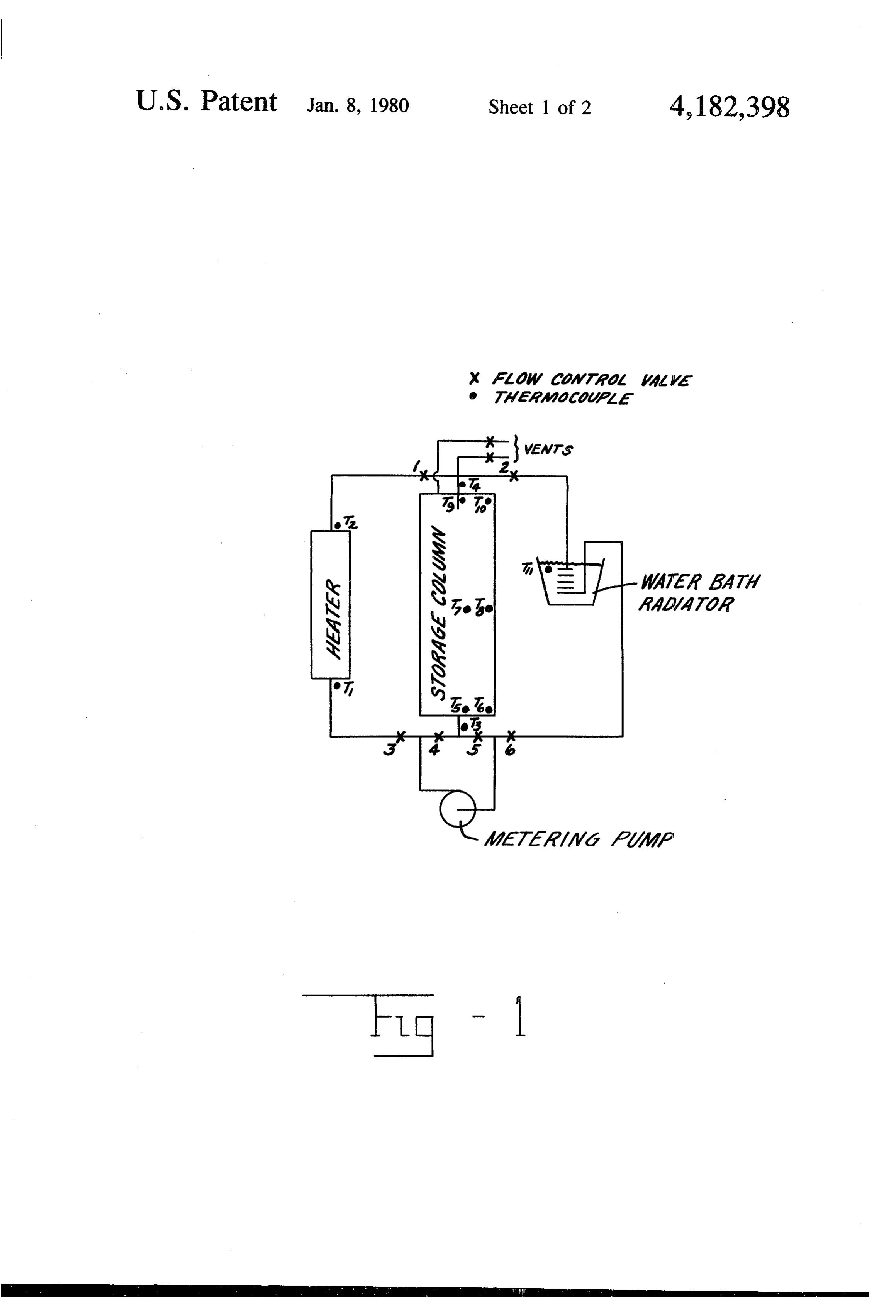
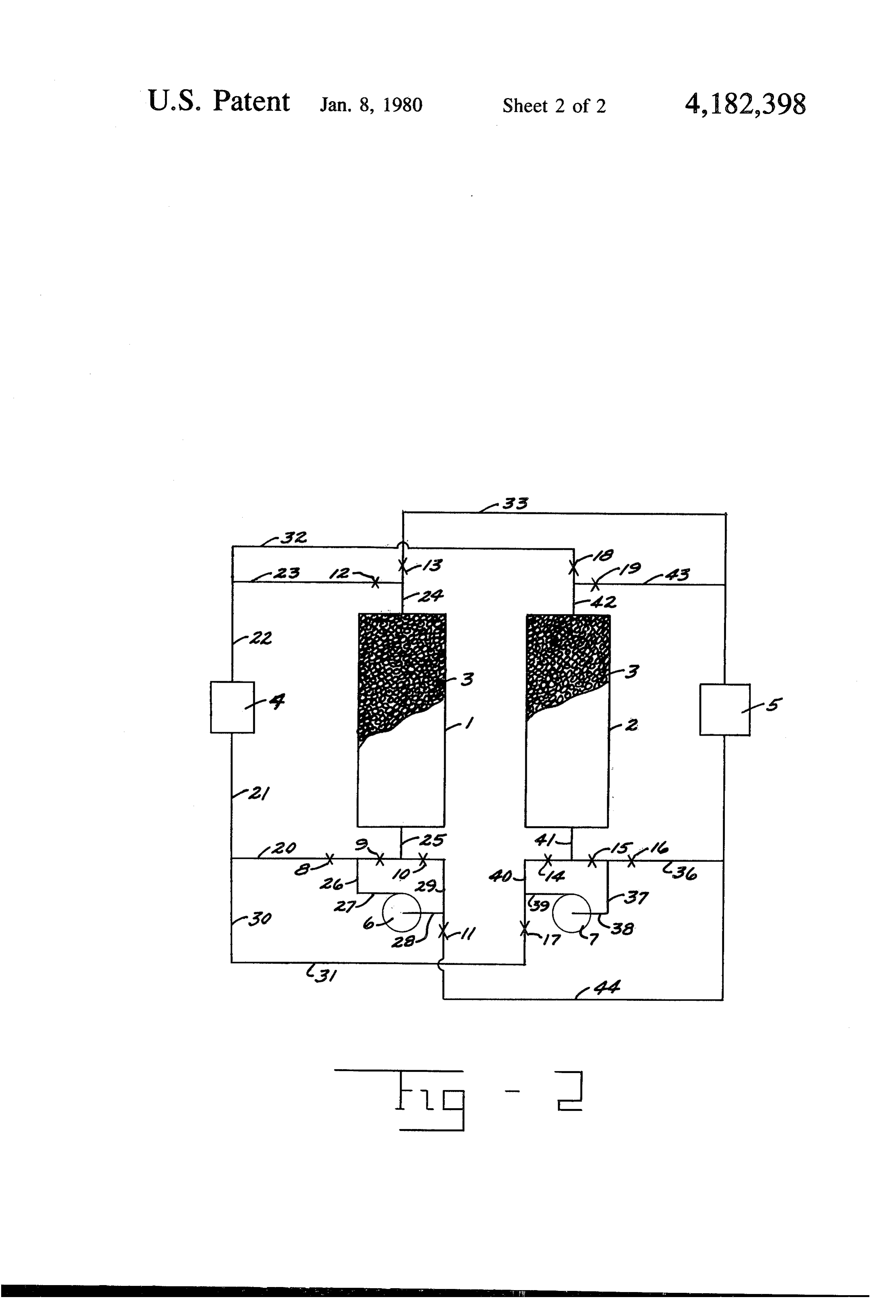
BRIEF DESCRIPTION OF DRAWINGS the melting points of the crystalline phase of the poly FIG. 1 is a schematic drawing of a pilot plant sized e.
system used to further prove the operability of the in Various methods are available for crosslinking poly vention; and 45 ethylene (PE), such as radiation-crosslinking, grafting FIG. 2 is a schematic view of a heating system of the of an alkoxysilyl group onto PE with subsequent cross invention. linking, and crosslinking with peroxides. Radiation crosslinking has several disadvantages
DESCRIPTION OF PREFERRED which make it less attractive than the other methods EMBODIMENTS 50 cited. It is largely a surface phenomena, carried out near Crosslinked crystalline polymer pieces, e.g., cross ambient temperatures, rather than in a melt. This would linked polyethylene, polymethylene oxide, isotactic make it difficult to apply uniformly to thick samples, polystyrene, and polypropylene pieces, can be used for i.e., pieces and the like.
storage of thermal energy from a solar collector or Crosslinked pieces of polyethylene can then be other heat source, and this stored energy can be recov 55 placed in a metal or other suitable container through ered from the pieces and can be used to heat dwellings. which liquids or gases can be circulated for heat ex Polyethylenes of varying degrees of linearity (crystal change.
linity) and with melting points ranging from 100 to Crosslinked crystalline polymer pieces can also be 136 C. are commercially available, and crystalline used for storage of thermal energy from sources other polypropylenes are also available. Depending on their than solar energy collectors, such as geothermal and linearity (crystallinity), these polyethylenes have a heat waste from conventional or nuclear power generation. of fusion ranging from about 10 to 50 calories/gram. For these uses it may be more desirable to use cross Thus, it is possible to store significant quantities of en linked crystalline polymers having higher melting ergy by heating pieces of these crystalline polymers points higher than polyethylene, such as polymethylene above their melting points. Unfortunately, heating 65 oxide (polyformaldehyde), isotactic polystyrene, etc., pieces of these crystalline (linear) polyethylenes to a however crosslinked crystalline polyethylene can still temperature above their melting points will allow them be used for heat recovery supplementary to other pri to flow and to eventually coalesce into a large mass mary heat exchange recovery that reduces the tempera 5 ture of the fluid being cooled to a temperature closer paratus; differential scanning calorimetry (DSC) deter above the melting point of polyethylene. minations of melting and recrystallization temperatures, Low levels of crosslinking will be used in the crystal and heat of fusion, on cycling around the crystalline line polyethylene and other crystalline polymers, so the melting point; and behavior (qualitative) after melting crosslinking does not significantly reduce the crystallin 5 in a liquid heat transfer medium. Also tests were carried ity of the polymer. Statistically, one crosslink per mole out in a pilot plant unit cyclically heating and cooling a cule (2000 CH2 units) should be sufficient to eliminate bed of crosslinked polyethylene pieces. melt flow and reduce total crystallinity less than 1%. Two different methods used in crosslinking the poly Pieces are used in this application to distinguish from ethylene are discussed and they are as follows: powder and small particles which would not be nearly 10 Method as suitable for the heat storage uses of this invention. In this method the dicumyl peroxide was incorpo Pieces can be circular, cylindrical, square, rectangular, rated into the polyethylene (PE) on a steam-heated mill short fibers either solid or hollow, saddles, rods, pellets, roll and the crosslinking was carried out on the mill roll. most any shape that packing for columns normally The PE pieces (~50 g) were first melted on the mill, takes, but generally pieces having about equal dimen 15 then as soon as a smooth sheet of PE was formed, the sions in all directions are desirable, i.e., most closely dicumyl peroxide was added. Milling was continued as approximating spherical. Alternatively, rather than long as possible in order to maximize the crosslinking. packing a heat exchanger with pieces of the crosslinked However, after a few minutes or so, the crosslinked PE crystalline polymer, the heat exchanger can be filled would no longer remain on the rolls but came off as one with the polymeras film and in a form such as a helix to solid piece of opaque PE. Crosslinking had proceeded provide greater surface area, or long solid or hollow to a sufficient degree that melting and flowing of the PE fibers or tubes running from end to end in the heat around the rolls was no longer possible. Initially, some exchanger or the like. The heat exchanger can also be variations in milling time was tried, but it was quickly compression molded or injection molded from the un found that the maximum possible time needed on the crosslinked crystalline polymer, which is subsequently 25 roll was only a few minutes however to be able to pro crosslinked by heating, providing suitable passages duce an improvement in form stability. through the heat exchanger for the heat exchange fluid. Method II
For the long hollow fibers or tubes the heat exchange In this method the dicumyl peroxide was incorpo fluid or fluids can be circulated over the outside surface rated into the PE on the mill roll but milling was contin of the fibers and/or through the hollow portion of the 30 ued only long enough to effect mixing. The PE sheet fibers. was then removed and transferred to a 6'X6' mold and A stack of perforated sheets of polymer can be used crosslinking accomplished by compression molding for with the perforations in line to provide for circulation -30 min. at 350 F./700 psi. The press used in this case of fluid through the stack. was both steam and electrically heated in order to reach A solar energy concentration collection device such 35 the 350 F. temperature. Method II is the superior as that described in FIG. 11 of Winston, U.S. Pat. No. method and the one used in data reported herein. 3,923,381 will be suitable to heat the fluid medium Regardless of the crosslinking method used, the above the melting point of the crosslinked crystalline crosslinked polyethylene was treated in the same man polyethylene and store heat therein in the system of the ner, in order to obtain smaller particles from it. First, invention. Other types of solar energy collection de 40 the crosslinked sheet was cut into long narrow strips on vices known in the art will also be suitable, provided a bandsaw. These strips were then cut into small, rect they heat the fluid medium above the melting point of angular pieces on a "chopper'. The strips had to be fed the polymer pieces. into the chopper manually due to their relatively small For dissipation of the thermal energy stored in the size. These rectangular particles of crosslinked PE were crosslinked crystalline polymer pieces, fluid can be 45 then used for testing purposes.
circulated through, e.g., conventional house heat radia Three different tests were performed on the cross tion systems, at a temperature below the melting point linked polyethylene materials: (1) approximate melting of the pieces. point and form-stability; (2) DSC determinations of The desirable temperature range of operation for melting and recrystallization temperatures and heat of cycling around crosslinked crystalline polyethylene 50 fusion; and (3) melting in a liquid heat transfer medium pieces is about 90 to 150 C. For other crosslinked to determine if the particles would "stick' to one an crystalline polymer pieces, the desired temperature other on cooling. A more detailed description of each range for cycling would be expected to vary somewhat test follows.
depending on the melting point of the particular poly Melting Point and Form-Stability e. 55 The initial test performed on all of the crosslinked PE Varying amounts of peroxide can be incorporated samples was to determine approximately the crystalline into a crystalline, high density polyethylene, using dif melting point and whether or not the sample flowed on ferent methods for crosslinking. Crystalline high den melting (i.e., form-stability). This was done on a Fisher sity linear polyethylene is available commercially from Johns melting point apparatus. "Melting' was pre a number of different companies. A number of different sumed to occur when the PE sample changed from peroxides are also commercially available from differ opaque to clear. Simultaneously, it could be determined ent companies. Dicumyl peroxide, 2,5-dimethyl-2,5- whether or not the sample "flowed' on melting (i.e., if bis(t-butylperoxy)hexane (Lupersol 101) and 2,5- it was form-stable or not). Generally, "crosslinked' PE dimethyl-2,3-bis(t-butylperoxy)hexyne-3 (Lupersol 130) samples which did not pass this initial test were not are examples of suitable peroxides. 65 tested further, since it was obvious from this that they Measurements performed on the crosslinked PE in had not been sufficiently crosslinked to make them cluded: Observation of the approximate melting point form-stable.
and form-stability on a Fisher-John's melting point ap DSC Testing of Crosslinking Polyethylenes
Page 6scan →
In order to: accurately determine the melting and 3. The silane-grafted flakes are next co-extruded in a recrystallization temperatures of those crosslinked 95/5(w/w) ratio with a catalyst batch consisting of 100 polyethylene samples which did exhibit form-stability parts Alathon 7040, 1 phr dibutyl tin dilaurate and 0.15 on melting, differential scanning calorimetry (DSC) phr benzoyl peroxide prepared via mixing on a hot mill was used. The instrument used was the Perkin-Elmer 5 roll, and granulated into flakes using a 1' extruder (2 DSC-1B. Two or more melting and recrystallization passes, all zones at 165 C.) and chopped into pieces. cycles were run for each sample to determine what 4. These silane-grafted HDPE pieces are next cross changes, if any, occurred on repeated cycling about the linked by heating in boiling water for S 24 hours, re crystalline melting point. Instrument conditions used moved, and air (or low-temperature) oven-dried. A were as follows: 10 C. rise in temperature per minute, 10 sample of crosslinked pieces heated in air and 200 C. range 8, scan 305-435 K., and cool to recrystallize PE. exhibited excellent form stability (no flow); neither did Heating Crosslinked PE in Liquid Media the pieces tend to stick to one another when cycled In order to simulate the behavior of the crosslinked around the PE melting point in ethylene glycol several PE if it were contained in a storage reservoir and a times or so.
liquid heat transfer agent circulated through it, some of 15 Although the exact mechanism of the silane grafting the crosslinked PE was placed in such a liquid medium and crosslinking reaction with PE is not totally certain, and cycled around the crystalline melting point. On the reaction is believed to proceed largely as follows: cooling, observations were made as to whether or not the particles "stuck' together. The test was done in a glass beaker, and gentle agitation provided by a stirring 20 | | | || ochs bar. Either silicone fluid (DC-200, 500cs viscosity) or ----- - H2C = c-stoch, s ethylene glycol was used as the liquid medium. Samples H H H H. OC2H5 went through one or more melting cycles, unless the H H H H H. H. H. H. particles "stuck” after the first cycle. cat AS A number of manufacturers of high density polyeth 25 ylenes (HDPE) sent samples and literature on their products. The HDPE products received were evalu Si Si - ROH ated via DSC measurements to determine which have / IN /N maximum heats of fusion (and hence crystallinity). The R. R. O basic polymer selected for crosslinking and testing in 30 RO OR the pilot plant scale testing unit described schematically Si in FIG. 1 was Du Pont's Alathon 7040, although others H H. H. would be suitable. -C-C-C-C- Preparation of a Five-Pound Batch of Silane-Grafted
Crosslinked HDPE 35 H. H. H. H. The incorporation of a vinyl silane into a HDPE resin, followed by extrusion and crosslinking was car A five-pound batch of silane-grafted and crosslinked ried out. The general procedure used followed exam Alathon 7040 HDPE was evaluated for thermal energy ples given in U.S. Pat. No. 3,646,155 with variations storage (TES) capabilities in the macroscale TES evalu described below. 40 ation unit. The usual characterization data (DSC, gel Some improvements were made in the process used contents, etc.) was obtained on it.
here, in order to optimize the grafting reaction. Use of Preparation of 2five pounds each of (1) a thermally an extruder or a Banbury mixer, instead of the hot mill initiated peroxide crosslinked commercial HDPE and roll, for carrying out the grafting reaction provides two (2) a silane-grafted and crosslinked commercial HDPE advantages: (1) it is much more of a "closed' system 45 for evaluation in the macroscale TES unit was com than is the mill roll, thus reducing loss of the silane and pleted.
(2) somewhat higher temperatures and better mixing, Macroscale evaluation of one five-pound sample of can be obtained with the shearing action of the Ban peroxide-crosslinked Alathon 7040 (prepared via mill bury. ing and compression molding) was completed. Charac Preferred Silane Grafting and Crosslinking Proce 50 terization of the uncrosslinked control Alathon 7040 dure resin, and the crosslinked resin (before and after testing The following procedure and reactants are employed in the TES unit) was carried out. Results are given in in the preparation of silane-grafted and crosslinked Table I.
HDPE. A second five-pound sample of peroxide-crosslinked 1. A charge of 2000 g of Alathon 7040 HDPE (Du 55 Alathon 7040 (prepared via extrusion only) has been Pont) pieces is added to a large Banbury mixer and evaluated briefly in the TES unit and is also being char fluxed 4 to 5 minutes at a temperature slightly above RT acterized (Table II).
(no steam). A charge of 120 g (6 phr, i.e. parts per hun Extrusion-Crosslinking Process for PE dred parts resin) vinyl triethoxy silane (Union Carbide A simple, essentially one-step extrusion process for A-151) containing 4 g (0.2 phr) benzoyl peroxide is the crosslinking of HDPE was carried out as follows: added and 5 minutes of mixing with steam on (120 psi) Alathon 7040 HDPE (Du Pont) pieces were tumble begun. At the end of this time, cooling water is turned blended with 0.25 phr of Lupersol 130 (Lucidol Div. of on and the ~4 lb silane-grafted PE cake removed from Pennwalt) peroxide in 1.25 phr of paraffin oil (diluent), the Banbury after 2 min. cooling time. then extruded at ~180 C. (die temp.) in a "extruder. 2. The grafted PE cake is next cold pressed into 65 "Spiralled' rods are extruded which are then chopped round flat discs which can readily be cut into strips via into pieces which do not flow when melted in air or a band-saw, and then granulated into flakes or pieces stick together on melting in ethylene glycol. suited for extrusion. Macro-Scale Evaluation of TES Polymers
Page 7scan →
Testing with the macro-scale prototype TES unit has is preheated in the lower, cooler zones before reaching been carried out. The unit, with a 1' insulating coat of the maximum temperature top zone. portland cement/asbestos on the storage chamber, Heating is provided by two steel immersion type heater and connecting plumbing, is shown schemati- resistance heaters with 300 and 500 watt capacities. cally in FIG. 1. 5 Operating at about 700 watts (87.5%) the heating unit Circulation is top to bottom through the storage raises the temperature of a 150 ml/min ethylene glycol chamber in the heating phase, with valves 1, 3 and 5 stream about 65" C. This should produce a heating time open. Reversing the valve positions (2, 4 and 6 open) of approximately three hours to raise the storage cham reverses the cirection of flow and circulates through the ber temperature from 110' to 150 C., the anticipated radiator instead of the heater for the cooling phase. 10 cycle range.
Thus, the pumping direction corresponds to the natural Thermocouples, shown at T to T11 in FIG. 2, will be convective flow direction in heating, and charges the used to define the heat exchange rate and the total en storage chamber from the top downward. The flow ergy storage capacity of the system. The metering direction is reversed in cooling to discharge from the pump provides a constant and precise circulating flow hottest zone of the storage chamber. The exchange fluid 15 rate. Thus by monitoring the storage chamber inlet and outlet temperatures, and knowing the fluid volume and specific heat, we can calculate the total energy stored.
Table i
Characterization of Five-Pound Samples of Peroxide-Crosslinked Alathon 7040 HDPE
Before and After Cycling Around M.P. in Ethylene Glycol
Crosslinking Conditions No. of Ave. Overall 9% of Melt Sam- Peroxide Melting Cycles DSC Results AH/DSC Average Starting Index ple and Conc. in TES unit DSC Tn Te AH/ Sample AH? AHf (g/10 min/ No. (phr) Method (Ethylene Glycol) Sample Cycle (C.) (C.) (cal/g) (cal/g) (cal/g) Retained 190 C.) 1 - One 1 30 110 45.5
2 Lupersol Peroxide none 1 l 131 109 42.7 Could not 101 hot 2 130 109 39.6 ) 40.6 be extruded (0.5 phr) milled 3 30 109 39.6 into PE & com- 2 l 130 109 38.1 pression 2 129 109 35.2 36.7 molded 30/ 3. l 130 108 38.0 350 F. 2 28 108 35.2 36.7 38.9 84% (of
3 Lupersol Peroxide 16 1 132 108 38.8 Could not 10 hot 2 129 108 36.1 37.5 be extruded into PE 2 132 109 37.8 and 2 29 109 35.9 36.9 compres sion molded 3 1 130 109 36.6 30/ 2 128 108 34.2 35.4 37.4 96% 350 F. (of AH? 4. l 32 08 38.1 before unit 5 33 109 4.3 cycling)
Alathon 7040 HDPE, Du Pont
DSC Conditions:
10 C./min. heating and cooling rate, range 8, chart speed - 20 mm/min., indium standard.
T = melting temperature (peak)
T = recrystallization temperature (peak)
AH/ = heat of fusion (crystalline melting)
Page 8scan →
Table ii
Characterization of Five-Pound Samples of Peroxide-Crosslinked Alathon 7040 HDPE
Before and After Cycling Around M.P. in Ethylene Glycol
Crosslinking Conditions No. of Ave. Overall 2 of Melt Sam- Peroxide Melting Cycles DSC Results AH/DSC Average Starting Index ple and Conc. in DSC Tm Te AHf Sample AHf AH? (g/10 min/ No. (phr) Method Ethylene Glycol Sample Cycle ("C.) ("C.) (cal/g) (cal/g) (cal/g) Retained 190 C.) 1 --- --- none l l 129 109 43.7
2 132 110 47.4 ) 46.5 46.5 - 6.28
2 Lupersol Dry- One 1 129 14 38.1 130 blending 2 129 14 39.0 38.6 peroxide 2 128 114 35.4 ) and 2 128 114 37.4 36.4 followed 3 128 115 37.3 ) 82% (of Could not by 2 130 114 38.8 38.1 38.0 above) be extruded extrusion
G180° C. 4. 1. 130 12 37.8
3 Lupersol Dry- 6 1 1 126 114 35.8 130 blending 2 128 114 37.7 } 37.0 m-m- 97% (of - (0.25 phr) of 3 28, 114 37.4 AHf peroxide before and cycling followed extrusion
Alathon 7040 HDPE, Du Pont
DSC Conditions:
10 C/min...heating and cooling rate, range 8, chart speed - 20 mm/min., indium standard
T = melting temperature (peak)
T = recrystallization temperature (peak)
AH/ = heat of fusion (crystalline melting)
but uncrosslinked (and partially crosslinked) material.
50 Results are given in Table III.
The AHrvalues of the two peroxide-crosslinked five Form-stability of the seven-pound silane-grafted ma pound samples of Alathon 7040 are also within one terial which had been crosslinked for 40 hours in boiling cal/g (38-39) of one another and represent 82-84% H2O was very good. Neither the uncrosslinked, silane retention of the AH? of the original polymer. grafted sample, nor one which was crosslinked only 18 The Lupersol 130 peroxide-crosslinked (via extru 55 hours in boiling water, had sufficient form stability to be sion) sample shows no change (or a slight increase) on useful for TES purposes.
going from the first to the second DSC melting cycle. Probably of most significance is the fact that the heat Sample uniformity does not appear to be as good, how of fusion (AH?) value (42.8 cal/g) of the crosslinked ever, as the Lupersol 101. Both peroxide-crosslinked material is very close to the initial AHrfor the uncross samples retain 296% of their initial AHf values after linked Alathon 7040 HDPE (46.5 cal/g). Thus -92% cycling several times or so around the melting point in of the polymer's original heat of fusion is retained even ethylene glycol. after sufficient crosslinking to achieve form-stability. Seven pounds of silane grafted and crosslinked Ala This is significantly higher than that retained by the thon 7040 HDPE was prepared, as described above, to peroxide-crosslinked HDPE samples (82-84%). have sufficient material for testing in the macroscale 65 The sample (batch-to-batch) uniformity appears to be TES unit. Characterization of the total - 7 pound sam very good, from the close agreement of the AH? values ple of silane-grafted, crosslinked PE was carried out, in successive DSC melting cycles, and also after cycling along with smaller samples of the same silane-grafted 6 times around the melting point in ethylene glycol.
Page 9scan →
Table iii
Characterization of Five-Pound Sample of Silane-Grafted (and Crosslinked) Alathon 7040 HDPE"
DSC Data AH/DSC Average Starting
Sample Observations DSC Trn Te AHf Sample AH/ . AHr No. Crosslinking Conditions on Form-Stability Sample Cycle (C.) (C.) (cal/g) (cal/g) (cal/g) Retained Silane-grafted (8 phr) Pieces "flatten 1 13, 16 43.2 and coextruded with out" as they melt; 2 13, 16 43.0 } 43.0 --- 92d catalyst-containing PE stick together 3 13, 16 42.9 batch (not crosslinked). firmly even at R.T.
2 Same as 1 above plus Slight "flatten- 32 116 47.4 crosslinked 18 hr/boil- ing" of pieces; 31 116 44.8 } 44.2 o 95d ing H2O. stick together 3 131 16 '43.5 slightly in melt, not at R.T.
3 Same as 1 above plus Virtually no 1 132 115 46.0 crosslinked 40 hraboil- "flattening" of 2 32 15 43.5 ) 42.9 ing H2O pieces on melting; 3 132 15 42.2 very slight stick ing in melt, none 2 1 132 5 45.4 at R.T. 2 13 116 43.2 } 42.6
2. 132 115 43.5 ) 43.0 42.8 92d
4. Same as 3 above and A few pieces stick 1 1 130 116 41.3 cycled 6X around m.p. together after 6 2 130 116 39.5 } 39.5 92 in ethylene glycol. cycles (in ethylene 3 130 116 39.5 (of 3) glycol) - most not at all or break apart readily/R.T.
Alathon 7040 HDPE, Du Pont
Form Stability:
Observations on heating in air to 200 C. on Fisher-Johns m.p. block (unless otherwise noted). DSC Conditions:
10 C.Amin. heating and cooling rate, range 8, chart speed - 20 mm/min., indium standard. T = melting temperature (peak)
T. s recrystallization temperature (peak)
AH = heat of fusion (crystalline melting) compared to AHof 46.5 cal/g for Alathon 7040 HDPE.
Characterization of the five-pound samples of cross resin, 7-10% more than did either of the peroxide-cross linked HDPE materials prepared for evaluation in the 45 linked HDPE's. Also, although not shown here, all AHf four-liter TES test unit was completed. Results are values were averages of 5 separate DSC samples, and given in Table IV. the range of values for the silane-grafted-crosslinked As had been noted previously, the silane-grafted HDPE was much narrower than for the peroxide-cross crosslinked HDPE material retained a higher percent linked samples.
age of the AH? of the starting Alathon 7040 HDPE
Table iv
Physical Characteristics of the Three Prime Candidate Form-Stable
Crystalline Polyethylene Pieces and Their Precursors
Initially and After Multiple Melt-Freeze Cycles
Crosslinking Conditions 4L-TES Unit Evaluation DSC Results(a)
Material Agent & Conc. Melt-Freeze Tn T AH/ Ref. No. (phr) Process Cycles Piece Fusion ( C.) ( C.) (cal/g) Alathon 7040 m O 132 109 46 2 Lupersol 101 Compression O ow 13 110 39
3 Lupersol 101 Compression 16 slightly 130 07 37
Alathon 7040 o O m 13 09 47 5 Lupersol 130 Extruded O o 130 14 38
6 Lupersol 130 Extruded 3 fusion of pieces near
Page 10scan →
TABLE IV-continued walls & top
Alathon 7040 Vinyl tri- Ot not tested 31 116 43 grafted
8 Vinyl tri- Pieces in 0 m 132 115 43 grafted
AH/(b) Gel Contents(c) Piece(c)
Material Retained Average Range Melt Index(d) Density
Ref. No. (%) (%) (%) (g/10 min/190 C.) (g/cc)
Alathon 7040 o 3.3 0-7 5.8 0.96 (mfgr) 2 84 19 0-29 N.O. 0.950 3 8O 20 4-39 N.O. m
Alathon 7040 ww. O 0.-0.1 6.3 O.96 (mfgr) 5 81 20 0-48 N.O. 0.947
Alathon 7040 9. 22 19-26 1.65 8 91 44 39-47 N.O. 0.974 “DSC Conditions: 10 C/min heating and cooling rate, range 8, chart speed 20mm/min; indium standard AH/values given are averages of 5 separate DSC samples run (b)As compared to AHrfor starting Alathon 7040 HDPE resin
After 16 hour extraction in refluxing ethylbenzene. Values are averages of 5 or more separate samples. ASTM-D-1238, N.O. = not obtainable (could not be extruded)
"Densities by buoyancy method on pellets themselves - manufacturer's data given for starting Alathon 7040 resin. 30 crosslinked material appears to be superior in this re
In addition to the greater uniformity in AH? value spect. from sample-to-sample, the silane-grafted-crosslinked Comparative analysis of the data obtained from test HDPE also exhibited much greater crosslink unifor ing in this unit shows the silane-grafted-crosslinked PE mity. This is shown by the gel content data as deter has ~ 11% more storage capacity than does the perox mined by extraction in ethyl benzene, according to a 35 ide-cross-linked PE, and 75% more than does ethylene Phillip's Petroleum Company procedure. The peroxide glycol itself, between 150 and 100 C. crosslinked samples varied as much as -20% or more Further, on a smaller scale, thermal cycling of all in gel content, whereas the silane-grafted-crosslinked three candidate TES materials has been initiated and HDPE varied no more than +4% for five samples. carried through 50 cycles. Form stability of the materi These differences are no doubt attributable to the pro als has remained unchanged and DSC analysis to deter cessing differences involved. Initial distribution of the mine AH? after cycling is underway. In addition, the peroxide and its subsequent reaction in the polyethylene effect of aging the three candidate TES materials in is probably not as even and uniform as is the silane refluxing ethylene glycol is being determined, with no distribution and grafting reaction, prior to crosslinking. visible changes observed or apparent after three weeks The decrease in melt index observed on grafting of 45 (508 hours) in the molten state. Whereas form stability the silane onto the PE would be expected due to the of any of the pellets has not been a problem, the perox increase in molecular weight, and the slight increase in ide-crosslinked HDPE pieces have agglomerated into density of the crosslinked pellets could be attributed to larger, but porous masses. The silane-crosslinked the Si-O-Si present in the crosslinked polymer. As ex grafted pieces have remained separate, however. pected, no melt index values could be obtained on any 50 The invention will be even more clearly understood of the crosslinked materials. from the following detailed description of the accompa Most of the "small-scale' characterization data on nying drawings. Two heat exchange columns 1 and 2 these materials have been completed. Based on the data contain crosslinked crystalline polyethylene pieces 3 to now available, and on its behavior in the 4 L TES unit, store and release heat. Suitable ethylene glycol can be where virtually no fusing of the pieces has occurred 55 used for both the heating and the cooling medium al after eight cycles, the silane-grafted-crosslinked Ala though other liquids with boiling points substantially thon 7040 HDPE appears to be a good choice for scale higher than the melting point of pieces 3 can also be up and commercial use. used, e.g., a silicone fluid, or a gas such as air, nitrogen, Results obtained with the crosslinked HDPE pieces etc. can be used for the heating and cooling fluid. Solar in the four-liter (2 kg) TES test unit indicate that heat 60 heating means 4 provides the heat to increase ethylene transfer from or through the pieces is not a limiting glycol above the melting point of pieces 3. Other ethyl factor. ene glycol at a temperature below the melting point of Evaluation of the silane-grafted-crosslinked Alathon the pieces serves as a cooling medium for pieces heated 7040 HDPE has been continued through eight heating above their melting point, and the heat recovered in this and cooling cycles in the lab-scale TES unit. These 65 ethylene glycol cooling medium flows through, e.g., pieces show virtually no sintering or agglomeration. building radiators 5 to dissipate the heat. Pumps 6 and 7 Although adequate form stability was achieved with the and the various pipes serve to circulate the ethylene peroxide-crosslinked HDPE pieces, the silane-grafted glycol. Columns 1 and 2 could represent in each case 11 banks of 2 or more columns to be switched in and out of and operating techniques will become apparent to those heating and cooling cycles. skilled in the art in view of the disclosure. Accordingly, Let us first describe column 1 in a heating cycle. modifications are contemplated which can be made Ethylene glycol leaving the bottom of the column without departing from the spirit Qf the described in through line 25 flows through pipe 20, valve 10, pipe 29 s vention.
and pipe 28 to pump 6, valves 9 and 12 being closed. What is claimed is:
From pump 6 the ethylene glycol flows through pipe 1. A method for removing heat from a fluid compris 27, pipe 26, pipe 20 through valve 8 to pipe 21 and solar ing circulating a fluid through crystalline polyethylene heating means 4, where the ethylene glycol is heated to silane-grafted-crosslinked polymer pieces crosslinked to a temperature above the melting point of the pieces 3 in O retain at least 70% of the heat of fusion of the uncross column 1. From solar heating means 4 the heated ethyl linked crystalline polymer and sufficiently crosslinked ene glycol flows through pipe 22, pipe 23, valve 12 and for the pieces not to stick together upon being cycled pipe 24 into the top of column 1, and through the pieces above and below the melting point of said polymer, said 3, valve 13 being closed. When the pieces 3 in column 1 fluid having a temperature above the melting point of have been heated sufficiently above their melting point, 15 said polymer.
column 1 is isolated with stored heat by suitable valve 2. A method of claim 1 wherein said fluid is a gas. switching or immediately switched to a cooling cycle to 3. A method of claim 1 wherein said fluid is a liquid. recover the heat, 4. A method of claim 1 wherein said pieces are in the Let us describe column 2 in a cooling cycle with form of a bed of pieces.
other ethylene glycol at a temperature below the melt 20 5. A method for heating a fluid comprising circulat ing point of pieces 3 in column 2 circulating in column ing a fluid through crystalline polyethylene silane-graft 2. This cooling ethylene glycol leaves pump 7 by pipe ed-crosslinked polymer pieces crosslinked to retain at 39, proceeds through pipe 40, valve 14 and pipe 41 to least 70% of the heat of fusion of the uncrosslinked the bottom on column 2, valves 17 and 15 being closed. crystalline polymer and sufficiently crosslinked for the Heated ethylene glycol exits the top of the column 2 25 pieces not to stick together upon being cycled above through pipe 42 and proceeds through valve 19, pipe 43 and below the melting point of said polymer, said poly and pipe 34 to building heating radiator 5 which dissi mer pieces having been heated above their melting pate heat and cool the ethylene glycol. From radiators point prior to fluid circulation through said pieces and 5 the ethylene glycol proceeds through pipe 35, pipe 3, said fluid having a temperature below the melting point valve 16, pipe 37 and pipe 38 to pump 7 to complete the 30 of said polymer.
cycle, valve 18 being closed. 6. A method of claim 5 wherein said fluid is a gas. In switching column 1 to a cooling cycle and column 7. A method of claim 5 wherein said fluid is a liquid. 2 to a heating cycle, pumps 6 and 7 can be stopped and 8. A method of claim 5 wherein said pieces are in the so circulation through the system long enough to make form of a bed of pieces.
appropriate switches in the valves. Valves 8, 10 and 12 35 9. A method of heat transfer comprising would be closed associated with column 1, and valves (a) circulating a fluid through crystalline polyethyl 11, 19 and 13 would be opened. For column 2, valves ene silane-grafted-crosslinked polymer pieces 17, 18 and 15 would be opened, and valves 19, 16 and 14 crosslinked to retain at least 70% of the heat of would be closed. The pumps can then be started to put fusion of the uncrosslinked crystalline polymer and column 1 in the cooling cycle and column 2 in the heat sufficiently crosslinked for the pieces not to stick ing cycle. together upon being cycled above and below the The above discussion illustrates a crude but operable melting point of said polymer, said fluid having a method of operating the system. Vents, possibly heating temperature above the melting point of said poly and cooling ethylene glycol storage and makeup, and mer to store heat in said pieces, then the like have been omitted in order not to unduly com 45 (b) circulating a fluid through said heated pieces, said plicate describing the system, but these are obvious fluid having a temperature below the melting point engineering design additions that can be made without of said polymer to recover heat from said pieces. the need for further invention. It might also be desirable 10. A method of claim 9 wherein said fluid is a gas. to have substantially completely separate ethylene gly 11. A method of claim 9 wherein said fluid is a liquid. col for heating and for cooling, which would make 50 12. A method of claim 9 wherein said pieces are in the desirable draining each column into separate storage form of a bed of pieces.
vessels (not shown), before switching from heating to 13. Crystalline polyethylene pieces crosslinked with a cooling modes and vice versa. grafted silane to retain at least 70% of the heat of fusion When the statement is made throughout this specifi of uncrosslinked crystalline polyethylene and suffi cation and the claims that the polymer pieces do not 55 ciently crosslinked for the pieces not to stick together stick together upon being cycled above and below the upon being cycled above and below the melting point of melting point of the polymer, it means that although said polymer.
there may be some agglomeration of pieces into larger 14. A heat exchange vessel containing as a heat stor but porous masses there is no substantial loss in porosity age medium crystalline polyethylene pieces crosslinked and the agglomerates are porous. 60 with a grafted silane to retain at least 70% of the heat of Although the invention has been described in terms fusion of uncrosslinked crytalline polyethylene and of specified embodiments which are set forth in consid sufficiently crosslinked for the pieces not to stick to erable detail, it should be understood that this is by way gether upon being cycled above and below the melting of illustration only and that the invention is not neces point of said polymer.
sarily limited thereto, since alternative embodiments 65 ck K k
Provenance
- Collection
- Patents citing this work
- Pages
- 11
- Method
- pdftotext (the PDF's own text layer) + pdftoppm 300dpi page scans
- Patent office record
- patents.google.com →
- Source
- Google Patents citing-documents table
- Assignee
- The United States Of America As Represented By The United States Department Of Energy
- Published
- 1980-01-08
- Transcribed from
- patentimages.storage.googleapis.com →