

patent · US4282835A
Internal combustion engine with gas synthesizer
11 August 1981
Text
Page 1bibliographic recordscan →
United States Patent [191
Peterson et al.
[54] INTERNAL COMBUSTION ENGINE WITH
GAS SYNTHESIZER
[75] Inventors: William D. Peterson, Salt Lake City,
Utah; John M. Lytle, Richland,
Wash.
[73] Assignee: Wm. D. Peterson & Associates, Salt
Lake City, Utah
[51] Int. Cl.3 ........................ .. BOIJ 7/00; FOlN 3/15;
[52] US. Cl. ...................................... .. 123/1 A; 123/3 [58] Field of Search ........................ ........ .. 123/1 A, 3
3,968,775 7/1976 Harpman ............................... ,. 123/3 3,986,350 10/1976 Schmidt 123/3 4,003,343 l/l977 Lae ...................... .. 123/3 4,033,133 7/1977 Housemann et a1. . 123/3 4,059,076 1l/1977 Kosaka et a]. l23/3 4,059,415 11/1977 Kosaka et al. 123/3 4,064,340 12/1977 Vierling .......... .. 123/3 4,079,703 3/1978 Yamanc et al. ........................ .. 123/3
Fl ON Ala 03
4,088,450 5/1978 Kosaka et a1. ......................... .. 123/3 4,170,200 10/1979 Takeuehi et a1. .. 123/3 v4,185,595 l/l980 Muhlberg .............................. .. 123/3
Primary Examiner—Charles J. Myhre
Assistant Examiner—R. A. Nelli
Attorney, Agent, or Firm——Robert Finch
An internal combustion engine, synthesizing CO and
H2 fuels from methanol in a first synthesizer, and also synthesizing H2 fuel from C0 and water in a second synthesizer, thus upgrading a technically difficult to use fuel to a low polluting, easily usable fuel, by use of the energy from exhaust gas waste heat thus improving the fuel heating value by 20%; the engine fuel system also having an alternate energy source for synthesizing the fuel, the engine also having an additional alternate fuel source for engine starting and operation when the syn thesized fuel reservoir is low and electrical battery en ergy is limited thus allowing time for the heat ex changer synthesizers to warm up to produce CO and
H2 fuel, which is especially required during cold operat ing seasons.
1 Claim, 1 Drawing Figure
Drawings
Page 2drawing sheetscan →
Page 3scan →
oxidizer. Water may be pumped in from the water tank
INTERNAL COMBUSTION ENGINE WITH GAS to reduce the combustion temperature to minimize the SYNTHESIZER nitrous oxide pollutants generated.
Advantages have been claimed for the use of hydro
BACKGROUND OF THE INVENTION 5 gen in an internal combustion engine. These advantages ' Methanol, commonly known as wood alcohol, is are a low lean limit and high specific heat which lead to easily manufactured from municipal or forest wastes, higher compression ratios, greater efficiency and possi coal or petroleum. In some respects methanol hasbeen bly, less pollution. These advantages are increased with considered as a possible alternate fuel to gasoline. Like high pressure injection into the engine. There is, how gasoline it is aliquid. There exists the ‘technology to ever, a great disadvantage, that is, the fuel is gaseous at produce methanol from a variety of sources including ambient conditions. The use of synthesis gas as a fuel coal. Methanol, however, suffers problems of poor cold will have some of the same advantages as hydrogen weather starting, causing corrosion to engine parts and with the additional advantage that its source is a liquid low heating value. These problems are related to metha fuel. This means that conventional automobile tankage nol’s similarity to water. For instance, methanol has a and dispensaries may be utilized. high heat of vaporization of 184 calories per gram. This ' Greater ef?ciency may be attained from two sources acts to cool the intake manifold rapidly thus causing by converting CH3OH or other fuels to synthesis gas methanol to remain a liquid into the combustion cham and using this as the engine fuel: 1. energy is added to ber. By comparison, gasoline’s heat of vaporization is the fuel from the sensible heat of the exhaust gases and about 80 calories per gram. Gasoline also has some very 2. the synthesis ‘gas itself may be burned more effi volatile (light ends) components which are easily vapor ciently. Other advantages include the possibility of ized to provide easy cool weather starting. Like water, using non-conventional fuel sources such as fuel oil or methanol also catalyzes some'corrosion reactions espe pulverized coal to produce the synthesis gas for the cially when small amounts of water are present. The internal combustion engine.
heating value of methanol is less than one half of that of 25 ‘gasoline. This means that automobile tankage and exter BRIEF SUMMARY OF THE INVENTION nal storage facilities would have to be more than dou The invention is 21 methanol or wood alcohol fueled bled in size to be on par with present standards. Mixing internal combustion engine. The engine also uses water methanol with gasoline to increase automobile fuel and synthesizes hydrogen and carbon monoxide fuels supplies has been considered. However, methanol’s low from the original fuel before consuming the fuel to solubility in gasoline especially in the presence‘ of a generate work.
small amount'of water is of vital concern, and the fuel mixture becomes corrosive when methanol is added. ‘ BRIEF DESCRIPTION OF THE DRAWING At approximately 500° C. in the presence of a nickel
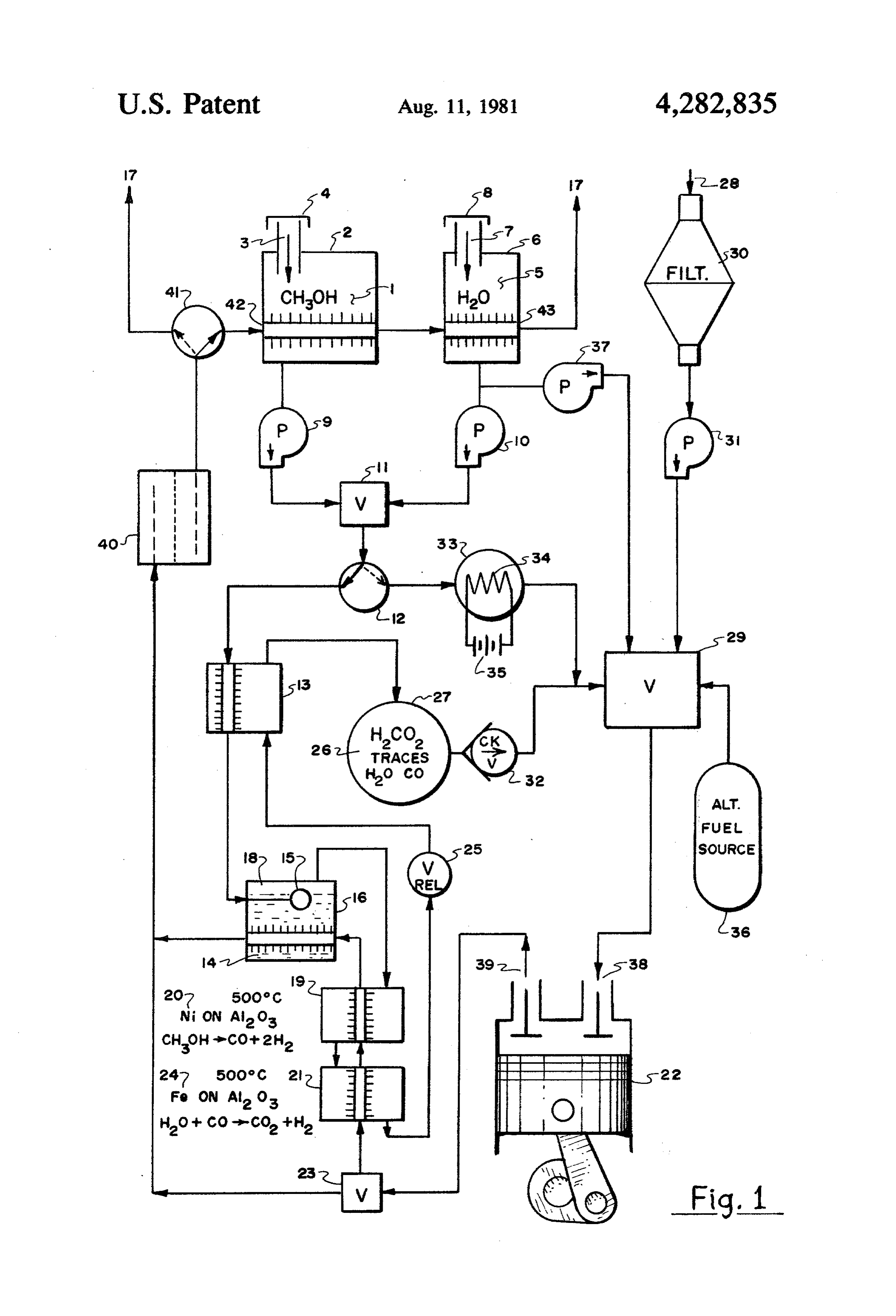
The drawing shows a typical system of the invented
(Ni) catalyst on aluminum oxide (Al2O3) methanol 35 engine and the fuel intake systems and oxidizer air sys (Ch3OH) rapidly disassociates to carbon monoxide
(CO) and hydrogen (H2). The equilibrium for this reac tem to the intake valve and the exhaust system fromthe tion is greater than 97% toward synthesis gas at the 500° exhaust valve. The exhaust line has a routing through C. temperature and one MPa (10 atm). The heating the fuel intake system to use the exhaust gas waste heat value of the fuel is now increased from methanol at 4802 40 to synthesize the fuel to increase the fuel heating value cal/g (8644 Btu/lb) to the synthesis gas (C0 and H2) at and thus the overall engine ef?ciency. The engine also 5693 cal/g (l0,24 Btu/1b.). This is 119% of the original has an alternate energy source for synthesizing the fuel. heating value. In essence, waste heat from the exhaust The engine also has an additional alternate fuel source gas is used to increase the energy content of the fuel and for engine starting and operating when the synthesized thus increase the overall engine efficiency. 45 fuel reservoir is low and electrical battery energy is In a secondary synthesis at around the same tempera limited. This allows time for the heat exchanger synthe ture but in the presence of an iron (Fe) catalyst on sizer to warm up and produce. This is especially benefi Al2O3 the CO and water (H2O) shift to CO2 and H2. cial during cold operating seasons. The heating value has little change, however, an im DETAILED DESCRIPTION provement in pollution control results when the fuel is burned in the engine. This is due to the lower burning Methanol 1, or wood alcohol is con?ned in a fuel tank temperature because of the heat capacity added by the 2, as a liquid which is put into the tank 2, through ?ller CO2 being carried into the engine which must be heated 3, and closed by a cap 4. Likewise, water 5, is confined in combustion. The equilibrium for nitrous oxide forma in a water tank 6, having a water tiller 7, and a cap 8. A tion is less at the lower combustion temperatures. fuel pump 9, and water pump 10, pump fuel 1, and water The source of heat for heating the methanol and 5, to a mixing valve 11. The fuel 1, and water 5, are water is the waste heat in exhaust gases. This consists of routed by a 3-way valve 12, to the synthesized fuel cool around 35% of the fuels energy. Approximately 55% of heat exchanger 13, where the liquid fuel 1, water 5, the exhaust gas’ available heat is the amount required to have their ?rst normal heating. The liquid fuel and heat the fuel for the synthesis. The hot synthesis gas 60 water along with some gas vapor from the fuel 1, as it heats the entering methanol and water to exchange heat may be, proceeds to the liquid 14, float 15, heat ex which cools the synthesis gas for storage before con changer 16, where the engine exhaust gases 17, heat the sumption. fuel 1, and water 5, to a gas 18. The gas 18, now being The engine fuel system to the combustion chamber is above the liquid 14, can now proceed to the ?rst exhaust typically a gas fuel system such as a propane type. An 65 gas heated synthesizer 19, heat exchanger containing a alternate fuel source may be provided which typically is Ni on A1203 catalyst 20, which is heated to around 500° propane. Air typically 21% oxygen and 79% nitrogen is C. by the engine exhaust gases 17, where the CH3OH pumped from the ambient atmosphere to provide the disassociates to CO plus 2H2. The fuel 1 with water 5, 4 v'apor then proceeds to the second exhaust. gas heated perature lower, water 5, can be added to the mix valve synthesizer 21, heat exchanger which is heated :by ex 29, by way of a water pump 37.‘ haust gases 17, coming directly from the engine 22, via The combustable fuel 26, and air 28, enters the engine the exhaust switch valve 23. The second synthesizer 21, 22, through an intake valve 38, and the resulting exhaust contains a Fe on A1203 catalyst 24, where at tempera-v gases 17, leave the engine 22, by way of the exhaust tures above 500° C. H20 and CO disassociate toCOg valve 39, and proceed to the exhaust switch valve 23. 'plus H2. Ideally, the fuel is now Hg with CD; which is The exhaust gases 17, 'can be switched to the fuel syn nonreactive with traces of H20 and CO. This material thesizing heat exchangers 21, 19, and the fuel 1, vaporiz now proceeds to a pressure drop valve 25, then on to ing heat exchangerv16, or if their temperatures are suf? the fuel cool heat exchanger 13, where ‘the fuel 1, and IO ciently hot the exhaust gases 17, can be switched around water 5, have their initial heating and the synthesized these heat exchangers 21, 19, 16, in either case on to a fuel 26, is cooled and. routed to the synthesized fuel muffler then on to a 3-way exhaust valve 41 where the accumulator 27, prepared for mixing with air 28, at the exhaust gases 17, can either be exhausted into the atmo mix valve 29, and, fed to the engine 22. The air 28, comes sphere or can be further routed through a fuel tank heat thru the ?lter 30, as pumped by the air pump 31. A ' exchanger 42, and a water tank heat exchanger 43, check valve 32,,separates the synthesized fuel accumu where the fuel 1, and water 5, can be initially heated in lator 27, and the mix valve 29. Fuel 26, also accumulates very cold conditions and possibly kept from freezing in ,in a heated liquid/vapor fuel accumulator 33, which some instances. , connects between the check valve 32, and mix valve 29,. Weclaim: . .
, After the engine 22, has been off, synthesized fuel 26, 20 1. ‘In combination, an internal combustion engine, a is available from the synthesized fuel accumulator 27, source of fuel comprising a mixture of Methonol and and the liquid/vapor fuel accumulator 33. The'li'quvid water, for ‘supply, to apair of synthesizers serially con float heat exchanger 16,,must be up to temperature to nected and accepting exhaust gas from said engine, the produce vaporized methanol 1, for the engine to pre ?rst of said synthesizers ?rst'receiving exhaust gases pare fuel for itself. Should the engine run out of synthe 25 containing a catalyst of iron on A1203 and the second sized fuel 26, before basic fuel 1, can be prepared by one of . said synthesizers containing a catalyst of Nickel vaporizing, a heater 34, operated by electric power 35, on A1203, a ?rst heat exchanger accepting engine ex ‘such as a battery can boil methanol 1, routed to the haust, gases discharged from said second synthesizer and heated liquid/‘vapor fuel accumulator 33, the 3-way arranged to accept said fuel mixture; means for con 'valve 12, and fcon?ned by the check Ivalv‘e 32, to 'main -,ducting said fuel mixture from said ?rst heat exchanger tain the pressure to keep the'fuel 1, from accumulating to said synthesizers to pass sequentially through said back into the synthesized fuel accumulator‘ 27, and on second and ?rst synthesizers thence, to said engine for back into the heat exchangers. Anothersource of start combustion therein; and a second heat exchanger lo ‘ing and also operating fuel is an alternate fuel source 36, cated between said internal combustion engine and the which could be a) gas or low pressure and ‘temperature 35 discharge from said ?rst synthesizer for the passage ‘vaporizing fuel such as propane which can be mixed therethrough of gas discharged from said synthesizers "with air 28, at the mix valve 29, and used as a fuel as in prior to supply to said engine, and means conducting conventional propane consuming engine systems.‘ said fuel mixture through said second heat exchanger H'ydr'ovgenfrom the synthesized fuel 26, burns‘hot in prior to the supply of said mixture to said ?rst heat an engine'22, and can thus' potentially produce excessive exchanger.
"nitrous: oxide pollutants. To‘ keep the combustion tem
Provenance
- Collection
- Patents citing this work
- Pages
- 4
- Method
- pdftotext (the PDF's own text layer) + pdftoppm 300dpi page scans
- Patent office record
- patents.google.com →
- Source
- Google Patents citing-documents table
- Assignee
- Wm. D. Peterson & Associates
- Published
- 1981-08-11
- Transcribed from
- patentimages.storage.googleapis.com →