

patent · US4367016A
Flat field lens with image splitting effect
4 January 1983
Text
Page 1bibliographic recordscan →
United States Patent (19)
(54) FLAT FIELD LENS WITH IMAGE
SPLTTING EFFECT
(75) Inventor: Joerg Wilhelm, Wetzlar, Fed. Rep. of Germany (73) Assignee: Ernst Leitz Wetzlar GmbH, Wetzlar, Fed. Rep. of Germany
30 Foreign Application Priority Data
52 U.S. C. ..................................... 350/452; 354/219
3,004,470 10/1961 Riihile .................................. 350/437 3,523,720 8/1970 Schiele. ... 350/452 3,740,119 6/1973 Sakurai et al. ... 350/167 4,057,048 li/1977 Maine .................................. 350/167
Primary Examiner-John K. Corbin
Assistant Examiner-Scott J. Sugarman
Attorney, Agent, or Firn-Schwartz, Jeffery, Schwaab, Mack, Blumenthal & Koch
Disclosed is a flat field lens having an image splitting effect, comprising a generally planar lens of substan tially transparent material having an optical axis; and a plurality of deformations of identical cross-sectional configuration formed on concentric paths about the optical axis of the transparent lens. Each of the defor mations has at least two light-refracting surfaces which are symmetrical to an axis of the deformation, wherein the axis of symmetry of each deformation lying on the same concentric path has the same inclination with respect to the optical axis, and the inclination of the axes of symmetry of deformations located on radially adja cent concentric paths varies, preferably constantly, with respect to the optical axis.
13 Claims, 3 Drawing Figures
Drawings
Page 2drawing sheetscan →
Page 3scan →
having an effective flank, and the deformations are
FLAT FIELD LENS WITH IMAGE SPLITTING located on the effective flank of the individual steps. EFFECT Further objects, features and advantages of the pres ent invention will become apparent to a person of ordi nary skill in the art from the detailed description of
The present invention concerns a flat field lens and preferred embodiments which follows, when consid more especially a flat field lens capable of producing an ered together with the attached figures of drawing. image splitting effect. BRIEF DESCRIPTION OF THE DRAWINGS Flat field lenses are usually constructed in the form of 10
Fresnel echelon lenses. They are used, for example, in 1. In the drawings:
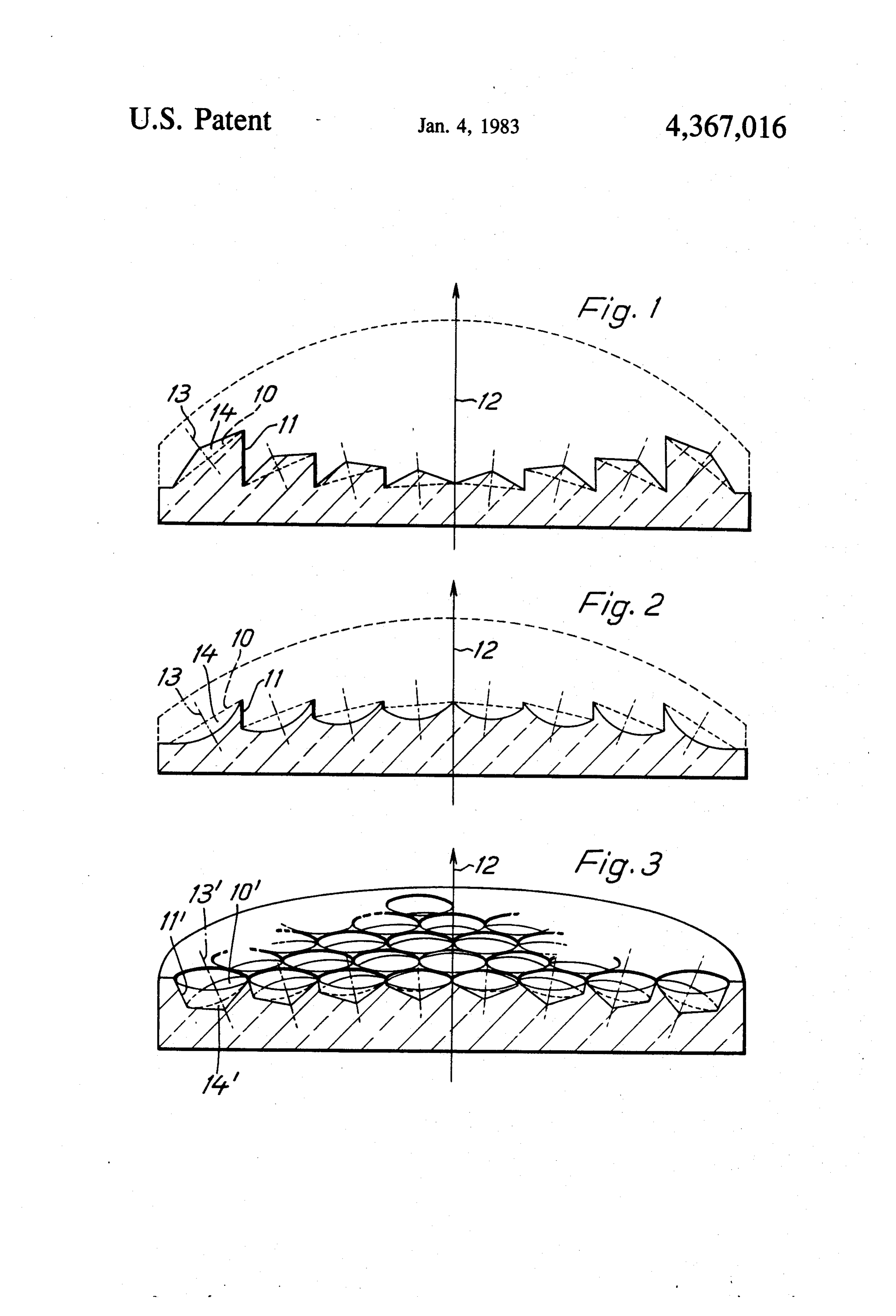
or in the vicinity of an intermediate image plane in FIG. 1 is a schematic sectional view through a Fres single lens reflex cameras to brighten the view finder nel echelon lens with prismatic rings set upon the effec image. In this way, the field lens reproduces the pupil of tive flanks;
the camera lens in the pupil of the eye of the observer. 15 FIG. 2 is a schematic sectional view through a Fres Other optical structural elements in the intermediate nel echelon lens having cylindrical lens rings impressed image plane serve to make possible a sharp focusing of into the effective flanks; and the view finder image. These consist of either ground FIG. 3 is a schematic perspective sectional view glass plates, prism grids, wedge splitters or other image through a field lens with successive conical impressions splitting structures. located on concentric paths.
The field lens and the image splitting structures may 20 be arranged adjacently to each other in the same plane, DETAILED DESCRIPTION OF PREFERRED whereby the central part is used for sharpness of focus EMBODIMENTS adjustment and the periphery for the brightening of the The invention provides a flat field lens having an image. Such an arrangement is known, for example, image splitting effect. The lens comprises deformations from the Journal Feingeraetetechnik (1963) pages of equal 25 cross-sections located on concentric paths, 330-332 and 366-373. The focusing screen described with at least two refracting surfaces having a symmetri therein comprises in a center annular zone a measuring cal axis, wherein field which consists of annular prism or cylindrical the deformation the inclination of the symmetry axis of located on the same path is constant lenses placed concentrically with respect to each other with respect to the optical axis of the field lens but and arranged on the flat side of a conventional plano 30 convex lens. These elements produce dual images out varies constantly in the radial direction on the concen side the focusing plate, with the coincidence of the tricThe paths.
deformations may comprise elevations or depres images represent the focusing criterion. The arrange sions.
ment possesses increased focusing accuracy and en symmetry axis The constant variation of the inclination of the hanced image luminous density in comparison with 35 may be increasing or decreasing, de ground glass focusing arrangements. There is, however, pending on whether a collecting or scattering effect of the disadvantage that only a small section of the image the field lens is to be achieved. In one specific embodi is available for focusing. Because of the absence of light ment, the field lens may be constructed in the form of a scattering elements, observation of the image composi Fresnel echelon lens, wherein the deformations are tion in the usual manner provided by the ground glass located on the effective flank of the individual steps. observation device is not possible either in the measur The deformation may have the configuration of a pris ing field or in the surrounding Fresnel field. matic or a cylindrical lens. In another embodiment of
Summary of the invention
the field lens, each path may consist of a row of succes sive deformations, each deformation having the shape
It is therefore an object of the present invention to 45 of a pyramid, a cone or a spherical cap. provide an improved flat field lens. Referring now to the illustrative embodiments shown It is a further object of the invention to provide an in the drawings, in FIG. 1 a plano-convex lens is repre improved flat field lens combining over its entire area, sented in section by the broken line. By approximating in the same plane, the property of pupil reproduction the individual circular arc sections of the convex side of with the possibility of observing the image and of focus 50 the lens with the use of their chords and by displacing ing with enhanced luminous density. the individual optically-refracting zones together into a In accomplishing the foregoing objects, there has plane, a Fresnel echelon lens having a saw tooth cross been provided according to the present invention a flat sectional profile is created. The steps consist in each field lens having an image splitting effect, comprising a case of an effective flank 10 and interference flank 11. generally planar lens of substantially transparent mate 55 The interference flanks are aligned parallel to the opti rial having an optical axis; and a plurality of deforma cal axis 12 of the lens. The inclination of the normal 13 tions of identical cross-sectional configuration formed to the effective flanks 10 steadily increases with respect on concentric paths about the optical axis of the trans to the optical axis 12 in the radial direction. Fresnel parent lens. Each of the deformations has at least two echelon lenses of this known design focus parallel inci light-refracting surfaces which are symmetrical to an 60 dent light beams at least approximately in one point on axis of the deformation, wherein the axis of symmetry of the optical axis 12.
each deformation lying on the same concentric path has According to one embodiment of the invention, ele the same inclination with respect to the optical axis, vations 14 with triangular cross sections are set upon whereas the inclination of the axes of symmetry of de the effective flanks 10. All of the elevations on the dif formation located on radially adjacent concentric paths 65 ferentially inclined effective flanks have the same base varies, preferably constantly, with respect to the optical angle, if the effective flank 10 is designated the base. axis. Most preferably, the lens comprises the form of a The normals 13 on the effective flanks 10 are symmetry Fresnel echelon lens, comprising concentric steps each axes of the elevations 14. Because of the rotational sym 4 metry of the Fresnel echelon lens to the optical axis 12, a plurality of deformations of identical cross-sectional the elevations 14 represent prism rings. configuration formed on concentric paths about In FIG. 2, the conditions concerning the construction the optical axis transparent lens, each of said defor of the Fresnel echelon lens are similar to those in FIG. mations having at least two light-refracting sur 1. According to this alternative embodiment of the 5 faces which are symmetrical to an axis of the defor invention, however, the effective flank 10 is impressed mation, wherein the axis of symmetry of each de in the shape of a circular arc. All impressions have the formation lying on the same concentric path has same radius of curvature, with the center of curvature the same inclination with respect to the optical axis being located on the normal 13. and the inclination of the axes of symmetry of de Viewed from above, the impressions represent cylin 10 formations located on radially adjacent concentric drical lens rings. paths varies with respect to the optical axis. From the literature reference cited hereinabove, the 2. A field lens according to claim 1, wherein the image splitting effect in prismatic rings and cylindrical inclination of the axes of symmetry of deformations rings of this type is known, however, in the case where located on radially adjacent concentric paths varies their symmetry axes are parallel to each other and the 15 constantly with respect to the optical axis. reproducing effect of a plano-convex lens is arranged 3. A field lens according to claim 1 or 2, wherein the subsequent to the image splitting elements. Experiments deformations comprise elevations.
have shown that both effects may be combined in a 4. A field lens according to claim 1 or 2, wherein the single plane by means of the invention. In this manner, deformations comprise depressions.
a flat field lens is obtained, which over its entire surface 20 5. A field lens according to claim 1 or 2, wherein the area both contributes to the brightening of the image inclination of the axes of symmetry of deformations and is suitable for image focusing. With an adequate located on radially adjacent concentric paths increases fineness of the grooved structure, an observation of the in the radial direction.
image comparable to that viewed with a ground glass 6. A field lens according to claim 1 or 2, wherein the element is possible. 25 inclination of the axes of symmetry of deformations Further approximation of the scattering of a ground located on radially adjacent concentric paths decreases glass plate is obtained by providing the elevations or in the radial direction.
depressions described hereinabove, not in a continuous 7. A field lens according to claim 1, wherein it com closed annular form, but as individual symmetrical de prises the form of a Fresnel echelon lens, comprising formations located on a path. These deformations have 30 concentric steps each having an effective flank, wherein a larger number of refracting surfaces. An example of said deformations are located on the effective flank of such an embodiment is shown in FIG. 3. the individual steps.
In FIG. 3, each deformation consists of a conical 8. A field lens according to claim 7, wherein each of impression 14. The inclination of the base surface 10' said deformations comprises the form of a prism. increases from path to path in the same manner as the 35 9. A field lens according to claim 7, wherein each of inclination of the effective flank of a corresponding said deformations comprises the form of a cylindrical Fresnel echelon lens. The symmetry axis 13' of the lens.
impressions nutates on each path around the optical axis 10. A field lens according to claim 1 or 2, wherein 12. each path comprises a plurality of successively placed When the impression is produced by means of a cylin 40 deformations, each having the form of a pyramid. drical tool having a conical tip, an interference flank 11 11. A field lens according to claim 1 or 2, wherein parallel to the symmetry axis 13' is obtained. The tip of each path comprises a plurality of successively placed the tool may naturally also have a pyramidal or spheri deformations, each having the form of a cone. cal configuration. When, in place of a deformation with 12. A field lens according to claim 1 or 2, wherein a circular base area, a deformation with a regular poly- 45 each path comprises a plurality of successively placed gon as the base area is selected, this has the advantage of deformations, each having the form of a spherical cap. permitting a closer spacing of the deformations in the 13. A field lens according to claim 7, wherein the axis plane of the lens with respect to each other, thus filling of symmetry of each deformation is perpendicular to the lens surfaces to a greater degree. the effective flank of each concentric step, which repre What is claimed is: 50 sents the chord of the individual circular arc sections of 1. A flat field lens having an image splitting effect, an imaginary convex lens surface, whereby the axis of comprising: symmetry of each deformation is perpendicular to the a generally planar lens of substantially transparent imaginary convex lens surface.
material having an optical axis; and
Provenance
- Collection
- Patents citing this work
- Pages
- 4
- Method
- pdftotext (the PDF's own text layer) + pdftoppm 300dpi page scans
- Patent office record
- patents.google.com →
- Source
- Google Patents citing-documents table
- Assignee
- Ernst Leitz Wetzlar Gmbh
- Published
- 1983-01-04
- Transcribed from
- patentimages.storage.googleapis.com →