

patent · US4587279A
Cementitious building material incorporating end-capped polyethylene glycol as a phase change material
6 May 1986
Text
Page 1bibliographic recordscan →
United States Patent (19)
Salyer et al.
(54) CEMENTTIOUS BUILDING MATERIAL
NCORPORATING END-CAPPEED
POLYETHYLENE GLYCOLAS A PHASE
CHANGE MATERAL
(75) Inventors: Ival O. Salyer, Dayton; Charles W. Griffen, Mason, both of Ohio (73) Assignee: University of Dayton, Dayton, Ohio
(51) Int. Cl." ...................... C04B 24/32; C04B 24/34;
(52) U.S. C. ........................................ 523/206; 14/73;
(58) Field of Search ................428/913; 523/135; 524/4
3,223,082 12/1965 Smith .................................. 106/11 3,316,901 5/1967 Smith .................................. 106/11 3,819,388 6/1974 Cornwell ...... ... O6/109 4,111,189 9/1978 Dizon ................ ... 126/400
4,259,401 3/1981 Chahroudi et al. ... ... 52/302 4,277,357 7/1981 Boardman ........................... 126/400
4,504,402 3/1985 Chen et al. .......................... 427/212 4,505,953 3/1985 Chen et al. ............................ 252A70 4,513,053 4/1985 Chen et al. .......................... 428/22 4,524,102 6/1985 Hostettler ..... ... 428/318.8 4,532,917 8/1985 Taff et al........................ a -o 26/400
OTHER PUBLICATIONS
Vigo et al., "Temperature Adaptable Hollow Fibers
Containing Polyethylene Glycols,” Journal of Coated
Encapsulation of Phase Change Materials in Concrete Masonary Construction Progress Report No. 1 Aug.
Encapsulation of Phase Change Materials in Concrete Masonary Construction Progress Report No. 2, Mar.
"Phase Change Materials Handbook", U.S. Dept of
Commerce, National Technical Information Service,
Primary Examiner-Helen M. McCarthy
Attorney, Agent, or Firm-Biebel, French & Nauman
A cementitious composition comprising a cementitious material and polyethylene glycol or end-capped poly ethylene glycol as a phase change material, said poly- . ethylene glycol and said end-capped polyethylene gly col having a molecular weight greater than about 400 and a heat of fusion greater than about 30 cal/g; the compositions are useful in making pre-formed building materials such as concrete blocks, brick, dry wall and the like or in making poured structures such as walls or floor pads; the glycols can be encapsulated to reduce their tendency to retard set.
19 Claims, 6 Drawing Figures
Drawings
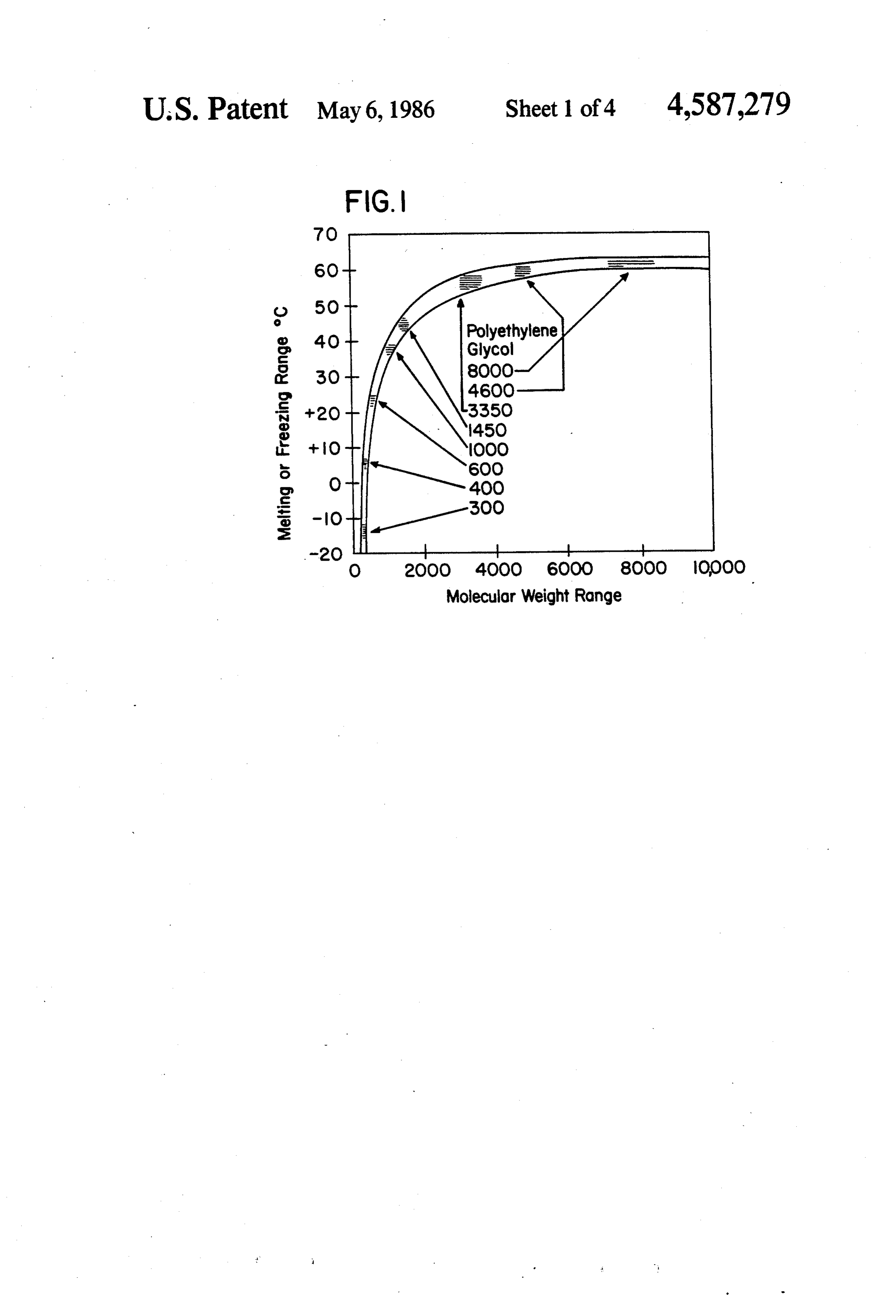
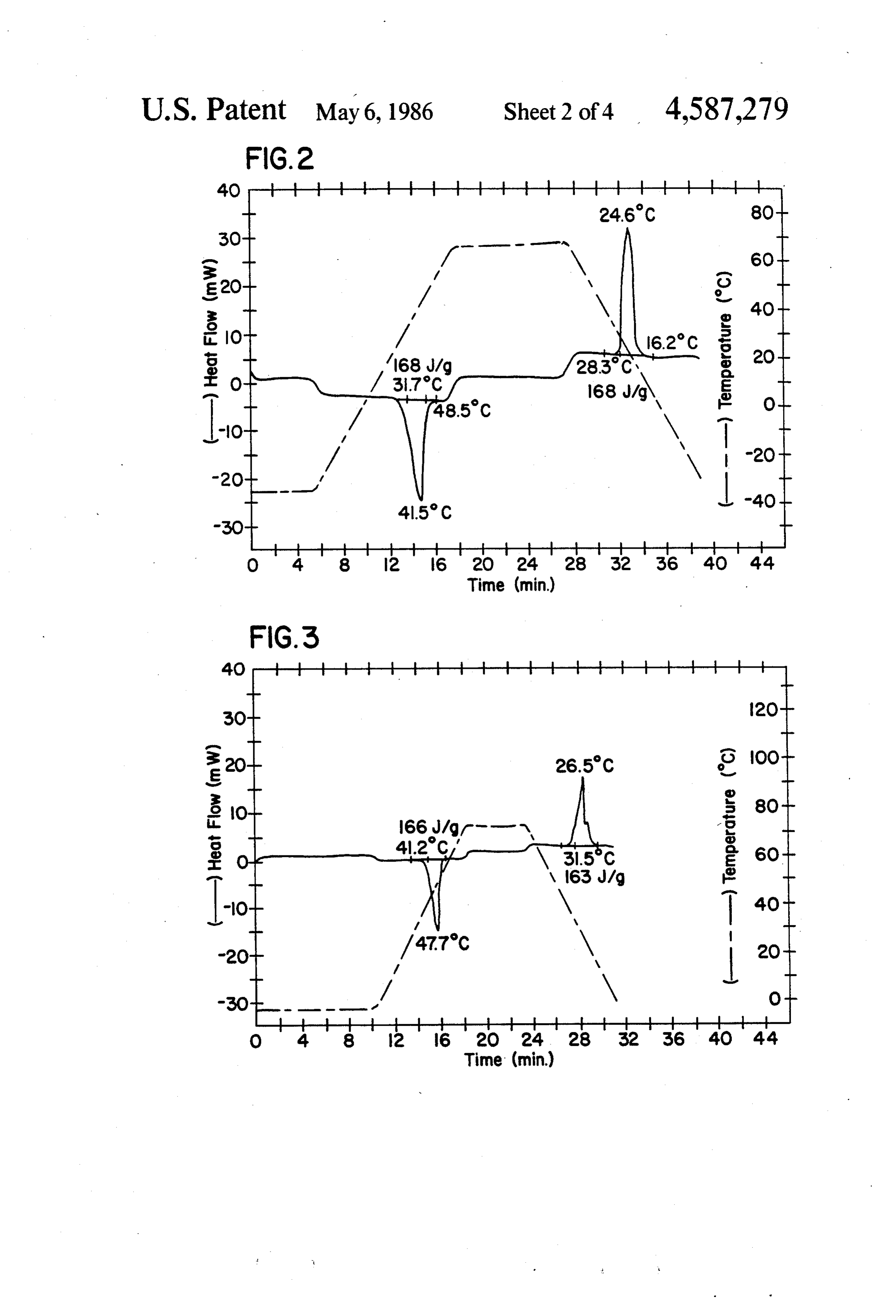
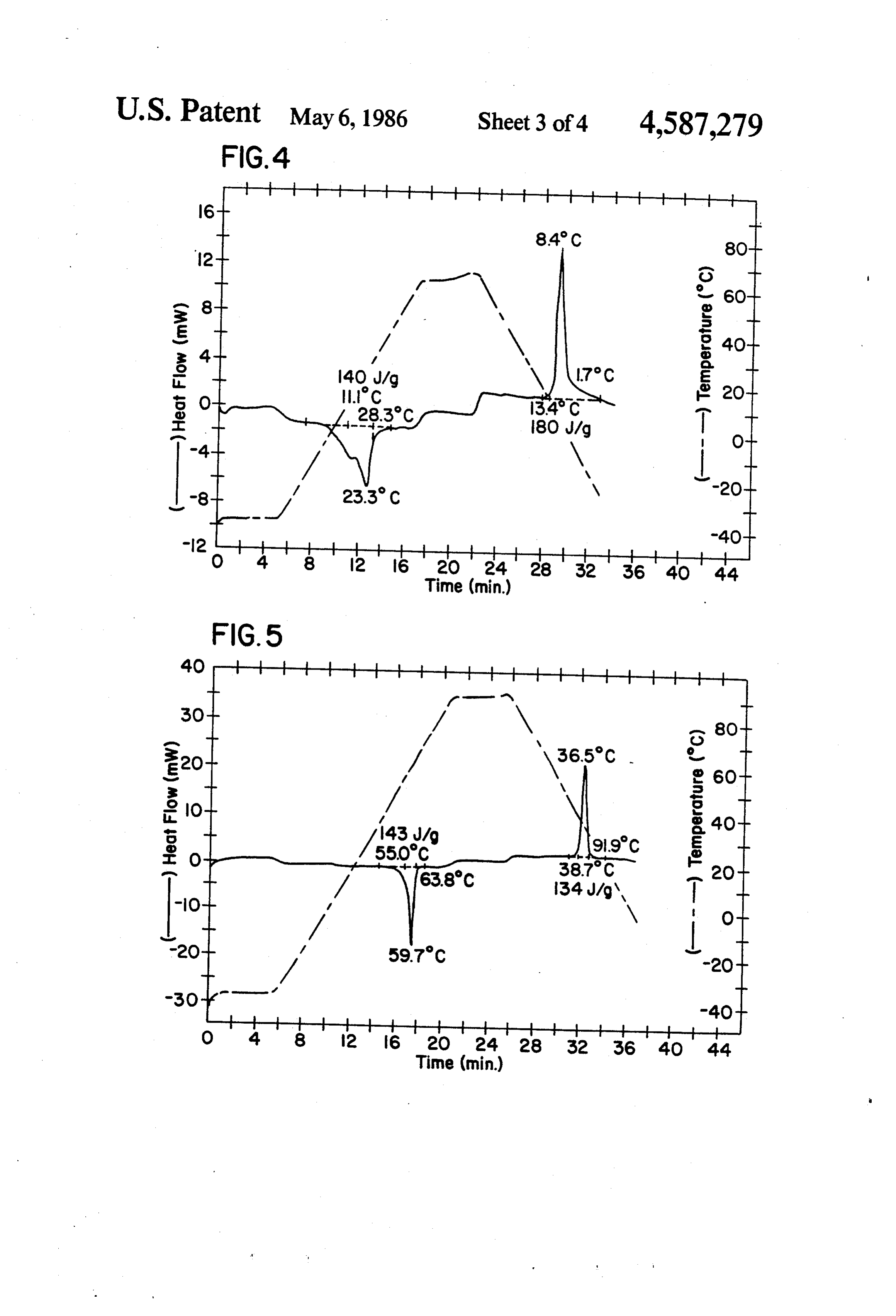
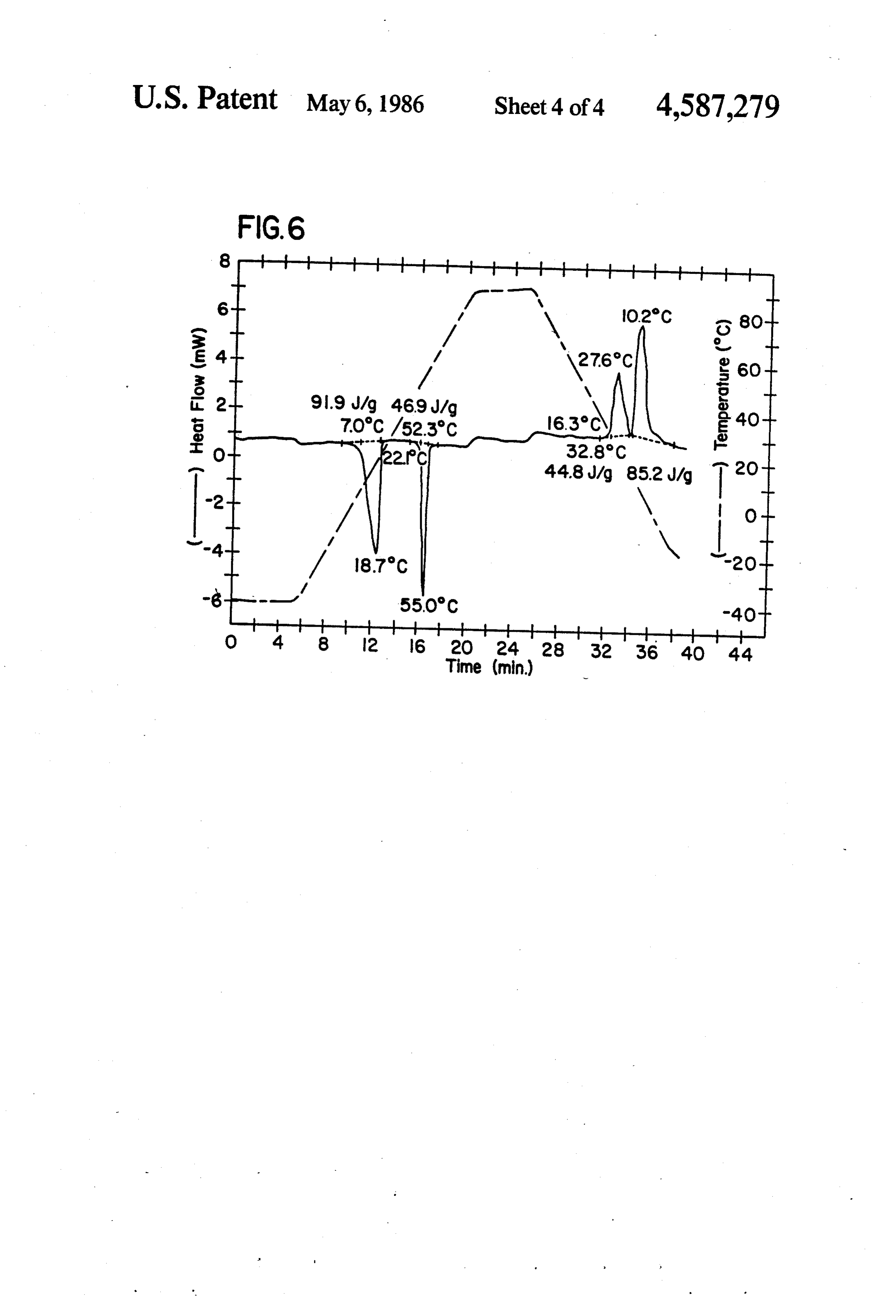
FIG. 5 is a differential scanning 100,000 molecular weight poly forming poured concrete structures such as used in ethylene oxide.
Page 2drawing sheetscan →
Page 3drawing sheetscan →
Page 4drawing sheetscan →
Page 5drawing sheetscan →
Page 6scan →
Among the teachings which were available in the art
CEMENT TOUS BUILDING MATERIAL prior to the present invention are those of U.S. Pat. No. NCORPORATING END-CAPPED 4,259,401 to Chahroudi et al which discloses both struc POLYETHYLENE GLYCOLAS A PHASE CHANGE tural and non-structural building materials incorporat MATERAL 5 ing phase change materials. These building materials are made up of a rigid porous matrix structure which is
GOVERNMENT RIGHTS impregnated with the phase change material and sealed for waterproofness. Three classes of phase change ma
The U.S. Government has certain rights under this terials invention. are disclosed, namely, hydrated salts, waxes, and 10 clathrates. Cements, plasters or thermosetting materials
BACKGROUND OF THE INVENTION may form the rigid matrix. Both pre-formed structural The present invention relates to cementitious compo elements such as building blocks, ceiling tiles, and dry sitions embodying phase change materials and, more wall and poured elements such as walls, floors and par particularly, to cementitious compositions incorporat titions are described in the patent. The encapsulation of ing polyethylene glycols and/or end-capped polyethyl 5 phase change materials which interfere with set is also ene glycols as phase change materials. These composi disclosed in the patent.
tions are useful in the manufacture of building materials. U.S. Pat. No. 4,277,357 to Boardman discloses a ther There has been a great deal of interest in phase mal energy storage composition similar to some of those change thermal energy storage systems due to their 20 described by Chahroudi et all wherein a salt hydrate is inherent ability to store large amounts of heat and re incorporated into a hydrated hydraulic cement. lease it to the surrounding environment as temperatures U.S. Pat. No. 4,111,189 to Dizon discloses a com drop below a predetermined level. These systems are of bined solar collector and thermal energy storage device particular interest in the architectural and building in which the collector employs phase change matrix trades where climate control and its concommitant 25 comprising a phase change material dispersed in a poly energy consumption is one of the principal consider meric matrix. The preferred phase change material is ations in building design and material selection. polyethylene glycol having a molecular weight in the A variety of building materials and techniques have range of 4500 to 20,000.
previously been used to conserve heat or cool and SUMMARY OF THE INVENTION thereby reduce energy costs. Included among them are 30 structural elements which incorporate phase change The present invention is directed to cementitious materials. By incorporating phase change materials into compositions which are useful in thermal energy stor building materials, energy in excess of that necessary to age and include polyethylene glycol and/or an end maintain comfort conditions is inherently absorbed and capped polyethylene glycol in a dispersed state as a released when the surrounding environment drops 35 phase change material.
below the comfort range. Thus, in winter months, phase It has been found that polyethylene glycols and end change materials incorporated into structural elements capped polyethylene glycols have relatively high heats in the walls or floors of buildings and the like can absorb of fusion (typically greater than 30 cal/gm) and melt at solar energy during daytime hours and release it to the temperatures which make them useful as phase change interior at night as temperatures drop. In summer 40 materials for climate control, deicing, or in active solar months, the same phase change material, due to its ther energy storage systems.
mostatic character, conserves coolness by absorbing It has been more particularly found that PEG's and energy. end-capped PEG's are compatible with conventional Structural elements incorporating phase change ma cementitious compositions and mixing procedures. terials are more desirable than elements which store 45 Consequently, they can be implemented by the cement only sensible heat because they have a higher capacity and building industry relatively easily and without sub to store energy and they absorb and release a large stantial modification of conventional techniques. They quantum of energy over a very narrow temperature are also particularly desirable as phase change materials range. A phase change material utilizes its latent heat of because they are relatively inexpensive, they are avail fusion for thermal storage. The latentheat of fusion is 50 able in a range of melting points depending on molecu substantially greater than the sensible heat capacity of lar weight, and their phase change characteristics can the material. That is, the amount of energy a material be modified through blending. Thus, it is possible to absorbs upon melting, or releases upon freezing, is much optimize their heat retention/releasing characteristics greater than the amount of energy it absorbs or releases to satisfy a particular end use. upon increasing or decreasing in temperature l' C. 55 Accordingly, a principal object of the present inven Thus, upon melting and freezing, per unit weight, a tion is to provide a cementitious composition which phase change material absorbs and releases substantially incorporates a polyethylene glycol or an end-capped more energy than a sensible heat storage material which polyethylene glycol as a phase change material. is heated or cooled through the same temperature A further object of the present invention is to provide range. Furthermore, as contrasted with a sensible heat a cementitious composition useful in the manufacture of storage material which absorbs and releases energy pre-formed or poured cement products exhibiting desir essentially uniformly over a broad temperature range, a able thermal energy storage characteristics. phase change material absorbs and releases a large quan A still further object of the present invention is to tum of energy in the vicinity of its melting/freezing provide cementitious compositions useful in bridge point. This is particularly advantageous in buildings 65 deck or roadway deicing.
where space is at a premium and energy storage and Another object of the present invention is to provide release are required within a very narrow comfort cementitious compositions incorporating end-capped range. polyethylene glycols having good setting characteris
Page 7scan →
3 weights greater than 1500 up to the ultra high molecular tics and reduced sensitivity to moisture or high humid weight polyethylene oxides having molecular weights ity. of 200,000 and higher are used. Still another object of the present invention is to The PEG's and end-capped PEG's used as phase provide cementitious compositions including encapsu 5 change materials in the present invention have molecu lated polyethylene glycols. lar weights greater than 400 and up to several million. BRIEF DESCRIPTION OF THE DRAWINGS Included in the term "polyethylene glycol" or "PEG" are
The present invention will be explained in more detail higher polyethylene oxides (PEO's), by which name the by reference to the following drawings wherein: molecular weight PEG's are known in the art. O The
FIG. 1 is a plot of the melting point of polyethylene end-capped energies of the phase changes of PEG's and glycols as a function of molecular weight. PEG's do not show a smooth correlation FIGS. 2-5 are differential scanning calorimetry with molecular weight, but, in broad outline, as the (DSC) diagrams for selected polyethylene glycols and molecular weight of the PEG increases, so do the fu sion/crystallization energies until a constant value of blends useful in the present invention. 15 about 40 cal/g is reached at molecular weights of 1000 FIG. 6 is a differential scanning calorimetry curve for and higher. This can be seen from the results of Refer a blend of 600 and 8000 molecular weight PEG's. ence Example 1 below. PEG's having molecular DETAILED DESCRIPTION OF THE weights of 1500 and 8000 are anomolous in this respect INVENTION and this may be due to the molecular weight distribu
Polyethylene glycols and end-capped polyethylene 20 tion PEG's in the material or other unknown factors. All of the and end-capped PEG's used in this invention glycols can be incorporated into substantially any have phase change energies greater than 30 cal/g. known cementitious composition and function as a While heats of fusion/crystallization are fairly con phase change material. Accordingly, the teachings of stant, the melting points of PEG's vary directly with the present invention are applicable to cementitious 25 their molecular weight.
materials previously known or compositions developed points and freezing pointsFIG. 1 is a plot of melting in the future. The only interaction which tends to limit molecular weight. Melting point variesasthea fastest of PEG's function of in the the usefulness of PEG's in cementitious compositions is molecular weight range of 300 to 1500 rising from about the highly hygroscopic nature of the PEG's (as opposed -15' C, to 45' C. with that molecular range whereafter to end-capped PEG's) themselves. As discussed below, 30 it increases more slowly to a limiting melting point of however, this limitation can be overcome by end-cap about 63' C.
ping, encapsulating the PEG in a polymeric shell, or By appropriately selecting PEG's, it is possible to dispersing the PEG in a polymer or rubber. achieve any desired melting point within a range of The cementitious compositions of the present inven about -15 C. (300 molecular weight) to about 63 C. tion include a cementitious material as a rigid matrix 35 (molecular weight greater than 8000). For climate con forming material. Typical examples of useful cementi trol, heating and cooling, tious materials are hydraulic cements, gypsum, plaster end-capped PEG's havingitmelting is desirable to use PEG's or of paris, lime, etc. Portland cement is by far the most about 16" to 42" C. Consequently,points in the range of widely used hydraulic cement. The term "hydraulic energy storage systems such as building inmaterials, for use passive cement" as employed herein includes those inorganic walls, floors, and the like, the polyethylene glycols and cements which, when mixed with water, set and harden end-capped polyethylene glycols preferably have a as a result of chemical reactions between the water and the compounds present in the cement. Portland cements molecular weight in the range of about 600 to 1500. are ordinarily used for construction purposes. Types I, 20For deicing applications, melting points of about 1 to C. (preferably 5' to 15' C.) are desirable. Hence, for
II, III, IV, and V may be used. White cements, air en trained cements, high alumina cements, masonry ce 45 these applications, polyethylene glycols falling within a relatively narrower, low molecular weight range of 450 ments can also be used. to 550 are desirable.
Concretes are mixtures of such hydraulic cements and inert aggregates. Typical aggregates include con beThe compositions of the present invention may also useful in certain active thermal energy storage sys ventional coarse aggregates such as gravel, granite, 50 tems, limestone, quartz sieve, etc., as well as those materials aboutsuch 63, as solar collectors. Here, melting points up to the maximum for PEG's, are useful and, as conventionally referred to as fine aggregates such as such, polyethylene glycols ranging from about 3500 to sand and fly ash. Conventional hydraulic cement con several million (polyethylene oxides) in molecular cretes, e.g., Portland cement concretes, employ major weight are used.
amounts, i.e., over 50%, usually up to about 75% by 55 To illustrate the phase change characteristics of poly volume of such aggregates in the set product. These ethylene glycols and end-capped polyethylene glycols, cements and concretes fall within the term "cementi tious material' as it used herein. differential scanning calorimeter curves are provided in The cementitious compositions of the present inven FIGS. 2-5 for commercially available 1000 (FIG. 2; and 1500 (FIG. 3) molecular weight polyethylene glycols tion also include concrete and plaster compositions and useful in the manufacture of pre-formed materials such PEGa (Carbowax 750 (FIG. 4) molecular weight methoxy capped as concrete blocks, dry wall, and the like as well as in calorimeter curve750). for a
FIG. 5 is a differential scanning 100,000 molecular weight poly forming poured concrete structures such as used in ethylene oxide.
forming the walls, floors, floor pads and partitions of In most cases, the melting/freezing points of polyeth buildings. In addition, the compositions of the present 65 ylene invention are also useful in road, runway and bridge glycolsglycols can be modified by blending polyethylene deck deicing as well as in solar active storage that oper differentormelting/freezing end-capped polyethylene glycols having points to obtain a phase ates effectively in the 40-65 C. temperature range change material having an intermediate melting/freez wherein polyethylene glycols having molecular
Page 8scan →
5 glycol before set is undesirably retarded. In addition to ing point. This practice can be used to tailor the thermal methoxy capped polyethylene glycols, specific exam storage characteristics of the phase change material to ples of other end-capped PEG's that can used in the meet the requirements of the particular end use. Thus, present invention include those end-capped by etherifi PEG's having molecular weights of 1000 and 1500 can cation with long chain, C18 and esterification with for be blended to produce a phase change material which mic and acetic acids and long chain C8 alkyl hydrocar melts at 45 C. It has been found, however, that if the bon acids such as stearic, oleic and the like. The etherifi molecular weights of the blended polyethylene glycols cation and esterification with C18 alcohols and acids can are sufficiently different, they retain their respective be used advantageously to obtain reduced water sensi melting/freezing points and heats of fusion and compo 10 tivity and enhanced storage simultaneously. From the sitions having two phase change temperatures can be standpoint of incorporating phase change materials into prepared. This is illustrated in FIG. 6 which is the dif cement without retarding set, end-capped PEG's and ferential scanning calorimeter curve for a blend of 50 more particularly di-end-capped PEG's are prepared. parts 600 and 50 parts 8000 molecular weight polyethyl To reduce set retardancy, polyethylene glycol can be ene glycols. As the curve illustrates, in the blend each of 15 added to the cementitious composition dispersed in a the glycols exhibits a separate latent heat of fusion and polymeric or high molecular weight material in the melting/freezing point. These materials offer the ability form of a pellet or granule. This isolates the PEG from to design building materials which perform optimally in the cementitious composition and, more particularly, both heat storage and cool storage or for use in both water and removes the adverse effect of the hydroxy active and passive thermal energy storage systems. The 20 groups on the setting properties of the composition. blend illustrated in FIG. 6 is particularly useful in that it Thermosetting or thermoplastic polymers may be used. could store solar heat for winter heating, and night time For ease of incorporation, it is desirable to disperse "cool" for summer cooling in a single composition. PEG's in polar polymers or rubbers. Typical examples As a general rule, separate heats of fusion and melting include nylons, polyesters, polyvinyl alcohol, polyvinyl points can be maintained as long as the difference in the 25 acetate, vinyl chloride/vinyl acetate copolymer, neo molecular weights of the polyethylene glycols is at least prene, copoly(butadiene/acrylonitrile), acrylate and 2000, and one of the two blend components has a molec methacrylate rubbers, neoprene and copoly(ethylene/- ular weight of 1000 or less. The phase change materials vinylacetate). However, less polar rubbers such as natu can be blended in any ratio depending upon the perfor ral rubber, butyl rubber, polybutadiene, copoly(- mance characteristics desired. Ratios of 1/10 to 10/1 30 butadiene/styrene) and copoly(ethylene/propylene) are useful. (EPDM) can also be used, although more intensive The cementitious compositions of the present inven mixing is necessary. These polymers are characterized tion can be used to form pre-formed building materials in that they are sufficiently compatible with the PEG's, such as cement blocks and dry wall or poured on site. that the PEG's can be incorporated in then in relatively Since the polyethylene glycols and end-capped polyeth 35 high concentrations (e.g., 50 phr or higher). Depending ylene glycols having molecular weights in excess of on the type and molecular weight of the PEG's and the about 500 are crystalline solids at room temperature, polymer, the PEG in the polymer may be present in these materials can be incorporated into a cementitious dissolved form or as a separate phase of discrete drop composition as a dry powder or in aqueous solution. In lets. This latter type of dispersion does not prevent the either case, because PEG's are quite water soluble, they melting and crystallization of the phase change mate are ultimately dissolved in the water and thereby dis rial.
persed in the cementitious matrix. Pellets or granules are formed by incorporating PEG In forming poured producrs, the PEG can be mixed in the polymer, and cutting or grinding the polymer to with the cementitious matrix material in a conventional produce particles ranging from about 0.25 to 3.0 mm in cement mixer, premixed in dry form with the cement, or 45 particle size.
sprayed into a mold with cement and aggregate. The polymer can be crosslinked or uncrosslinked. In The PEG's can be incorporated into-cementitious cementitious compositions, thermal form stability is compositions in amounts of up to 25% by weight, de generally not important and, as such, the pellets can be pending on the form of the polyethylene glycol used. used in an uncrosslinked form. The PEG can be dis Theoretically, there is no lower limit on the amount of 50 persed in the polymer in an amount of about 10 to 100 PEG or end-capped PEG that is used since some ther parts per 100 parts of polymer. In higher concentra mal energy storage benefit (although small) accompa tions, the PEG is present in the polymer in dissolved niesWhere PEG (molecular weight 600 to 1500) perse is andFillers any addition. dispersed form.
such as finely divided silica and carbon black added to a cementitious composition, it has been found 55 may also be advantageously added in amounts ranging that that set is retarded significantly if the amount of from 10 to 100 parts per 100 parts of polymer. So PEG exceeds about 5%. This is apparently the result of formed, PEG/polymer pellets can be dispersed in a the high affinity which the terminal hydroxy groups in cementitious composition in an amount up to 50% by PEG have for water. This tendency can be overcome or reduced by end-capping the glycol, by dispersing the weight. It is advantageous to disperse the PEG's in rubbers PEG in a polymeric or rubber material as discussed having significant crystallinity that they can also func below. tion as phase change materials. Natural rubber report The term "end-capped" PEG's refers to PEG's in edly has phase transitions at -6 and 25 C. Neoprene which at least one and preferably both of the terminal reportedly has a crystalline melting point at about 32 hydroxy groups are reacted and includes alkoxy-capped 65 C., as is desirable for comfort heating. Other semi-crys PEG's, urethane-capped PEG's, ester-capped PEG's talline rubbers include EPDM and copoly(ethylene/vi and like compounds. Methoxy capped PEG's (in which nyl acetate) rubbers. Hence, a crystalline matrix rubber only one of the two terminal hydroxyl groups is re containing dispersed PEG can provide augmented ther acted) can be used in higher amounts than polyethylene 9 mal energy storage capacity since both parts of the In climates where ice forms on the surfaces of side composite contribute. walks, streets, highways, bridges, and other structural Another technique that can be used to prevent PEG's objects normally formed of concrete or other conven from retarding set is to add the PEG in solid/crystalline 5 tional structural materials, the compositions of the pres form to a solution of a polyisocyanate such as tolylene ent invention can be advantageously employed to pro diisocyanate or the like whereupon the hydroxyl groups vide suitable pre-formed elements (such as tiles) or at the surface of the PEG crystal react with the diisocy poured-on-site installations (such as roadways) which anate. This has the effect of producing a thin urethane will store and release heat to retard or prevent surface shell about the crystal which isolates the internal hy O ice formation. In such applications, the melting point of droxy groups from the cement composition. This mate the phase change material is selected to be a few (prefer rial can be incorporated into the cementitious composi ably about 10' C.) degrees above the freezing point of tion in dry form. It does not retain water or otherwise water. For this reason, PEG's ranging from about 450 interfere with the setting properties of the concrete to about 600 in molecular weight are required. When because the hydroxyl groups at the surface of the phase 15 the average daily temperature of the atmosphere is change material are engaged in a urethane linkage and, higher than the melting point of the PEG, it melts and at the same time, such a minimal amount of reaction stores this energy for release during the colder night with the isocyanate occurs that the modified PEG re time when the temperature goes below 0°C. Thus, ice tains its crystalline heat of fusion and melting point. will never form on the surface of the road during the A still further modification that can be used to avoid night, following a day of above 10' C. temperature. If set retardency in compositions designed for active solar the average daily temperature drops below the melting storage systems is to form crosslinked PEG pellets. point of the PEG, then surface ice can form, but it will PEG's can be crosslinked chemically by reaction with tend to form later and melt sooner than if conventional crosslinking agents such as dicumyl peroxide or poly 25 materials had been used.
isocyanate or it can be crosslinked by radiation such as Roads, pathways, bridge decks, and roadbeds de electron bean.
Crosslinking can also be used to form pellets useful in rials offor signed the vehicles can also be constructed of the mate present invention. Preferably cement, aggre climate control or deicing. In crosslinking the phase gate, and PEG are poured on site. change material for this purpose, it is important that the 30 The cementitious degree of crosslinking be limited to that necessary to tion may also includecompositions additives of the present inven conventionally used in make the PEG form stable and prevent its dissolution in the art to modify setting or other performance charac water. If the PEG is too highly crosslinked, it loses the teristics. Typical additives that may be advantageously mobility required for crystallization and hence loses the phase change thermal energy storage capacity. 35 used in the present invention include accelerators, ag Another way to produce pre-formed building materi gregates, reinforcing fibers, pozzolans and the like. als and avoid interfering with the curing of the cement they These additives are employed in the amounts in which matrix is to pre-form a porous matrix and impregnate are conventionally used. Representative examples the matrix by immersing it in a PEG solution. Porous of accelerators include calcium chloride, alkali silicates, cement matrices are conventionally formed using such etc.
materials as air-entraining cement. These cements, Reference Example 1 when pre-molded into a concrete block, slab or tile have The phase change temperatures and energies of a a large pore volume that can be infiltrated with the series of PEGs of average molecular weight ranging PEG. In many cases where this technique is used, how 45 ever, it is essential to seal the pre-formed element in an from 600 to 14000 were determined using a DuPont impermeable sealing material such as polyvinylidene Model 912 Dual Cell Differential Scanning Calorimeter chloride or paint to prevent the PEG from slowly being (DSC) interfaced with a DuPont 1090 Thermal Analy extracted from the block by rain water or the like. zer. The cell constants for this instrument were deter Building materials such as dry wall and sheet rock 50 mined using Indium and Tin standards. The energies of can be prepared by the molding or infiltration tech the fusion endotherms of the standard materials were niques described above for the concrete blocks. How found to be within 2.6 to 6.2% of the literature values. ever, because these materials typically have a laminar The fusion temperature and energy of Gallium was used structure wherein the cementitious matrix material is to check the instrument calibration in the temperature laminated between sheets of Kraft paper, it is also possi 55 region of interest for the PEGs. The fusion temperature ble to apply the PEG as a film on one or both faces of of Gallium was 1.2% high (found 30.1 C., literature the sheet before or after application of the Kraft paper. 29.25° C) and the enthalpy of fusion was 1.5% low In this case, it is desirable to form a coating composition (found 18.87 cal/g, literature 19.16 cal/g) which is con comprising the phase change material dispersed in one sidered to be within experimental error. Temperature of the aforesaid polymers. Preferably, the two are codis control in a cooling experiment in the DuPont DSC is solved in a common solvent. This composition can be not as accurate as temperature control in the heating coated upon a pre-formed slab of dry wall prior to mode of operation.
application of the Kraft paper or thereafter. Each sample was put through four sequential heat In preparing dry wall, the hygroscopicity of the PEG 65 cool cycles at a heating/cooling rate of about 10 presents less of a set retardency problem. It is generally C./minute in a nitrogen atmosphere. Excellent preci possible to use up to about 20% by weight PEG without sion of measurement was obtained. Experimental values undesirably retarding set. are summarized in Table 1.
Page 10scan →
Table 1
Phase change properties of poly (ethylene glycols)
Molecular Onset --
Weight (ext) Maximum Final H -- s (cal/g)
Fusion 600 5.6 - 0.8 21.6 t 2.5 31.4 - 2.5 -32.65 0.50 000 27.7 - 1.5 42.9 2.3 S4 .6 - 40.85 - 1.04 500 41.4 - 0.2 48.7 0.9 55.5 - 1.8 -39.74 - 0.13
Fusion 3400 50.7 0.6 61.8 - 0.6 68.7 - 0.9 -46. 0.63 8000 49.6 - 0.7 62.0 t 0.4 68.3 - 1.5 - 4.40 - 1.23 4000 52.9 - 1.1 63.7 - O.S 71.4 - 2.5 - 46.90 it .18
Crystallization 600 9.7 0.6 6. 0.8 - 13.4 2. 3.69 0.50 000 32.6 - 3.2 26.9 - 3.4 8.6 S. 38.94 - 0.48 1500 33.4 1.7 28.9 3.5 20.9 - 8.5 36.7 - 4.28 3400 42.5 - 0.2 38. 1.0 30.5 - O.S 4.81 - 0.72 8000 43.2 - 2.0 39.3 - 0.2 27.0 - 4 38.45 at 0.42 4000 45.8 0.5 43.5 - 0.7 30.2 2.4 44.36 at 0.36
It is well documented in the thermal analysis literature 20 that the temperatures at which thermal events occur are 25% by weight and the solution was added to 150 g of a function of the DSC heating rate. Consequently, the plaster of paris. Additional water was added to adjust temperatures reported in Table 1 are to be considered as the consistency and facilitate setting. The mixture was representative of the range over which both fusion and 25 placed in a inch by 4 inch diameter circular mold and crystallation of the PEGs will occur. allowed to harden. A differential scanning calorimeter REFERENCE EXAMPLE 2 analysis (DSC) was performed as in Reference Example 1. The analysis showed that in the plaster, the glycol
One particularly advantageous feature of PEGs as retained phase change materials is that they generally do not its heat of fusion and melting point. exhibit a large supercooling effect. The amount of su 30 EXAMPLE 2 percooling observed in the DSC experiments at hea 20 g of polyethylene glycol 1000 was dissolved in ting/cooling rate of 10' C./minute are summarized in warm water in a concentration of about 20%. This Table 2. solution was added to a mixture of sand (300 g) and TABLE 2 35 Portland cement (100 g). The mixture was poured into
AMOUNT OF SUPERCOOLING IN POLY a mold and allowed to harden. DSC analysis showed (ETHYLENE GLYCOLS) that the glycol retained its original heat of fusion and Molecular Weight Onset (ext) Maximurn melting point.
1000 (+4.9) - 16.0 EXAMPLE 3 500 -8.0 - 19.8 40 3400 -8.2 -23.7 22.5g of polyethylene glycol, 600 molecular weight, 8000 -6.4 -22.7 was dissolved in 100 g of water. The solution was added 4000 -7. -20.2 to 150 g of plaster of paris and poured into a mold as in Example 1. DSC analysis was performed as in Refer
Two different values are reported for each PEG. The its heat ence Example 1 and showed that the 600 glycol retained extrapolated on-set temperature of the phase change is of fusion and melting point. affected by the integration limits selected for the peak ence Having described the invention in detail and by refer . . and consequently is not as accurate as the maximum ent that to preferred embodiments thereof, it will be appar temperature value. This is reflected by the parenthetical out departingmodifications and variations are possible with values of the extrapolated on-set temperature "super- 50 What is claimed from the scope of the appended claims. cooling" values for PEG 600 and PEG 1000. With these is:
two exceptions, supercooling ranges from a minimum of ture 1. A cementitious composition useful in the manufac -6.4°C. for PEG 8000 to a maximum of -23.7" C. for mentitious of building materials comprising an inorganic ce PEG 400. Again, both superheating and supercooling 55 ethylene glycol building material and an end-capped poly dispersed therein as a phase change may be a function of the heating and cooling rates, and material, said end-capped nucleation; and, thus will be less pronounced at the molecular weight greater polyethylene glycol having a much slower heating and cooling rates of the actual fusion greater than about than about 400 and a heat of application. Additionally, however, we have found that capped polyethylene glycol30iscal/g, wherein said end selected from the group small percentages (e.g., 10% weight) of higher molecu consisting of alkoxy-capped polyethylene glycol, ure lar weight PEG 8000 can be used in PEG 1000 to re thane-capped polyethylene glycol, and ester-capped duce the supercooling to about the value of Table 2 polyethylene glycol.
above. 2. The composition of claim 1 wherein said cementi The present invention is illustrated in more detail by tious material is selected from the group consisting of the following non-limiting examples. 65 portland cement, gypsum, and plaster of Paris. EXAMPLE 1 3. The cementitious composition of claim 1 wherein 15 g of polyethylene glycol, molecular weight 1000, said phase change material is a di-end-capped polyethyl was dissolved in warm water in an amount of about ene glycol.
Page 11scan →
4. The cementitious composition of claim 3 wherein sisting of nylons, polyesters, polyvinyl alcohol, polyvi said phase change material is a methoxy end-capped nyl acetate, ethylene vinylacetate copolymer, butadi polyethylene glycol.
5. The cementitious composition of claim 1 wherein ene-acrylonitrile rubbers, neoprene, copolymer, acrylate and methacrylate natural rubber, butyl rubber, polybu said end-capped polyethylene glycol has a molecular tadiene, butadiene/styrene copolymers and EPDM. weight in the range of about 600 to 1500.
6. The cementitious composition of claim 2 wherein wherein13. The cementitious composition of claim 10 said cementitious material is portland cement and said said polymeric material is crosslinked or un end-capped polyethylene glycol is present in an amount crosslinked.
up to about 5% by weight. O 14. The cementitious composition of claim 13 7. The cementitious composition of claim 2 wherein wherein said phase change material is end-capped by said cementitious material is plaster of Paris and said reaction with a polyisocyanate. end-capped polyethylene glycol is present in an amount 15. A building block comprising an inorganic cemen up to about 20% by weight. titious matrix having dispersed therein an end-capped 8. The cementitious composition of claim 1 wherein 15 polyethylene glycol as a phase change material, said said phase change material is a blend of end-capped end-capped polyethylene glycol having a molecular polyethylene glycols having distinct melting points weight greater than about 400 and a heat of fusion such that said blend exhibits two distinct melting points greater than about 30 cal/g, wherein said end-capped and two distinct heats of fusion. polyethylene glycol is selected from the group consist 9. The cementitious composition of claim 8 wherein 20 ing of alkoxy-capped polyethylene glycol, urethane said blend comprises end-capped polyethylene glycol capped polyethylene glycol, and ester-capped polyeth having a first molecular weight of 1000 or less and an ylene glycol.
end-capped polyethylene glycol having a second no 16. The building block of claim 15 wherein said end lecular weight and the difference between said first capped polyethylene glycol has a molecular weight of molecular weight and said second molecular weight is 25 about 600 to 1500.
at least 2000. 17. A dry wall comprising, gypsum and an end 10. The cementitious composition of claim 2 wherein capped polyethylene glycol dispersed therein as a phase said end-capped polyethylene glycol is incorporated change material, said end-capped polyethylene glycol into said cementitious composition in the form of a having a molecular weight greater than about 400 and a pellet or granule, said pellet or granule being formed 30 heat of fusion greater than about 30 cal/g, wherein said from a polymer material having said phase change ma end-capped polyethylene glycol is selected from the terial dissolved and/or dispersed therein, wherein said group consisting of alkoxy-capped polyethylene glycol, polymer material is other than said end-capped polyeth urethane-capped polyethylene glycol, and ester-capped ylene glycol and said polymer material isolates the dis polyethylene glycol.
persed phase change material from the cementitious 35 18. The dry wall of claim 17 wherein said end-capped composition. polyethylene glycol has a molecular weight of about 11. The cementitious composition of claim 10 600 to 1500.
wherein said polymer is a natural or synthetic rubber. 19. A bridge deck prepared from the cementitious 12. The cementitious composition of claim 10 composition of claim 1.
wherein said polymer is selected from the group con 40 k
Provenance
- Collection
- Patents citing this work
- Pages
- 11
- Method
- pdftotext (the PDF's own text layer) + pdftoppm 300dpi page scans
- Patent office record
- patents.google.com →
- Source
- Google Patents citing-documents table
- Assignee
- University Of Dayton
- Published
- 1986-05-06
- Transcribed from
- patentimages.storage.googleapis.com →