(4) · also written as a run, 4a xxx 4n
Atomic attraction force, attenuated
Also written Optical lens · spatially concentric lenses · concentric lenses · atomic electrical attraction force · outer peripheral lens surface · Electrical Pressure · inner lens surface
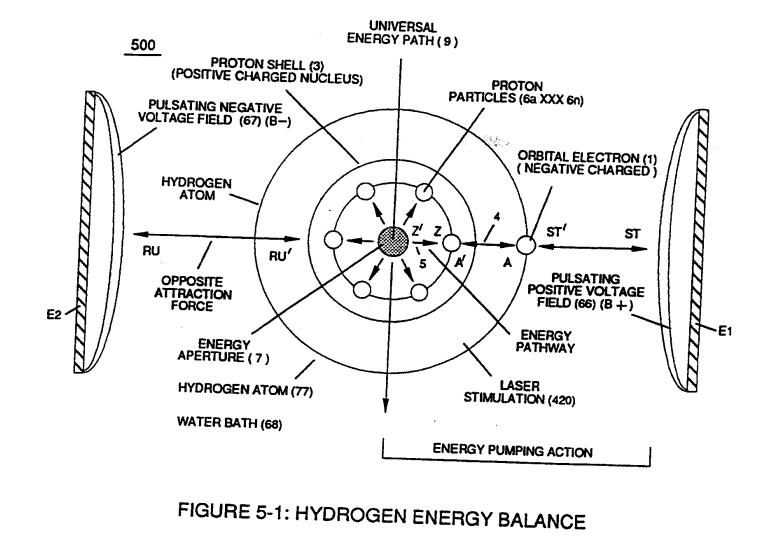
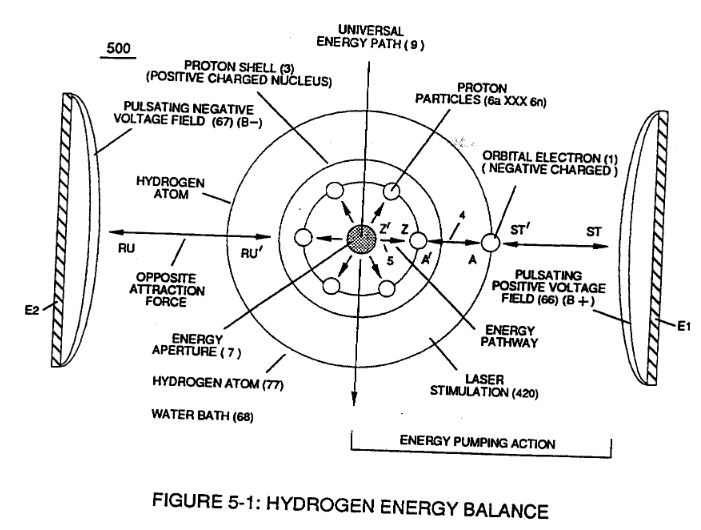
On the Easer page, (4) is the atomic electrical attraction force between the deflected orbital electron (1) and the proton (3). The run with deltas, (∆4a xxx ∆4n - ∆5a xxx ∆5n), is that force being attenuated step by step under atomic electrical stress (Aes), which slows the spin of the nucleus's gyroscopic regulator and opens the energy aperture (7). On other pages (4) is a different part.
How it is written
- (4) 4×
- (4 / 5) 2×
- (4a xxx 4n) 2×
- (4a) 1×
- (4n) 1×
4a xxx 4n is Meyer's shorthand for a run of the same thing: 4a is the first, 4n the last, and the x's stand for however many lie between. Every stage of the run is this one numeral.
Drawings 69
-
Copyright © 1983 by Stanley A Meyer Stanley A. Meyer Page16 of 28 · WFC 417 — WFC 417
-
Newton's and Coulomb's Laws of electrical-force is used to combine or join atoms together by way of Covalent Bonding (opposite electrical forces) to form liquids, solids, or air. · ATOMIC INTERACTION TO VOLTAGE STIMULATION
-
The Resonant Frequency (F) of an LC circuit in series is given by (Eq 4) · LC Circuit
-
Figure (3-5) · Acceleration Control Circuit (30)
-
Figure (3-5) · Acceleration Control Circuit (30)
-
where Resonant frequency (63) of LC circuit in series is given by (Eq 4) · Voltage Intensifier Circuit (60)
-
Carries this number · Laser Distributor
-
Carries this number · WFC 422DA - Illustrations
-
Carries this number · Voltage Intensifier Coil Assembly
-
Carries this number · Voltage Intensifier Coil Assembly
-
3-14 WFC Voltage Ignition Wire · Voltage Intensifier Coil Assembly
-
3-15 VIC Mount Plate · Voltage Intensifier Coil Assembly
-
3-16 Mount Bar · Voltage Intensifier Coil Assembly
-
Carries this number · Electronic Circuit Design
-
Carries this number · Electronic Circuit Design
-
Carries this number · Electronic Circuit Design
-
Carries this number · Electronic Circuit Design
-
Carries this number · Electronic Circuit Design
-
Carries this number · Electronic Circuit Design
-
Carries this number · Electronic Circuit Design
-
Carries this number · Electronic Circuit Design
-
Carries this number · Electronic Circuit Design
-
Carries this number · Electronic Circuit Design
-
Carries this number · Electronic Circuit Design
-
Carries this number · Electronic Circuit Design
-
Carries this number · Electronic Circuit Design
-
Carries this number · Electronic Circuit Design
-
Carries this number · Electronic Circuit Design
-
Carries this number · Electronic Circuit Design
-
Carries this number · Electronic Circuit Design
-
Carries this number · Electronic Circuit Design
-
Carries this number · Electronic Circuit Design
-
Carries this number · Electronic Circuit Design
-
Carries this number · Electronic Circuit Design
-
Carries this number · Electronic Circuit Design
-
Carries this number · Electronic Circuit Design
-
Carries this number · Electronic Circuit Design
-
Carries this number · Electronic Circuit Design
-
(220) of Figure (18) · Water Fuel Injector (Taper Resonant Cavity Chamber)
-
Carries this number · Water Fuel Injector (Taper Resonant Cavity Chamber)
-
Carries this number · Water Fuel Injector (Taper Resonant Cavity Chamber)
-
Carries this number · Water Fuel Injector (Taper Resonant Cavity Chamber)
-
The Following Page 1-7 was not available · Water Fuel Injector (Taper Resonant Cavity Chamber)
-
thereby, attenuating voltage amplitude (voltage intensity) beyond Secondary Coil (53) voltage levels (71), as illustrated in (220) of Figure (18). · Funneling Effect
-
2-6 Ceramic Insert · Water Fuel Injector Illustrations
-
(160) of Figure (3-26) · Water Fuel Injection System - Page 1
-
Figure (7-3) · Inductance (FL)
-
(820B) of Figure (8-6) · 8-7 - Application of Usage
-
(820C) of Figure (8-6) · 8-7 - Application of Usage
-
Carries this number · WFC 427 Illustrations
-
(210) of Figure (3-27) · Electrovalent Bonding
-
Figure (10-3 A/B) · Propagating Electrical Stress
-
(990) of Figure (10-3) · Propagating Electrical Stress
-
The programmable pulse-frequency (49a xxx 49n) of Figure (10-1) input is simply adjusted to tune-in to the dielectric property of the Water Molecule. · Propagating Electrical Stress
-
Carries this number · Voltage to Amp Differential Ratio
-
Figure (10-3A) · Voltage to Amp Differential Ratio
-
Carries this number · WFC 429 - Illustrations
-
Carries this number · WFC 429 - Illustrations
-
Carries this number · WFC 429 - Illustrations
-
Carries this number · Wobbling Effect
-
(1030) of figure (11-3) · Voltage Flexing Process
-
voltage intensifier circuit (990) of Figure (10-3) · VIC Switchover Circuit
-
(970) of Figure (10-1) · VIC Switchover Circuit
-
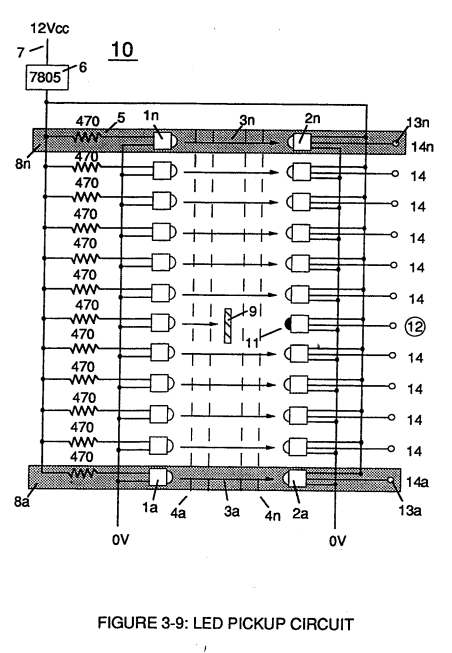
Led Pickup Circuit (10) of Figure (3-9) · Laser Accelerator Assembly
-
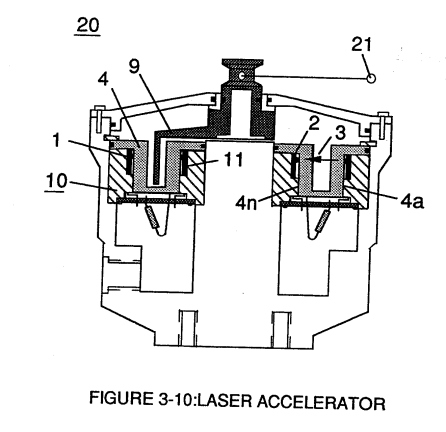
Light-gate (9) integrated with led pickup circuit (10) make up Laser Accelerator assembly (20), as shown in Figure (3-10). · Laser Accelerator Assembly
-
Laser Accelerator (20) of Figure (3-10) · Laser Distributor
-
The figure it sits on · WFC 422DA - Illustrations
-
The figure it sits on · WFC 422DA - Illustrations
-
The figure it sits on · Voltage Intensifier Coil Assembly
Where it is named · 10
Laser Accelerator Assembly 6×
-
Optical lens (4)
Optical lens (4) of Figure (310) redirects and focuses the transmitted light source (3) of Figure (3-9) (traveling infrared light waves) to the Optoschmitt (2) by passing the light source through a series of concentric lenses (4a xxx 4n) of Figure (3-10) which become progressively smaller from the outer peripheral lens surface (4a) to the inner lens surface (4n).
-
concentric lenses (4a xxx 4n)
Optical lens (4) of Figure (310) redirects and focuses the transmitted light source (3) of Figure (3-9) (traveling infrared light waves) to the Optoschmitt (2) by passing the light source through a series of concentric lenses (4a xxx 4n) of Figure (3-10) which become progressively smaller from the outer peripheral lens surface (4a) to the inner lens surface (4n).
-
outer peripheral lens surface (4a)
Optical lens (4) of Figure (310) redirects and focuses the transmitted light source (3) of Figure (3-9) (traveling infrared light waves) to the Optoschmitt (2) by passing the light source through a series of concentric lenses (4a xxx 4n) of Figure (3-10) which become progressively smaller from the outer peripheral lens surface (4a) to the inner lens surface (4n).
-
inner lens surface (4n)
Optical lens (4) of Figure (310) redirects and focuses the transmitted light source (3) of Figure (3-9) (traveling infrared light waves) to the Optoschmitt (2) by passing the light source through a series of concentric lenses (4a xxx 4n) of Figure (3-10) which become progressively smaller from the outer peripheral lens surface (4a) to the inner lens surface (4n).
-
spatially concentric lenses (4a xxx 4n)
The spatially concentric lenses (4a xxx 4n) of Figure (3-10) causes the beam angle of the light source to trigger the Optoschmitt (2) beyond the minimum irradiance that is needed to switch the Optoschmitt from quiescent state (high logic state I B+ ) to on-state (output changing to zero volts).
-
optical lens (4)
Together, the matched infrared devices (1)(2) with optical lens (4) forms optical circuit (8) of Figure (3-9).
Energy Pumping Action 3×
-
electrical tension (4)
... applying and superimposing electrical tension (4) onto opposite attraction force (AA') that exist between the negative charged orbital electron (1) and positive charged Proton (3)
-
electrical tension (4 / 5)
Interlocked together, the resultant "Electrical Tension of Forces" (4/5) is directly related to Voltage Intensity (ST - ST' / RU - RU' ) of applied voltage fields (66/67) which is variable as to applied voltage amplitude ( Vo xxx ). Increasing voltage amplitude ( xxx Vn) still further increases electrical tension (4 / 5 ) being applied to Energy Aperture (7) or vice versa.
-
Electrical Pressure (4 / 5)
This established increase or decrease in Electrical Pressure (4 / 5 ), now causes Energy Aperture (7) to either enlarge or become smaller as to applied voltage amplitude (VO xxx Vn), respectively.
A Technique Called "Easer" 1×
-
atomic electrical attraction force (4)
... whereby, atomic electrical attraction force (4) that exists between the deflected orbital negative charged electron -(1) and the pivotal positive charged Proton (3) is attenuated (∆4a xxx ∆4n - ∆5a xxx ∆5n)