(E14)
Stationary Voltage Fields
Also written Voltage Zones
Where it is first named
... whichever the case may be, the applied stationary voltage fields (952/E13 – 953/E14) or (954/E15 – 956/E16) alternately switch over periodically superimposes electrical stress forces (S-S' and R - R') onto the energy spectrum of the water molecule atom (s )(210) while physical flexing (951) of Figure (11-5) of the water molecule atom (s) occurs
How it is written
- (952/E13 – 953/E14) 1× with (952) Stationary Voltage Fields, (E13) Stationary Positive Voltage Plate, (953) Stationary Voltage Fields
- (E14/953) 1× with (953) Stationary Voltage Fields
- (E18/E14) 1× with (E18) Voltage Zones
Drawings 5
-
Carries this number · Dual Switchover Circuit
-
dual unipolar voltage pulse circuit (1010) of Figure (11-1) · Voltage Flexing Process
-
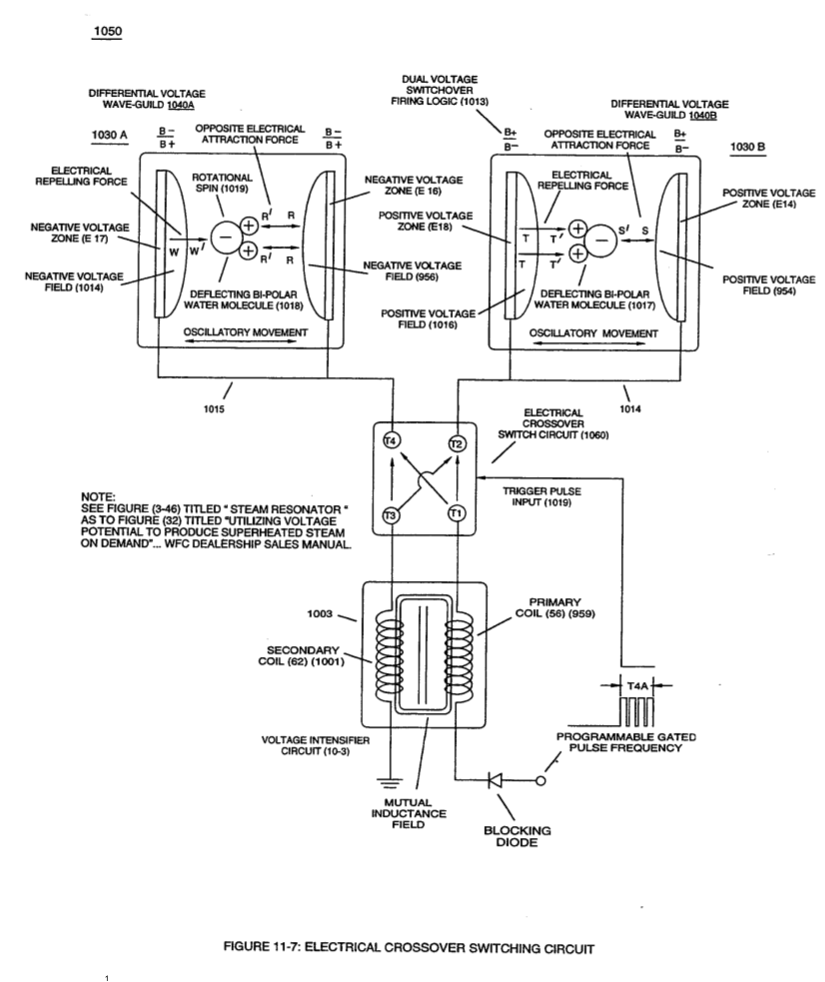
Differential Voltage Wave-Guild (1040B) · Electrical Crossover Switching Circuit
-
When (B+/B+ - B-/B- / 1030B) switch function is activated, switch terminals (T1/T2 - T3/T4) are closed. · Electrical Crossover Switching Circuit
-
Carries this number · WFC 430 - Illustrations
Where it is named · 3
Voltage Flexing Process 1×
-
stationary voltage fields (952/E13 – 953/E14)
... whichever the case may be, the applied stationary voltage fields (952/E13 – 953/E14) or (954/E15 – 956/E16) alternately switch over periodically superimposes electrical stress forces (S-S' and R - R') onto the energy spectrum of the water molecule atom (s )(210) while physical flexing (951) of Figure (11-5) of the water molecule atom (s) occurs
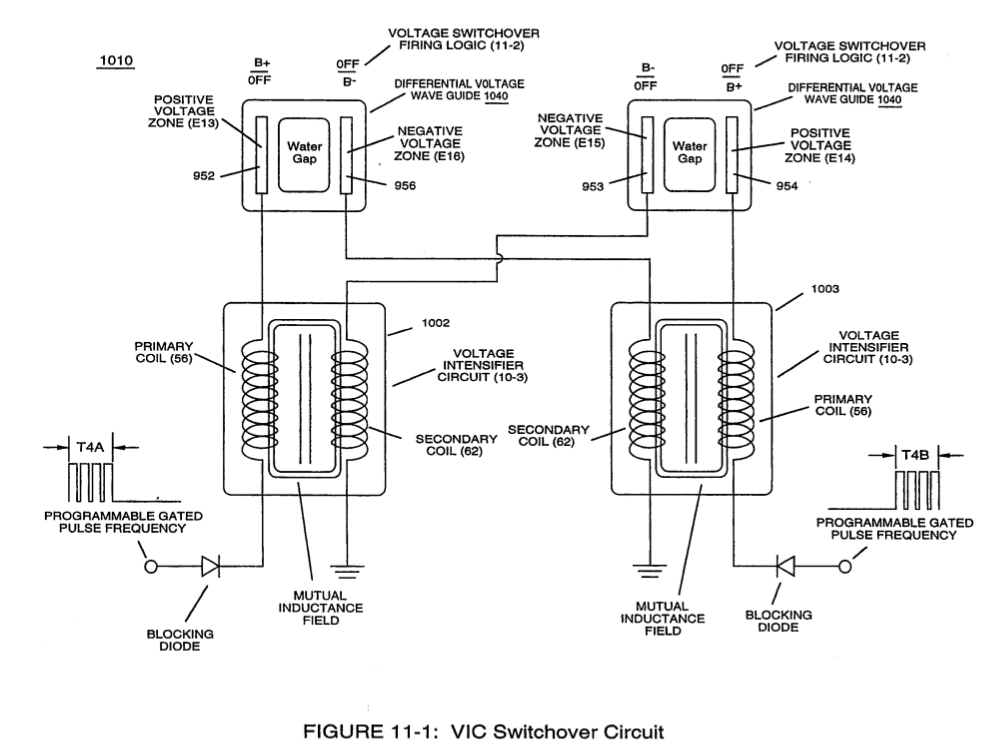
VIC Switchover Circuit 1×
-
Pairing together positive voltage zone (E13/952) with negative voltage zone (E16/956) and doing the same with voltage-surfaces (E14/953) to (E15/954) as so graphically shown in (1O1O) of Figure (11-1) and each having an longitudinal axis of identical length, now, individually forms what is called hereinafter a "Differential Voltage Wave-guide" (1040)