

article
“I’m at war. It’s not military. It’s economic.”
12 November 1984
Inventor faces uphill battle
COLUMBUS, Ohio (AP) — A suburban Grove City inventor trying to develop a device that substitutes hydrogen for oil to produce power describes his pursuit as a “war.”
Stanley A. Meyer has applied for 30 patents and is seeking $195 million to commercialize his water fuel cell.
“I’m at war,” said Meyer, 44. “It’s not military. It’s economic. Do you know that since 1965, the Arabs have bought up 65 percent of the (corporate) energy base of this nation?”
Meyer said the water fuel cell can quickly and cheaply remove large amounts of hydrogen from tap water, snow or rain for operation of cars, furnaces, spaceships or power plants.
He said his system works because he uses voltage to separate the hydrogen and oxygen atoms in water by polarity rather than by conventional electrolysis.
“Projects like this shouldn’t be dismissed, since there’s a lot of interest in hydrogen, and there’s been a number of demonstration projects going on around the country,” said Robert E. Schwerzel, a senior research scientist in photochemistry at Battelle Memorial Institute.
But Walter J. Leukart, president of Ampsco Corp., recalls Meyer was just as enthusiastic when building solar power systems in the mid-1970s. Leukart was among area businessmen who helped Meyer with the solar project, but in 1979, Leukart sued Meyer for failure to pay for $200,000 worth of parts.
Which paper printed what
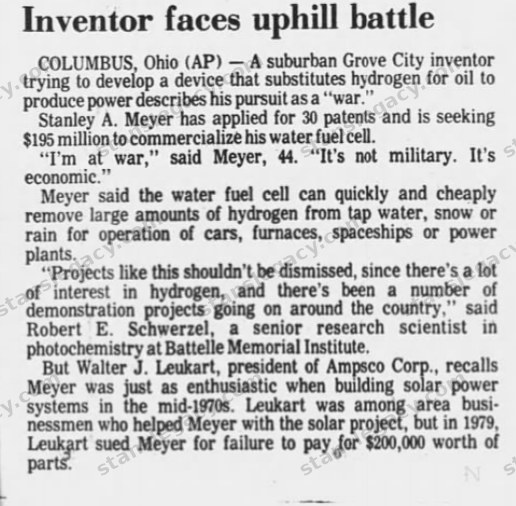
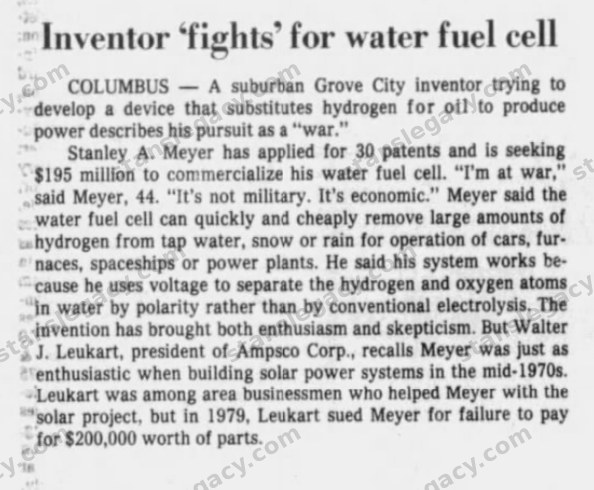
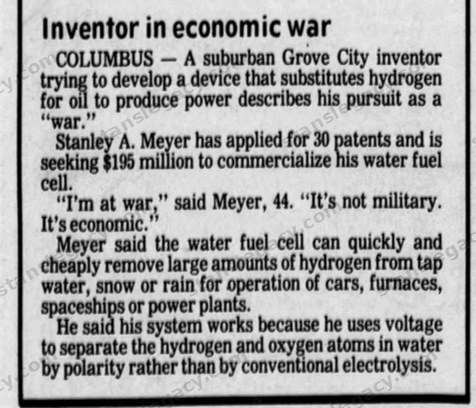
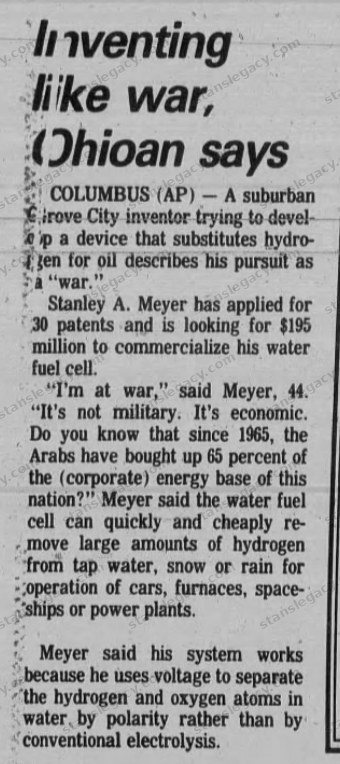
The Advocate of Newark carries the whole story, and is the only one of the four to name Schwerzel and Battelle. The Dayton Daily News carries everything except the Schwerzel paragraph, and runs the invention’s “enthusiasm and skepticism” as a sentence of its own. The Chillicothe Gazette stops after the electrolysis paragraph, so a Chillicothe reader got the claim and neither of the two outside voices. The Lima News, printing three weeks later, cuts the story at the same place as Chillicothe but keeps a sentence nobody else did: the line about the Arabs and sixty-five per cent of the corporate energy base. It is marked above where it falls.
Two things worth keeping
The lawsuit. Walter J. Leukart of Ampsco Corp. sued Meyer in 1979 for $200,000 of parts supplied to the solar silo. That is a named creditor, a figure and a year, and it is the earliest documented dispute in the holdings. It also explains something about the silo years that the Grove City Record’s progress reports do not: the parts were bought on other people’s money.
Battelle. Robert E. Schwerzel was a senior research scientist in photochemistry at Battelle Memorial Institute, twenty minutes from Grove City, and what he says is carefully not an endorsement: the field should not be dismissed. A reader skimming the page in 1984 would have taken it for one.
The original
Provenance
- Shelf
- Press coverage
- Page
- The Advocate, Newark, 12 November 1984; The Dayton Daily News, 12 November 1984; Chillicothe Gazette, 12 November 1984; The Lima News, 2 December 1984
- Rights
- The newspaper page is copyright its publisher and is reproduced here as a record of what was printed at the time; the archive claims nothing in it. The watermark marks the archive’s copy, not its ownership. The citation is what a reader needs to find the original.
- Caption
- Four printings: The Advocate of Newark (“Inventor faces uphill battle”), The Dayton Daily News (“Inventor ‘fights’ for water fuel cell”) and the Chillicothe Gazette (“Inventor in economic war”), all 12 November 1984, and The Lima News of 2 December 1984 (“Inventing like war, Ohioan says”).
- Citation
- Associated Press, November 1984, pp. The Advocate, Newark, 12 November 1984; The Dayton Daily News, 12 November 1984; Chillicothe Gazette, 12 November 1984; The Lima News, 2 December 1984
- Publication
- Associated Press
- Transcription
- Transcribed from four printings, photographed and supplied by the archive’s editor. Each paper cut the wire copy to a different length; the text below is the longest version, with the paragraphs that only one paper carried marked where they fall.