

article
No action now
9 July 1984
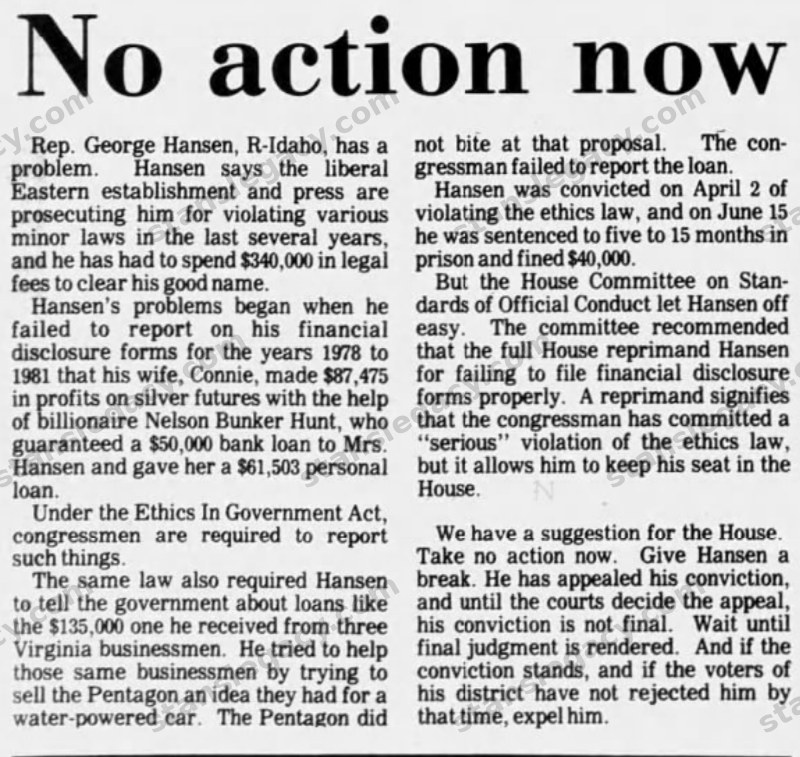
No action now
Rep. George Hansen, R-Idaho, has a problem. Hansen says the liberal Eastern establishment and press are prosecuting him for violating various minor laws in the last several years, and he has had to spend $340,000 in legal fees to clear his good name.
Hansen’s problems began when he failed to report on his financial disclosure forms for the years 1978 to 1981 that his wife, Connie, made $87,475 in profits on silver futures with the help of billionaire Nelson Bunker Hunt, who guaranteed a $50,000 bank loan to Mrs. Hansen and gave her a $61,503 personal loan.
Under the Ethics In Government Act, congressmen are required to report such things.
The same law also required Hansen to tell the government about loans like the $135,000 one he received from three Virginia businessmen. He tried to help those same businessmen by trying to sell the Pentagon an idea they had for a water-powered car. The Pentagon did not bite at that proposal. The congressman failed to report the loan.
Hansen was convicted on April 2 of violating the ethics law, and on June 15 he was sentenced to five to 15 months in prison and fined $40,000.
But the House Committee on Standards of Official Conduct let Hansen off easy. The committee recommended that the full House reprimand Hansen for failing to file financial disclosure forms properly. A reprimand signifies that the congressman has committed a “serious” violation of the ethics law, but it allows him to keep his seat in the House.
We have a suggestion for the House. Take no action now. Give Hansen a break. He has appealed his conviction, and until the courts decide the appeal, his conviction is not final. Wait until final judgment is rendered. And if the conviction stands, and if the voters of his district have not rejected him by that time, expel him.
The water-powered car was not Meyer’s
The editorial’s “water-powered car” is set out in the House Committee on Standards of Official Conduct’s own report, In the Matter of Representative George V. Hansen (H. Rept. 98-891, 19 July 1984), published in twelve scanned parts on the Ethics Committee’s website. The special counsel’s summary of the trial evidence names the three Virginia men and says what the car was:
- The lenders. Carl McAfee, a lawyer, and his business partner Arthur Odell Rodgers lent Hansen $25,000 and then $60,000 in July and August 1981, each time borrowing the same sum from Miners & Merchants Bank, where McAfee’s client John Meade was president. Meade lent Hansen a further $50,000 in November 1981. By Hansen’s account to the committee, McAfee was the southwest Virginia lawyer who had helped bring the U-2 pilot Francis Gary Powers home; Meade later pleaded guilty to misapplying bank funds.
- The car. “At around the same time of the loans, Messrs. McAfee, Rogers and Meade were involved in a plan to develop a hydrogen powered automobile.” They asked Hansen for a meeting with the Secretary of the Army, to “persuade him to send engineers to Australia and verify the workability of the car.” Hansen went to the meeting with them and left shortly after it began; the first $25,000 was deposited the day they came to Washington; and on 15 October 1981 Hansen telephoned Pentagon officials to urge an Army investigation of the car (the trial transcript at pages 559–567, 704, 722 and 854, as the special counsel cites it).
- The trip. The prosecution’s opening statement, printed in the report’s fifth part, gives the dates and the claim. The car “was invented by a man in Australia, and it ran on water, they said. You put water in the tank, and there’s a small nuclear reactor, they said, that will take hydrogen out of the water.” Hansen took Meade and McAfee to the Pentagon to meet the Secretary of the Army on 23 July 1981, the day the first $25,000 was deposited; on 14 August 1981, the day of the $60,000 loan, Meade and McAfee flew to Australia “to look at the hydrogen car, to negotiate buying the rights to sell this hydrogen car in America.”
- The two sides. The prosecutors told the jury it was “$135,000 from a bank swindler that he receives and then promotes a hoax at the Pentagon.” Hansen’s brief to the committee calls the bribery insinuation “ridiculous”: he had only arranged the meeting, at McAfee’s request, and his later calls were to complain about the treatment of federal employees contacted about the project. Hansen said the loans were for the Association of Concerned Taxpayers, the anti-IRS group he had founded.
So the car was a hydrogen car in Australia, not a water fuel cell in Ohio, and the trial testimony printed in the report’s seventh part names its inventor: Stephen Horvath.
- How it reached them. McAfee testified that Meade and “a man by the name of Fancher from Australia”, Wiley Fancher, an American formerly of Alabama, told him of “a gentleman in Australia who had developed a hydrogen-powered automobile” and was trying to fund it, and that “the Premier of Queensland” was keen to stir up interest in the United States. Meade testified that he first heard of it from “Wiley Fancher and Premier Peterson of Queensland”: Joh Bjelke-Petersen, who had put Horvath’s car on show in Brisbane in 1980. The launch is on film: Horvath’s hydrogen car in Brisbane, as 7NEWS retold it in 2020 from its own footage.
- The Army. McAfee went to the Redstone Arsenal at Huntsville, Alabama, carrying a letter from Australia’s nuclear authority that “gave some credibility” to the inventor, to find scientists who could go and test it; he was told that the conversion as proposed “would be highly dangerous.” The prosecutor put it to him that “the Army told you in July that the water car was not likely to be a success.” No scientists were sent.
- Horvath. McAfee went to Australia twice, the second time mainly on Meade’s property affairs there. “I met with the inventor … He never would show me the car.” Asked whether in October 1981 he was “discussing with Mr. Horvath the purchase of the rights for the hydrogen car,” he answered: “I had a meeting with Mr. Horvath in which he was trying to sell stock in a corporation.” His conclusion: “this fellow, really, in Australia, was not capable of doing what he said he could do.”
Horvath’s US patent, US 3,954,592 of 1976, assigned to the Beeston Company of Hong Kong, is in the archive as prior art. In New Zealand in 1989 Meyer named Horvath’s among “the two best patents ever issued in the electrolysis process”, and explained why his own cell was different: theirs needed distilled water and chemicals (New Zealand, 1989).
Nothing in the report mentions Meyer. In 1981 he was in Grove City, filing his first water-fuel application and being written up by the Grove City Record and UPI.
What happened next
The House reprimanded Hansen on 31 July 1984, by 354 votes to 52, and on 6 November he lost his seat to Richard Stallings by 170 votes. The Court of Appeals for the D.C. Circuit upheld the conviction in United States v. Hansen, 772 F.2d 940 (30 August 1985). He died in 2014.
The original
Provenance
- Shelf
- Press coverage
- Page
- 4
- Rights
- The newspaper page is copyright its publisher and is reproduced here as a record of what was printed at the time; the archive claims nothing in it. The watermark marks the archive's copy, not its ownership. The citation is what a reader needs to find the original.
- Caption
- The Marion Star, Marion, Ohio, Monday 9 July 1984, page 4, the editorial column.
- Citation
- The Marion Star, Marion, Ohio, July 1984, pp. 4
- Publication
- The Marion Star, Marion, Ohio
- Transcription
- A clipping from the printed page, supplied by the archive's editor; the committee report read from the scans on the House Ethics Committee's website, 1 October 2026.