

article
Parting the Water
Alex Heard · 1 October 1991
Parting the Water
Flights & Fancy. Alex Heard, Air & Space/Smithsonian, October/November 1991 (volume 6, number 4), page 32.
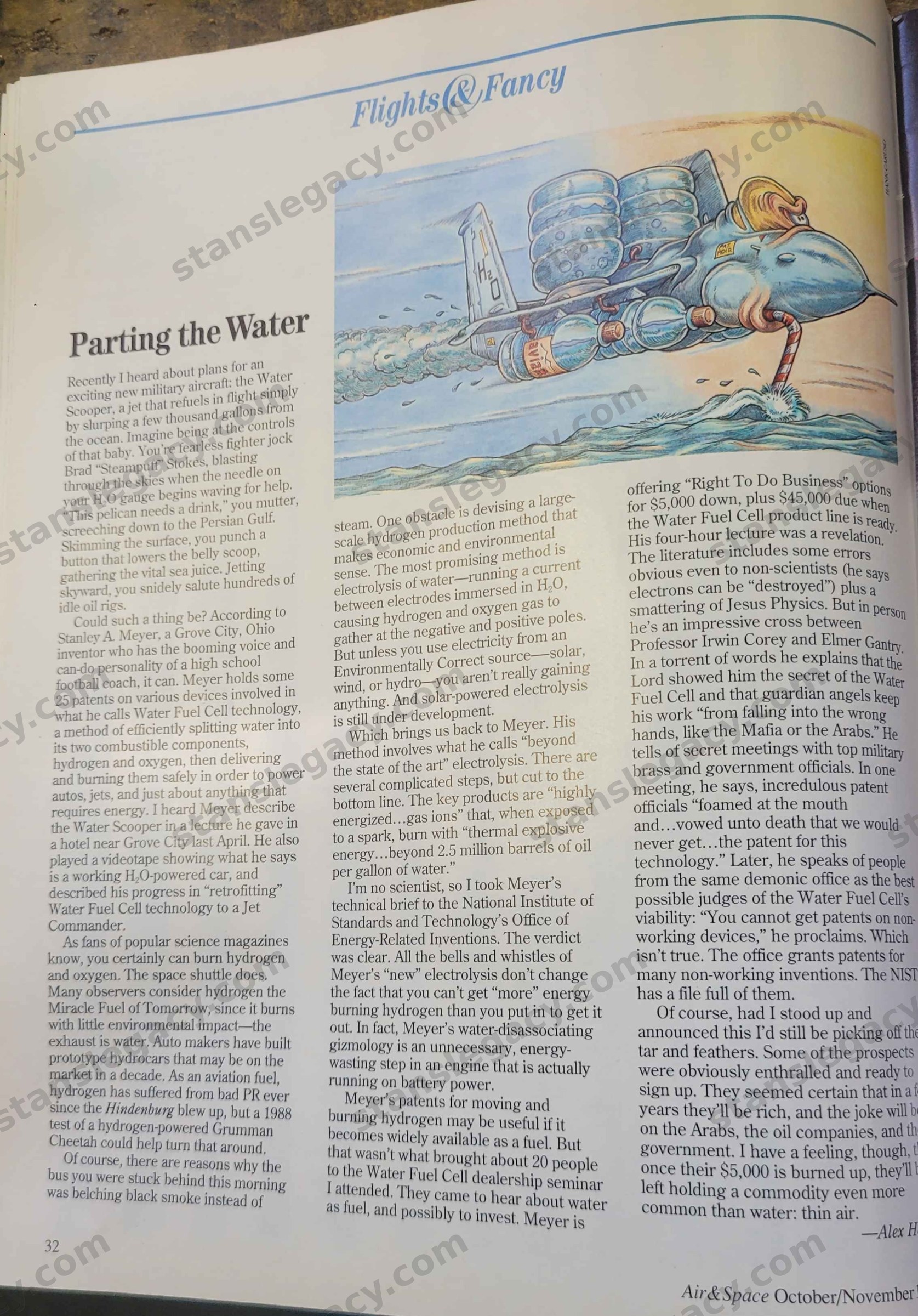
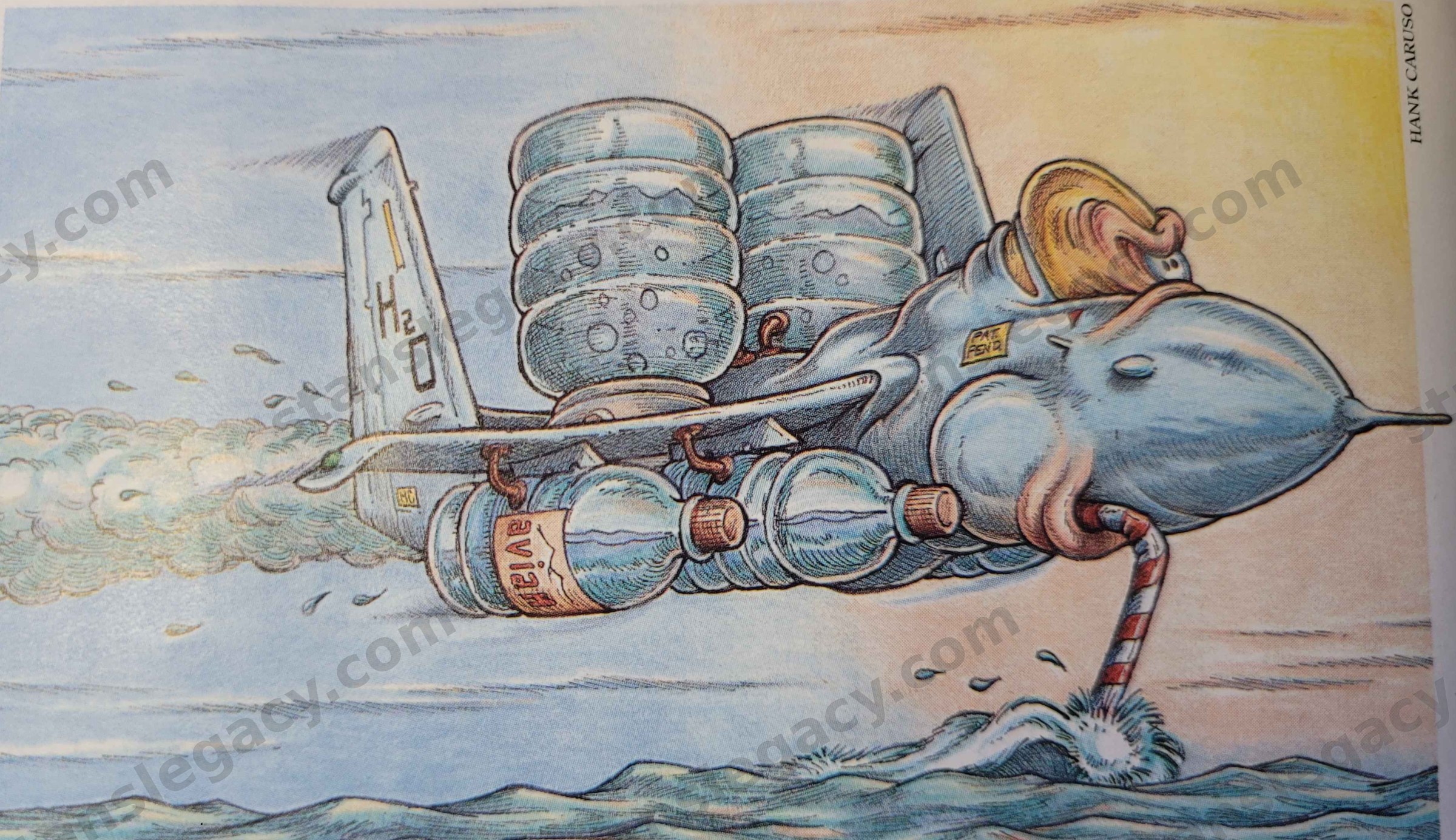
Recently I heard about plans for an exciting new military aircraft: the Water Scooper, a jet that refuels in flight simply by slurping a few thousand gallons from the ocean. Imagine being at the controls of that baby. You're fearless fighter jock Brad “Steampuff” Stokes, blasting through the skies when the needle on your H2O gauge begins waving for help. “This pelican needs a drink,” you mutter, screeching down to the Persian Gulf. Skimming the surface, you punch a button that lowers the belly scoop, gathering the vital sea juice. Jetting skyward, you snidely salute hundreds of idle oil rigs.
Could such a thing be? According to Stanley A. Meyer, a Grove City, Ohio inventor who has the booming voice and can-do personality of a high school football coach, it can. Meyer holds some 25 patents on various devices involved in what he calls Water Fuel Cell technology, a method of efficiently splitting water into its two combustible components, hydrogen and oxygen, then delivering and burning them safely in order to power autos, jets, and just about anything that requires energy. I heard Meyer describe the Water Scooper in a lecture he gave in a hotel near Grove City last April. He also played a videotape showing what he says is a working H2O-powered car, and described his progress in “retrofitting” Water Fuel Cell technology to a Jet Commander.
As fans of popular science magazines know, you certainly can burn hydrogen and oxygen. The space shuttle does. Many observers consider hydrogen the Miracle Fuel of Tomorrow, since it burns with little environmental impact—the exhaust is water. Auto makers have built prototype hydrocars that may be on the market in a decade. As an aviation fuel, hydrogen has suffered from bad PR ever since the Hindenburg blew up, but a 1988 test of a hydrogen-powered Grumman Cheetah could help turn that around.
Of course, there are reasons why the bus you were stuck behind this morning was belching black smoke instead of steam. One obstacle is devising a large-scale hydrogen production method that makes economic and environmental sense. The most promising method is electrolysis of water—running a current between electrodes immersed in H2O, causing hydrogen and oxygen gas to gather at the negative and positive poles. But unless you use electricity from an Environmentally Correct source—solar, wind, or hydro—you aren't really gaining anything. And solar-powered electrolysis is still under development.
Which brings us back to Meyer. His method involves what he calls “beyond the state of the art” electrolysis. There are several complicated steps, but cut to the bottom line. The key products are “highly energized…gas ions” that, when exposed to a spark, burn with “thermal explosive energy…beyond 2.5 million barrels of oil per gallon of water.”
I'm no scientist, so I took Meyer's technical brief to the National Institute of Standards and Technology's Office of Energy-Related Inventions. The verdict was clear. All the bells and whistles of Meyer's “new” electrolysis don't change the fact that you can't get “more” energy burning hydrogen than you put in to get it out. In fact, Meyer's water-disassociating gizmology is an unnecessary, energy-wasting step in an engine that is actually running on battery power.
Meyer's patents for moving and burning hydrogen may be useful if it becomes widely available as a fuel. But that wasn't what brought about 20 people to the Water Fuel Cell dealership seminar I attended. They came to hear about water as fuel, and possibly to invest. Meyer is offering “Right To Do Business” options for $5,000 down, plus $45,000 due when the Water Fuel Cell product line is ready. His four-hour lecture was a revelation. The literature includes some errors obvious even to non-scientists (he says electrons can be “destroyed”) plus a smattering of Jesus Physics. But in person he's an impressive cross between Professor Irwin Corey and Elmer Gantry. In a torrent of words he explains that the Lord showed him the secret of the Water Fuel Cell and that guardian angels keep his work “from falling into the wrong hands, like the Mafia or the Arabs.” He tells of secret meetings with top military brass and government officials. In one meeting, he says, incredulous patent officials “foamed at the mouth and…vowed unto death that we would never get…the patent for this technology.” Later, he speaks of people from the same demonic office as the best possible judges of the Water Fuel Cell's viability: “You cannot get patents on non-working devices,” he proclaims. Which isn't true. The office grants patents for many non-working inventions. The NIST has a file full of them.
Of course, had I stood up and announced this I'd still be picking off the tar and feathers. Some of the prospects were obviously enthralled and ready to sign up. They seemed certain that in a few years they'll be rich, and the joke will be on the Arabs, the oil companies, and the government. I have a feeling, though, that once their $5,000 is burned up, they'll be left holding a commodity even more common than water: thin air.
—Alex Heard
What it is
The same writer, the same seminar, a different magazine and two months earlier. Alex Heard went to a Water Fuel Cell dealership seminar “in a hotel near Grove City last April”, April 1991, and wrote it up twice: this one-page piece for the Smithsonian's aviation magazine, and the long feature “Put a Zokwendle in Your Tank!” in Spy that December. The Smithsonian version is the aviation angle. It opens on the “Water Scooper”, a jet that would refuel by scooping seawater, which Meyer described in the lecture. It also says he showed a videotape of the car and spoke of retrofitting the technology to a Jet Commander.
The two accounts mostly agree: the $5,000 down and $45,000 later, the four-hour lecture, the Lord and the guardian angels, the patent officials who “foamed at the mouth”, and the NIST Office of Energy-Related Inventions' verdict on the technical brief. They differ on the size of the audience: “about 20 people” here, “about 30” in Spy.
The Jet Commander is the nine-seat jet Meyer told the Colorado Springs conference in June 1991 he was retrofitting, to fly nonstop round the equator and then from pole to pole. This puts the claim in his lectures two months earlier, in April 1991, and comes from someone who was not one of his supporters.
The illustration
Hank Caruso's drawing runs across the top of the page: the Water Scooper as a fighter jet built of water bottles, with H2O on its tail, a “PAT. PEND.” sticker on its nose and a striped drinking straw dipped in the sea. The credit, “HANK CARUSO”, is printed up its right-hand edge.
Checked against the print
This entry was first put together from the snippets Google Books shows of the volume, and has now been read against the printed page. The words were right. Google's “avia steam” is “steam”: the “avia” is the label on a bottle in the drawing, which its text-reading picked up with the column. The rest was typography and layout, now as printed: the ellipses closed up, H2O with its subscript, Hindenburg in italics, and the paragraphs broken where the magazine breaks them.
The original
Provenance
- Shelf
- Press coverage
- Page
- 32
- Issue
- October/November 1991 (volume 6, number 4), in the department "Flights & Fancy"
- Byline
- Alex Heard
- Patent office record
- google.com →
- Rights
- Air & Space/Smithsonian is copyright the Smithsonian Institution; the illustration is Hank Caruso's. The page is reproduced as a record of what was printed about Meyer, and the archive claims nothing in it. The watermark marks the archive's copy, not its ownership.
- Caption
- Air & Space/Smithsonian, October/November 1991, page 32. First, the whole page, photographed from the archive's copy of the issue; second, Hank Caruso's illustration of the Water Scooper, which runs across its top.
- Citation
- Air & Space/Smithsonian, Washington, October/November 1991 (volume 6, number 4), in the department "Flights & Fancy", October 1991, pp. 32, by Alex Heard
- Publication
- Air & Space/Smithsonian, Washington
- Transcription
- The printed page, in the archive's copy of the issue, bought in October 2026. The text was first assembled from Google Books snippets on 2 October 2026 and has been checked against the print; the photograph clips the last letters of a few lines at the right edge of the page, and those words are as Google gives them.