

article
Poole firm in race to prove new cell
Chris Adamson · 12 July 1989
Poole firm in race to prove new cell
By Chris Adamson
AN AMERICAN invention currently being marketed in this country by a Hamworthy concern, could revolutionise the motor industry inside a decade.
The only problem is that the firm are having major difficulties convincing backers that a water powered fuel cell is a viable proposition, which, if proven, could shake the oil industry to its foundations.
Based on the principal that water is made up of hydrogen and oxygen, the new unit (which would replace the fuel tank of an ordinary car and run on any kind of water from snow to sea water) is said to utilise sophisticated electronics to separate the two, using just the power of an ordinary 12 volt battery.
Hydrogen, available on demand rather than being stored, is then forced into an ordinary cylinder head and burnt in the combustion chamber in place of petrol, providing automotive power as well as being pollution free.
Seemingly a simple operation, Anthony Harvard-Bailey, director of F & S Marketing of Fitzworth Avenue, (who are trying to establish the project in this country), says the reason why no one has achieved this before is because of the complicated electronics needed to separate off the hydrogen in small quantities at a time.
However he is convinced that the water powered car is feasible and that it could very soon be on the road.
To prove the theory, he and his partner, electronics engineer Donald Calqhoun-Walton, are to purchase two hand built sports cars from GTD Developments of Poole and convert one to water and the other to electromotive power.
Conversion kit
Mr Harvard-Bailey, a mechanical engineer who has been researching alternative energy sources for the last six years, says that a conversion kit for any vehicle could be available by 1990 at the cost of less than £2,000.
In addition to developing the car, F & S Marketing are aiming to find up to 100 south coast outlets for the conversion units within the next 12 years.
Asked why the oil giants, the ones most under threat, hadn’t made bids to buy-out the American inventor Mr Stan Meyor, he said that they had made approaches, but that Mr Meyor had gone to the US goverment for patent protection on the understanding that American space and military agencies would get the chance to utilise his fuel cell.
Mr Meyor has already reportedly run a water powered dune-buggy in America and is now planning a cross-country run using the new technology.
As well as the business potential of such a project, Mr Harvard-Bailey and his partner are keen to push the environmentally- friendly aspects of the project.
Not only does it have motor industry applications, the basic system, he adds, can be scaled-up to the size of conventional power stations, so replacing both the traditional fossil fuels with their inherent environmental impact, and the dangers of nuclear fuel.
The failure to generate any interest at their launch from the financial institutions is a sign of the great scepticism with which the water fuel cell is currently being greeted. . . . Time will tell if Poole is on the brink of being at the centre of a new fuel revolution.
About this piece
This is the beginning of the Bournemouth story the archive already held from the other end. In March 1990 the same paper found "Donald P. Walton" of Charminster and "Mr. A. Harvard-Bailey, of Hamworthy" planning an assembly plant, with the partnership already dissolved; the note on that page said the archive had nothing else on either man. Here they are eight months earlier, trading as F & S Marketing of Fitzworth Avenue, Hamworthy, with a named car supplier and a price. "Calqhoun-Walton" is how the paper printed Walton's name this time, and "Meyor" is its spelling of Meyer's.
Two claims are worth keeping apart from the record. The kit "by 1990" for under £2,000 did not appear. And the story that Meyer went to the US government "on the understanding that American space and military agencies would get the chance to utilise his fuel cell" is the partners' account, not Meyer's; what the patents themselves say is in the Voltage Intensifier Circuit and the patent pages. The dune buggy was real.
The original
Provenance
- Shelf
- Press coverage
- Page
- 8
- Byline
- Chris Adamson
- Rights
- The newspaper page is copyright its publisher and is reproduced here as a record of what was printed at the time; the archive claims nothing in it. The watermark marks the archive’s copy, not its ownership. The citation is what a reader needs to find the original.
- Caption
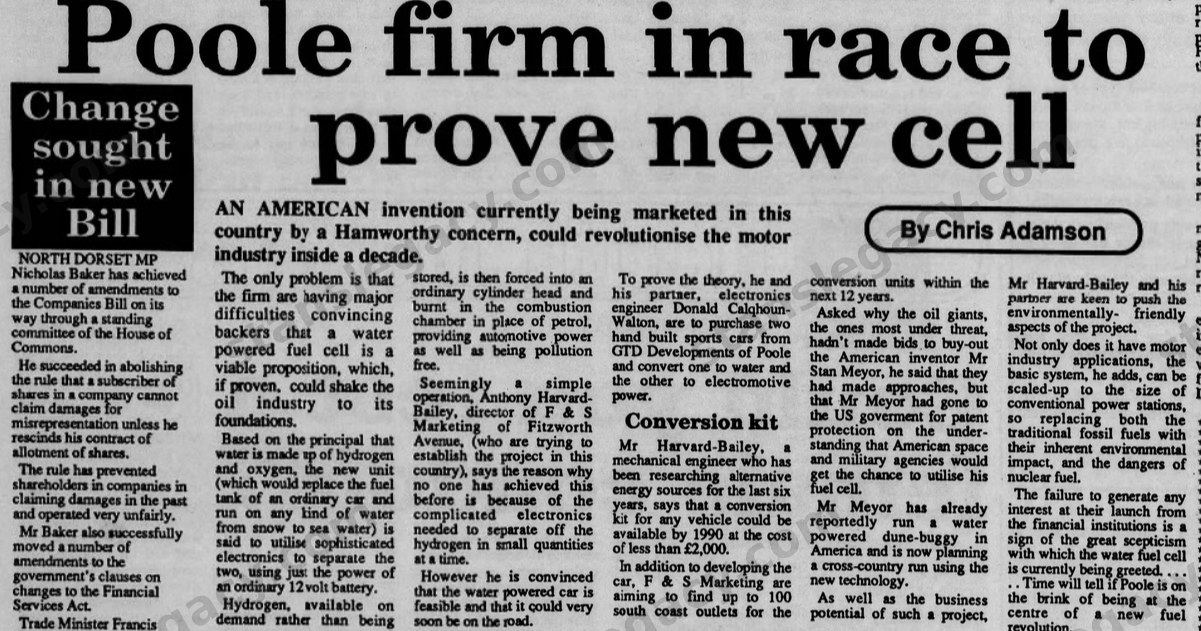
- Evening Echo, Bournemouth, Wednesday 12 July 1989, page 8. The column on the left is a different story.
- Citation
- Evening Echo, Bournemouth, July 1989, pp. 8, by Chris Adamson
- Publication
- Evening Echo, Bournemouth
- Transcription
- A clipping from the printed page, supplied by the archive’s editor.