

article
Mighty small
Peter Tate, in the Greenwatch column · 12 March 1990
Mighty small
“For by a machine three fingers high and wide and of less, a man could free himself and his friends of all danger of prison and arise and descend. Also a machine can easily be made by which one man can draw a thousand to him by violence against their wills, and attract other things in like manner…”
— Roger Bacon, Alchemist, (?1214-1292)
“Imagine a device the size of a matchbox that will power your refrigerator…or a unit about four inches square and a foot long, with no moving parts, that will provide all the electrical energy needed to service a four-bedroom house. From a little-known side of physics has come a new science that gives access to the ability to neutralise viruses and toxic and nuclear wastes…and the possible elimination of malignant diseases…A working model has been perfected that takes its energy from the myriads of charged particles in the vacuum that surrounds us…”
— Extract from “Spartec - The New Technology”, published in America some time during the 1980s
COMPARE THE TWO quotations above and it is clear that, on a trail that has led from ancient Babylon through the Middle Ages to the 1990s, alchemy is alive and well.
Today, rather than seeking the touchstone that will turn base metal into gold, certain physicists and technicians are ploughing lonely furrows towards workable systems of alternative energy.
They talk seriously and learnedly of science-fiction ideas like anti-matter, magnetic propulsion, gravity neutralisation and molecular disintegration.
And one of them lives in Chatsworth Road, Charminster, Bournemouth.
Electronics engineer Donald P. Walton has been working closely with the American inventor of a fuel cell that will enable cars to run on water instead of petrol. The technology can be extended to heat homes, to power ships and aircraft and energise industrial and agricultural processes.
The method, in simple terms, is this: water molecules are separated into their oxygen and hydrogen components by an electric current. The liquid becomes ionised gas. It goes through a “hydrogen fracturing process” which destabilises the gas atoms and releases their energy without explosion or radiation. By gas injection, the energy drives the car.
With partner Mr. A. Harvard-Bailey, of Hamworthy, Mr. Walton was planning to start an assembly plant and to market the water fuel cell devised by Mr. Stanley Meyer, of Grove City, Ohio.
There have been long delays while the necessary patents were secured in America and the latest word is that it will be another two years before the product is ready to be developed on a massive scale — “perhaps the oil companies are not too happy with it,” observes Mr. Walton.
In the meantime, it has been the partnership which has dissolved and Mr. Walton is seeking sponsorship for his own work on alternative energy sources after 30 years of self-funding. He is concentrating on equipment that can be built at relatively low cost in a laboratory environment and demonstrated to be commercially viable.
“When major concerns are involved in research, the private individual seldom gets the benefit,” Mr. Walton told me. “Any wind energy created, for instance, would go to the National Grid and the prices we pay for power would keep going up.”
“My own idea would be to provide means to make each home self-sufficient in power. Then each person could enjoy the fact that he was better off.”
This objective might not endear the idea to commercial concerns, who want to know what they will get out before they put in. But private investors might care to examine Mr. Walton’s credentials.
The English end of the business
Two names the archive did not hold: Donald P. Walton, an electronics engineer of Chatsworth Road, Charminster, and A. Harvard-Bailey of Hamworthy, across the water in Poole. Between them they were setting up a plant to assemble and market Meyer’s cell in Britain, and by the time this column was printed the partnership had already broken up.
This is five years before Admiral Griffin’s campaign reached the national press, and it is a different English connection entirely: not a retired Controller of the Navy raising money for a Thames experiment, but two men in Dorset trying to build the thing. The archive has nothing else on either of them.
Walton reappears in the same column in June 1991 and July 1991, the second time to say publicly that he is no longer connected with Meyer’s invention in any way.
The original
Provenance
- Shelf
- Press coverage
- Page
- 14
- Byline
- Peter Tate, in the Greenwatch column
- Rights
- The newspaper page is copyright its publisher and is reproduced here as a record of what was printed at the time; the archive claims nothing in it. The watermark marks the archive’s copy, not its ownership. The citation is what a reader needs to find the original.
- Caption
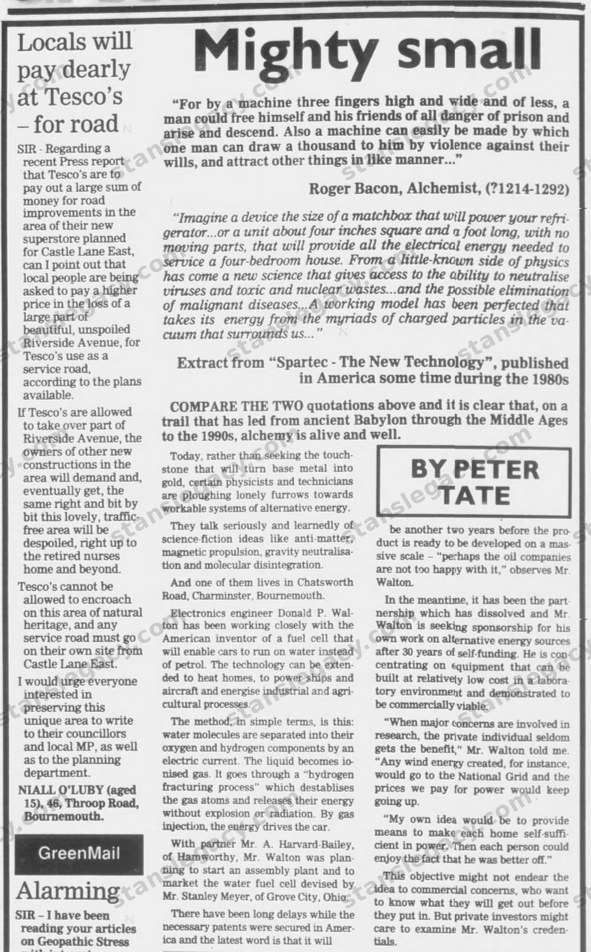
- Evening Echo, Bournemouth, Monday 12 March 1990, page 14.
- Citation
- Evening Echo, Bournemouth, March 1990, pp. 14, by Peter Tate, in the Greenwatch column
- Publication
- Evening Echo, Bournemouth
- Transcription
- A clipping from the printed page, photographed and supplied by the archive’s editor. The letters column to the left of it belongs to the page, not to this piece, and is not transcribed.