

article
A penny a mile – too true to be good?
Peter Tate, in the Greenwatch column · 24 June 1991
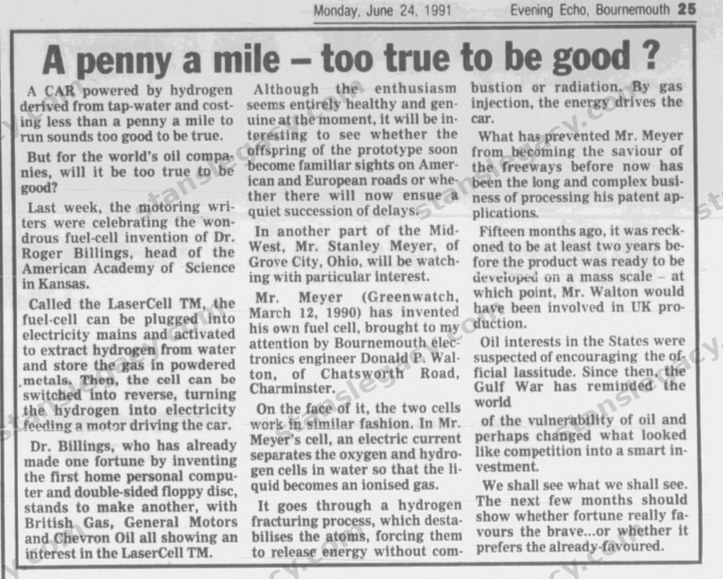
A penny a mile – too true to be good?
A CAR powered by hydrogen derived from tap-water and costing less than a penny a mile to run sounds too good to be true.
But for the world’s oil companies, will it be too true to be good?
Last week, the motoring writers were celebrating the wondrous fuel-cell invention of Dr. Roger Billings, head of the American Academy of Science in Kansas.
Called the LaserCell TM, the fuel-cell can be plugged into electricity mains and activated to extract hydrogen from water and store the gas in powdered metals. Then, the cell can be switched into reverse, turning the hydrogen into electricity feeding a motor driving the car.
Dr. Billings, who has already made one fortune by inventing the first home personal computer and double-sided floppy disc, stands to make another, with British Gas, General Motors and Chevron Oil all showing an interest in the LaserCell TM.
Although the enthusiasm seems entirely healthy and genuine at the moment, it will be interesting to see whether the offspring of the prototype soon become familiar sights on American and European roads or whether there will now ensue a quiet succession of delays.
In another part of the Mid-West, Mr. Stanley Meyer, of Grove City, Ohio, will be watching with particular interest.
Mr. Meyer (Greenwatch, March 12, 1990) has invented his own fuel cell, brought to my attention by Bournemouth electronics engineer Donald P. Walton, of Chatsworth Road, Charminster.
On the face of it, the two cells work in similar fashion. In Mr. Meyer’s cell, an electric current separates the oxygen and hydrogen cells in water so that the liquid becomes an ionised gas.
It goes through a hydrogen fracturing process, which destabilises the atoms, forcing them to release energy without combustion or radiation. By gas injection, the energy drives the car.
What has prevented Mr. Meyer from becoming the saviour of the freeways before now has been the long and complex business of processing his patent applications.
Fifteen months ago, it was reckoned to be at least two years before the product was ready to be developed on a mass scale — at which point, Mr. Walton would have been involved in UK production.
Oil interests in the States were suspected of encouraging the official lassitude. Since then, the Gulf War has reminded the world of the vulnerability of oil and perhaps changed what looked like competition into a smart investment.
We shall see what we shall see. The next few months should show whether fortune really favours the brave…or whether it prefers the already-favoured.
The original
Provenance
- Shelf
- Press coverage
- Page
- 25
- Byline
- Peter Tate, in the Greenwatch column
- Rights
- The newspaper page is copyright its publisher and is reproduced here as a record of what was printed at the time; the archive claims nothing in it. The watermark marks the archive’s copy, not its ownership. The citation is what a reader needs to find the original.
- Caption
- Evening Echo, Bournemouth, Monday 24 June 1991, page 25.
- Citation
- Evening Echo, Bournemouth, June 1991, pp. 25, by Peter Tate, in the Greenwatch column
- Publication
- Evening Echo, Bournemouth
- Transcription
- A clipping from the printed page, photographed and supplied by the archive’s editor.