

article
A new energy source – on tap
Nigel Galloway · 3 January 1995
A new energy source – on tap
Report: NIGEL GALLOWAY
CAST your mind ahead to the day when the oil and coal has run out. Will the 21st century be dominated by nuclear power, or is there a safe, cheap and pollution-free alternative?
A Sussex man believes there is and so far has put £50,000 of his own money into a campaign to persuade the Government that a miracle new source of energy has already been discovered.
In fact, most of the world is covered by it. Every home already has it. You only have to turn on the tap.
It is called water.
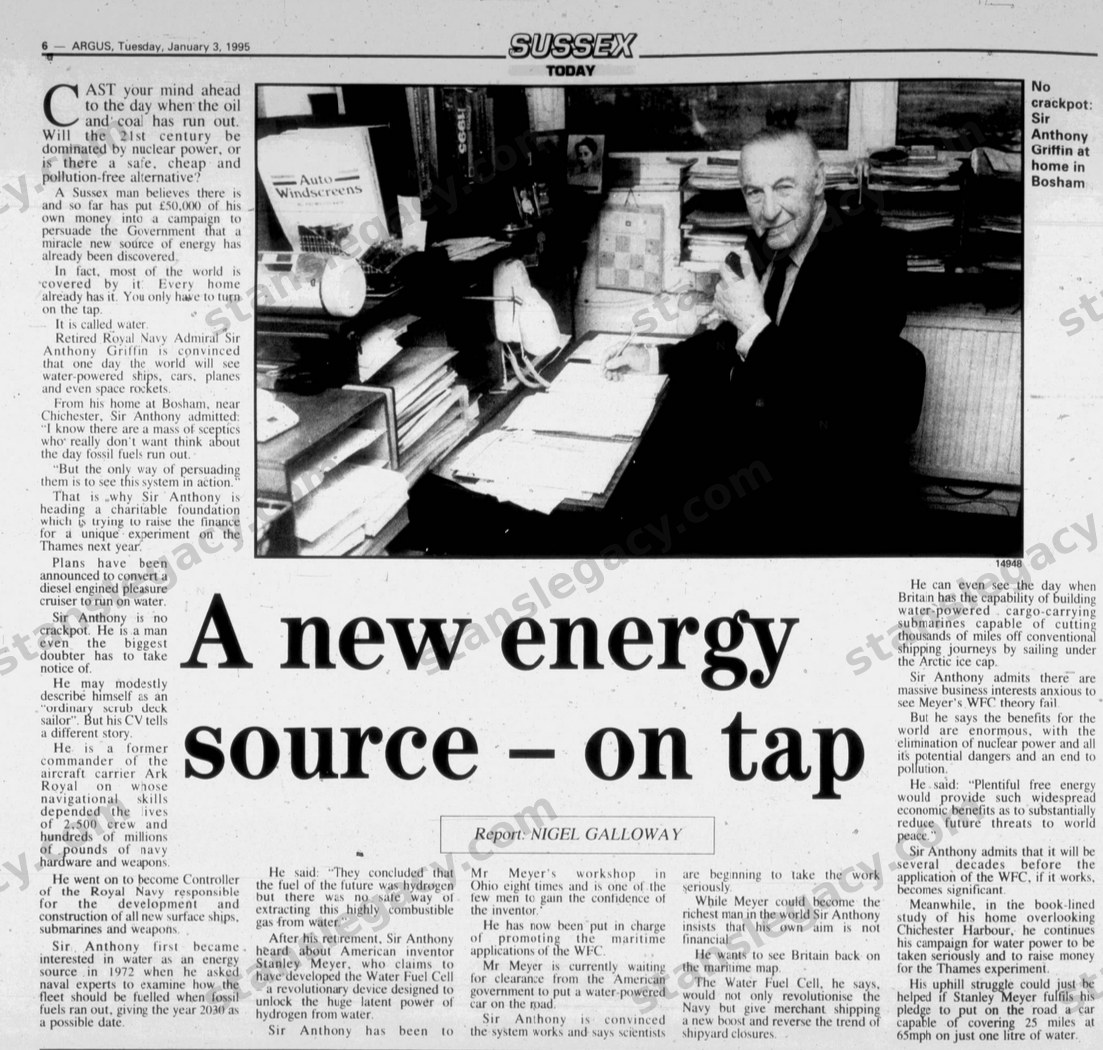
Retired Royal Navy Admiral Sir Anthony Griffin is convinced that one day the world will see water-powered ships, cars, planes and even space rockets.
From his home at Bosham, near Chichester, Sir Anthony admitted: “I know there are a mass of sceptics who really don’t want think about the day fossil fuels run out.
“But the only way of persuading them is to see this system in action.”
That is why Sir Anthony is heading a charitable foundation which is trying to raise the finance for a unique experiment on the Thames next year.
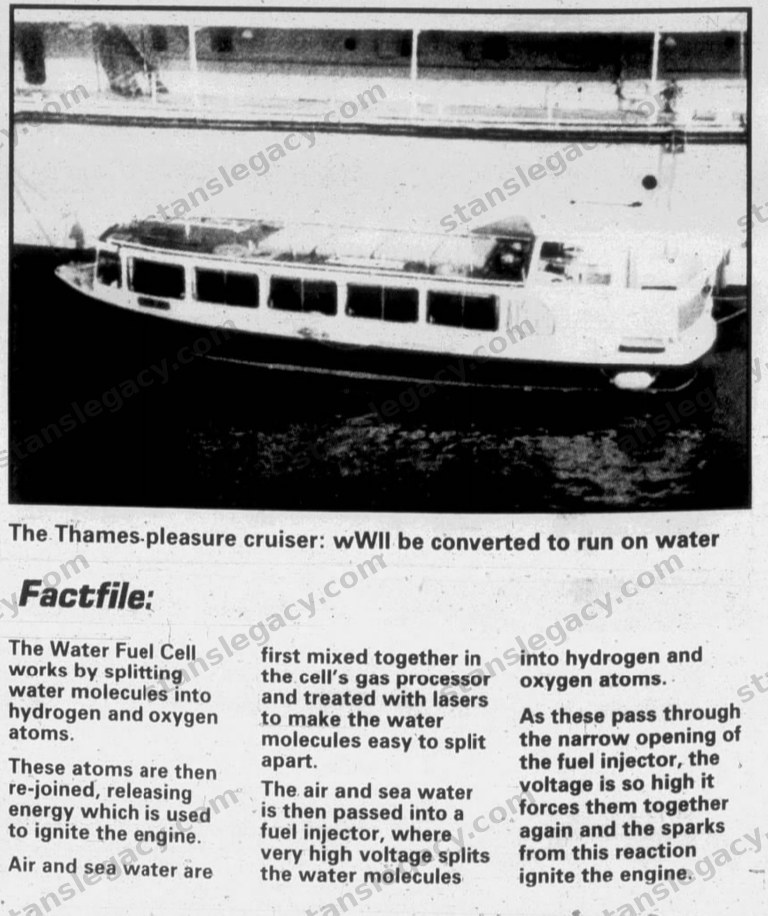
Plans have been announced to convert a diesel engined pleasure cruiser to run on water.
Sir Anthony is no crackpot. He is a man even the biggest doubter has to take notice of.
He may modestly describe himself as an “ordinary scrub deck sailor”. But his CV tells a different story.
He is a former commander of the aircraft carrier Ark Royal on whose navigational skills depended the lives of 2,500 crew and hundreds of millions of pounds of navy hardware and weapons.
He went on to become Controller of the Royal Navy responsible for the development and construction of all new surface ships, submarines and weapons.
Sir Anthony first became interested in water as an energy source in 1972 when he asked naval experts to examine how the fleet should be fuelled when fossil fuels ran out, giving the year 2030 as a possible date.
He said: “They concluded that the fuel of the future was hydrogen but there was no safe way of extracting this highly combustible gas from water.”
After his retirement, Sir Anthony heard about American inventor Stanley Meyer, who claims to have developed the Water Fuel Cell – a revolutionary device designed to unlock the huge latent power of hydrogen from water.
Sir Anthony has been to Mr Meyer’s workshop in Ohio eight times and is one of the few men to gain the confidence of the inventor.
He has now been put in charge of promoting the maritime applications of the WFC.
Mr Meyer is currently waiting for clearance from the American government to put a water-powered car on the road.
Sir Anthony is convinced the system works and says scientists are beginning to take the work seriously.
While Meyer could become the richest man in the world Sir Anthony insists that his own aim is not financial.
He wants to see Britain back on the maritime map.
The Water Fuel Cell, he says, would not only revolutionise the Navy but give merchant shipping a new boost and reverse the trend of shipyard closures.
He can even see the day when Britain has the capability of building water-powered cargo-carrying submarines capable of cutting thousands of miles off conventional shipping journeys by sailing under the Arctic ice cap.
Sir Anthony admits there are massive business interests anxious to see Meyer’s WFC theory fail.
But he says the benefits for the world are enormous, with the elimination of nuclear power and all its potential dangers and an end to pollution.
He said: “Plentiful free energy would provide such widespread economic benefits as to substantially reduce future threats to world peace.”
Sir Anthony admits that it will be several decades before the application of the WFC, if it works, becomes significant.
Meanwhile, in the book-lined study of his home overlooking Chichester Harbour, he continues his campaign for water power to be taken seriously and to raise money for the Thames experiment.
His uphill struggle could just be helped if Stanley Meyer fulfils his pledge to put on the road a car capable of covering 25 miles at 65mph on just one litre of water.
The panel on the same page
The photograph beside the report is captioned “The Thames pleasure cruiser: wWll be converted to run on water” — the paper’s own slip, kept as printed. Beside it is a box headed Factfile:
The Water Fuel Cell works by splitting water molecules into hydrogen and oxygen atoms.
These atoms are then re-joined, releasing energy which is used to ignite the engine.
Air and sea water are first mixed together in the cell’s gas processor and treated with lasers to make the water molecules easy to split apart.
The air and sea water is then passed into a fuel injector, where very high voltage splits the water molecules into hydrogen and oxygen atoms.
As these pass through the narrow opening of the fuel injector, the voltage is so high it forces them together again and the sparks from this reaction ignite the engine.
The Factfile is the newspaper’s, not Meyer’s, and it does not describe his device. Splitting water and then re-joining the atoms to release energy is a closed circle that yields nothing, which is not what any of Meyer’s own writing claims; and the voltage at the injector nozzle is, in his account, what ignites the gas, not what forces the atoms back together. It is printed here because it is what a hundred thousand Sussex readers were told on 3 January 1995.
What the report is good for
Eight visits. “Sir Anthony has been to Mr Meyer’s workshop in Ohio eight times.” That is the only count the archive holds of how often Griffin crossed the Atlantic to Grove City.
1972. Griffin’s interest starts with a naval study he commissioned as Controller, which concluded that hydrogen was the fuel of the future and that there was no safe way to get it out of water. He met Meyer looking for the missing half of an answer he already had.
£50,000 of his own money, and a charitable foundation raising more for a Thames conversion planned for 1996. The archive has no record that the Thames experiment ever happened.
The pledge. Twenty-five miles at 65mph on one litre of water. That is a specific, falsifiable claim with a date on it, and it is the kind of number the archive keeps.
The original
Provenance
- Shelf
- Press coverage
- Page
- 6
- Byline
- Nigel Galloway
- Rights
- The newspaper page is copyright its publisher and is reproduced here as a record of what was printed at the time; the archive claims nothing in it. The watermark marks the archive’s copy, not its ownership. The citation is what a reader needs to find the original.
- Caption
- The Argus, Brighton, Tuesday 3 January 1995, page 6, in the Sussex Today section. The second image is the photograph of the Thames pleasure cruiser and the “Factfile” panel from the same page.
- Citation
- The Argus, Brighton, January 1995, pp. 6, by Nigel Galloway
- Publication
- The Argus, Brighton
- Transcription
- Two clippings from the printed page, photographed and supplied by the archive’s editor.