

patent · US2969918A
Solar heating control system
31 January 1961
Text
Drawings
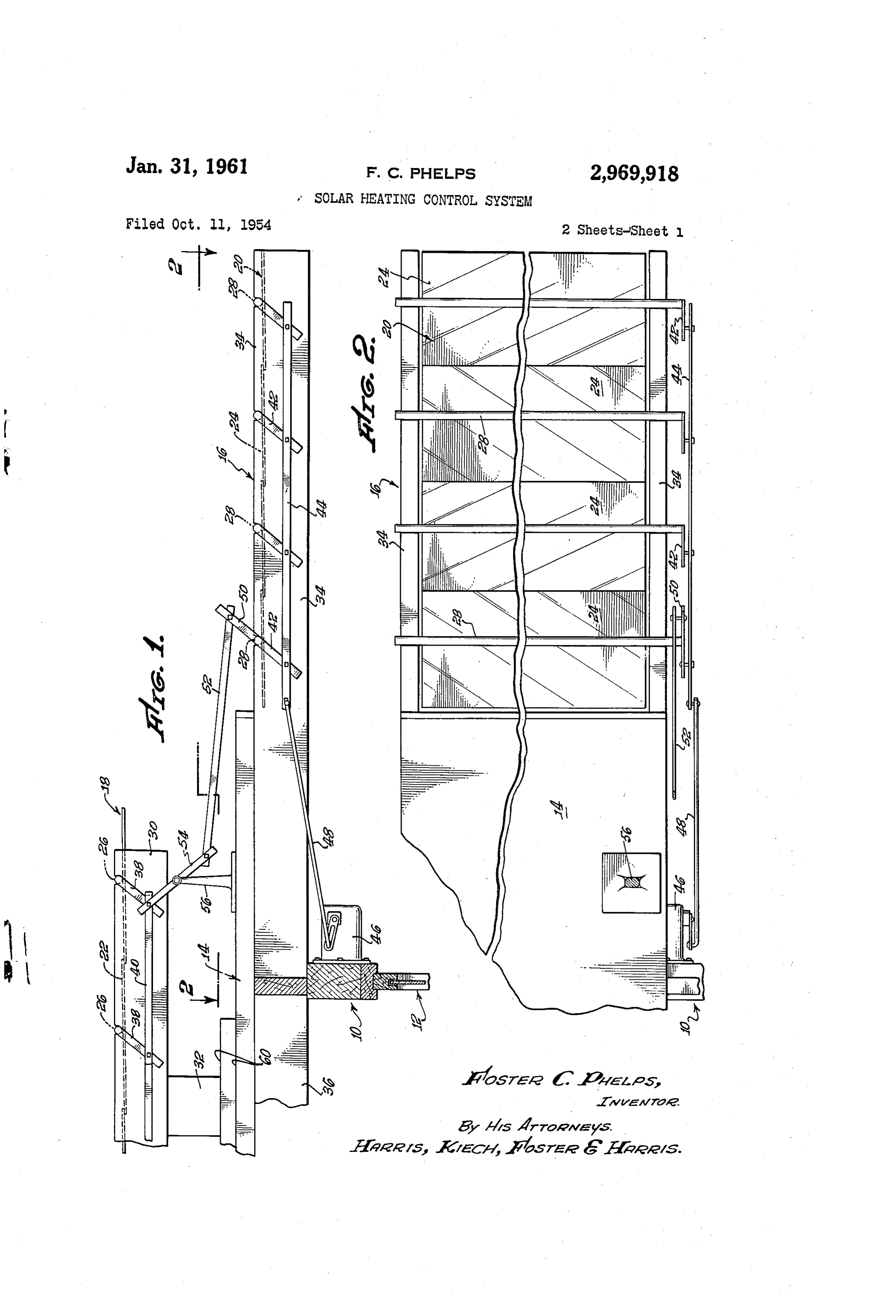
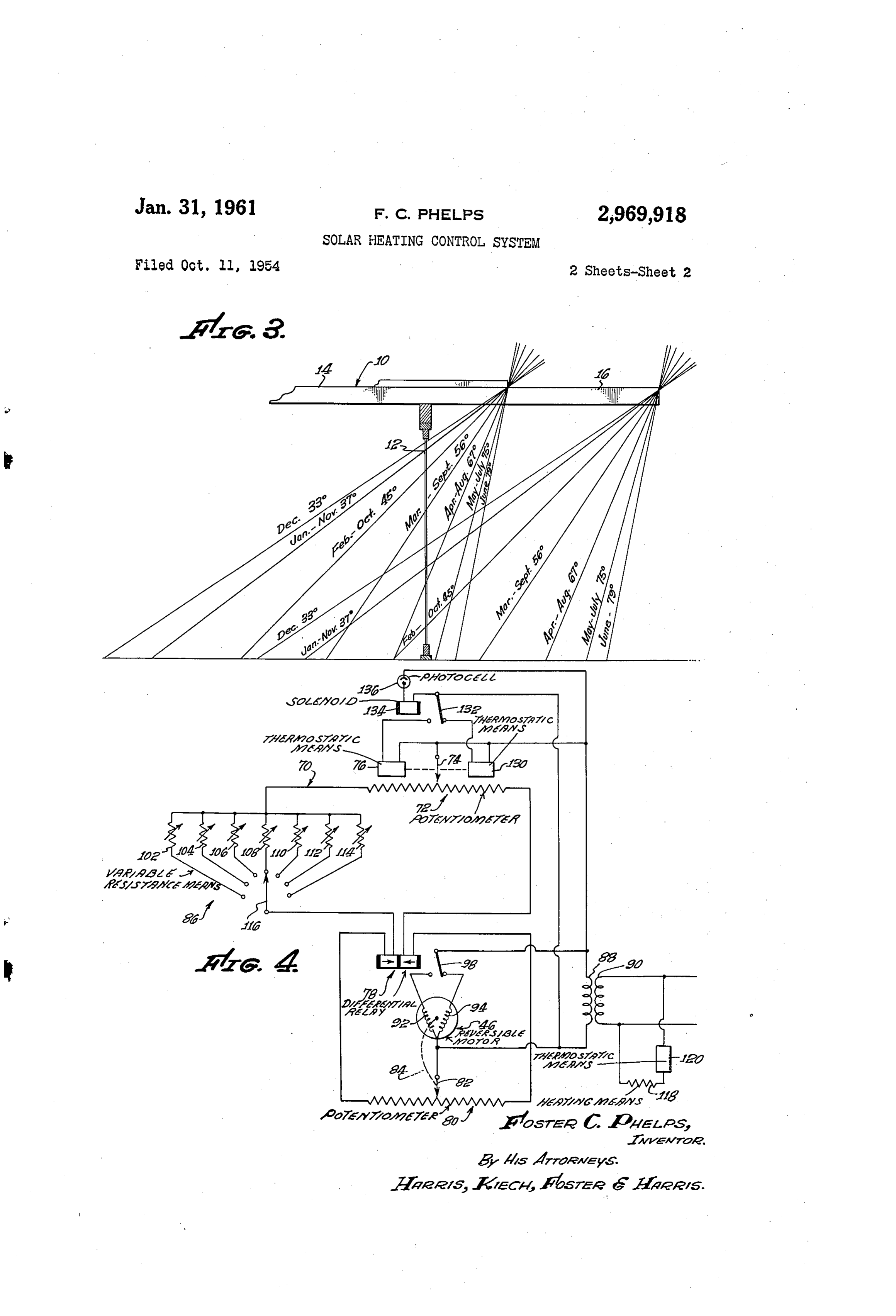
Fig. 1 is a fragmentary sectional view of a structure having the solar heating control system of the invention associated therewith;
Fig. 2 is a view taken along the arrowed line 2-2 of
Fig. 3 is a diagrammatic view illustrating the relation ship at latitude 34 north between the angles of the sun's rays at different times of the year and the structure shown in Figs. 1 and 2 of the drawings; and
Page 1drawing sheetscan →
Page 2drawing sheetscan →
Page 3scan →
Solar heating control system
Foster C. Pheips, 4328 Troost Ave.,
North Hollywood, Calif.
The present invention relates in general to an appa ratus or system for controlling the heating of a structure and, more particularly, to a control system for regul lating the temperature within the structure with solar heating alone, or with a combination of solar and arti ficial heating, a primary object of the invention being 20 to provide an improved control system for solar heating and for combined solar and artificial heating. An important object of the invention is to provide a control system which involves heating the structure solarly as long as the temperature is below a first pre 25 determined value, and heating the structure both Solarly and artificially when the temperature is below a second predetermined value, the second predetermined value being lower than the first predetermined value so that artificial heating is employed only when Solar heating is inadequate to maintain a desired temperature within the structure, whereby artificial heating of the structure is minimized, which is an important feature of the inven tion.
Another important cbject of the invention is to pro vide a solar heating control system which includes radia tion control means located externally of the structure and movable between open and closed positions for regu lating the solar heat radiation incident on the structure, the opening and closing of the radiation control means being effected by means responsive to the temperature within the structure.
More particularly, an object of the invention is to provide means responsive to the temperature within the structure for respectively opening and closing the radia 45 tion control means in response to temperatures within the structure below and above a predetermined value at such times when solar heat radiation is available. Another object is to provide means for closing the radiation control means at night at times, e.g., during the winter, when the temperature is below some prede 50 termined value so that heat losses from the structure are minimized when no solar heating is available. Another object is to provide means for opening the radiation control means at night at times, e.g., during 55 the summer, when the temperature is above some pre determined value so as to maximize heat losses to obtain cooling of the interior of the structure under such con
Another object is to provide a control system wherein 6 the means discussed in the two preceding paragraphs overrides the means for respectively opening and clos ing the radiation control means, at times when solar heat radiation is available, in response to temperature depar tures below and above a predetermined value.
Another important object of the invention is to pro vide a radiation contro! means comprising a plurality of louvers adapted to be positioned at different angles to vary the amount of heat transfer therethrough and, specifically, to vary the amount of solar heat radiation 70 incident on the structure.
Another object is to provide means for varying the maximum angle of the louvers with variations in the angle of the sun's rays from the horizontal, i.e., the altitude of the sun's rays, so that maximum solar heating is obtained when the louvers are fully open.
Another object is to provide means for limiting the maximum louver angle to one of a plurality of values respectively corresponding to the angles of the Sun's rays at different times of the year for a particular time of day and a particular latitude from the equator. Another object is to provide a control system having a circuit which includes means for varying the louver angle and which is adapted to be unbalanced by ten perature departures from a predetermined value to ener gize the louver-angle-varying means in one direction or the other, depending upon the direction of temperature departure from the predetermined value.
Another object of the invention is to provide a struc ture having a heat-radiation-absorbing external surface, such as a black surface, outwardly of which is located a radiation control means movable between open and closed positions and having a heat-radiation-reflecting external surface, such as a white or silvered surface. With this construction, when the radiation control means is open, a maximum amount of heat is absorbed by the heat-radiation-absorbing surface of the structure, whereas, when the radiation control means is closed, a maximum amount of solar heat radiation is reflected away from the structure by the heat-radiation-reflecting Surface of the radiation control means, which are important features of the invention.
Another important object of the invention is to pro vide a structure having a wall transparent to solar heat radiation and having an overhang projecting outwardly from the top of the wall, the overhang carrying a radia tion control means which is movable between open and closed positions in response to departures of the tempera ture within the structure below and above, respectively, a predetermined value so as to appropriately vary the amount of solar heat radiation incident on said radiation transparent wail, which may be formed of giass, for example.
Another object is to provide such an overhang-wall relationship wherein the radiation control means carried by the overhang comprises a plurality of louvers the maximum angle of which corresponds with the angle of the sun's rays as hereinbefore discussed.
The foregoing objects, advantages and features of the present invention, together with numerous other objects, advantages and features thereof which will become evi dent hereinafter, may be attained with the exemplary embodiment of the invention illustrated in the accom panying drawings and described in detail hereinafter. Referring to the drawings: -
Fig. 1 is a fragmentary sectional view of a structure having the solar heating control system of the invention associated therewith;
Fig. 2 is a view taken along the arrowed line 2-2 of
Fig. 3 is a diagrammatic view illustrating the relation ship at latitude 34 north between the angles of the sun's rays at different times of the year and the structure shown in Figs. 1 and 2 of the drawings; and
Fig. 4 is a schematic diagram of the electrical circuitry of the heating control system of the invention. Referring first to Figs. 1 and 2 of the drawings, frag mentarily illustrated therein is a structure 10 having a wall 2 transparent to solar heat radiation, the wall 2 preferably being of glass, for example. The structure it also includes a roof 14 having an overhang 16 which projects outwardly from the top of the wall 12, the struc ture 10 being so positioned that the wall 12 faces in the direction of the sun at some time during the day. For 4 maximum solar heating, the wall 12 preferably faces in tained at noon. However, the angles of the Sun's rays a generally southerly direction, although it may face in prevailing at other times of day may be utilized as a an easterly direction, or a westerly direction, if maxi base if maximum heating is desired at a time of day other mum solar heating is desired in the morning, or after than noon. Alternatively, means may be provided for noon. Of course, the foregoing directions apply to a making the maximum louver angle coincide with the structure located north of the equator insofar as a south angle of the sun's rays at all times. However, the con ery facing of the wall 12 is concerned. trol system hereinafter described is based on a maximum The roof 14 and the overhang 6 respectively carry louver angle corresponding to the noon sun angles shown radiation control means 18 and 20 movable between open in Fig. 3 as a matter of convenience. and closed positions to vary the solar heat radiation inci O Referring new to Fig. 4 of the drawings for a discus dent on the roof 14 and the wall 12, respectively. The sion of the electrical control system of the solar heating radiation control means 18 and 20 respectively include apparatus of the invention and a consideration of the pivoted louvers 22 and 24, the louvers 22 being carried operation of the solar heating apparatus, the numeral by shafts 26 and the louvers 24 being carried by shafts 70 designates generally a bridge circuit which includes 28. In the particular construction shown, the shafts 26 a potentiometer 72 having a movable contact 74 con and 28 are located intermediate the horizontal edges of trolled by a temperature-sensing device or thermostatic the louvers 22 and 24 so that the louvers are substantially means 76 located within the structure it to respond to balanced so far as gravitational forces are concerned. the temperature therein. One end of the potentiometer The shafts 26 are carried by rafter-like frame members 72 is connected through one side of a differential relay 30 spaced above the roof 14 by supporting means 32, 20 78 to one end of a potentiometer 30 having a movable and the shafts 28 are carried by extensions 34 of normal contact 82 driven by the motor 46, as indicated by the roof rafters 36. The shafts 26 terminate in arms 38 broken line connection 84. The other end of the po which are ganged together by a link 40 pivotally con tentiometer 80 is connected through the other side of nected thereto, the shafts 28 being provided with similar the differential relay 78 and a variable resistance means arms 42 ganged together by a link 44 pivotally con 25 86 to the other end of the potentiometer 72. The con nected thereto. The arms 38 and 42 are so angled rela tact 74 is connected to one end of a transformer sec tive to the louvers 22 and 24 that the weights of the arms ondary 88 having a primary 90, the other end of the and louvers tend to bias the louvers toward positions transformer secondary being connected to the contact 82 intermediate their fully closed, i.e., horizontal, positions and to windings 92 and 94 of the motor 46. The dif and their fully open, i.e., vertical, positions. 30 ferential relay 78 operates a switch 98 which connects A reversible motor 46, preferably an electric motor, either the winding 92 or the winding 94 in the circuit, is connected to the link 44 by a link 48 to open and close thereby operating the motor 46 in either direction to open the louvers 24. An arm 50 on one of the shafts 28 has or close the louvers 22 and 24. pivotally connected thereto a link 52 connected to one Considering the operation of the control circuit as end of a lever 54 carried by a fulcrum 56, the fulcrum 35 thus far described, if the thermostatic means 76 senses being between the ends of the lever and the other end of a temperature below a predetermined temperature at the lever being pivotally connected to the link 40. As which it is desired to maintain the interior of the struc will be apparent, with this construction, the motor 46 ture 0, it unbalances the bridge circuit 70 so as to en opens the louvers 22 and 24 in unison, and closes them 40 ergize the motor 46 in a direction to open the louvers 22 in unison. and 24, such opening movement continuing until the One feature of the present invention is that the upper contact 82 has been moved sufficiently to restore the surface 60 of the roof 14 is rendered as heat-radiation bridge circuit to balance. The reverse takes place in absorbing as possible as by making the surface 60 black, the event that the temperature is too high, the louvers as by painting, or otherwise. Thus, when the louvers 22 22 and 24 being moved toward their closed positions. are open, maximum solar heating is attained within the 45 Considering now the variable resistance means 86, it structure 10, which is an important feature. The upper is shown as including variable resistors 102, 104, 106, 108, surfaces of the louvers 22, i.e., the surfaces thereof which 10, 12 and 14 any one of which may be connected are uppermost when these louvers are closed, are prefer in the bridge circuit 70 by a movable contact 116. The ably rendered highly reflecting, as by painting them white, resistance of the variable resistor 102 is so adjusted that by painting them with aluminum paint, or by otherwise 50 it limits the maximum louver angle to, for example, 33 rendering them reflecting. Thus, when the louvers 22 are in December for the particular set of conditions shown closed, minimum solar heating of the structure 10 occurs, in Fig. 3 of the drawings. Similarly, the variable re which is an important feature. Similar considerations sistors 104, 106, 108, 110, 112 and 114 are so adjusted are also applicable to the louvers 24 carried by the over that they limit the maximum louver angles to those hang 16. 55 values shown in Fig. 3 of the drawings for January Referring now to Fig. 3 of the drawings, super-imposed November, February-October, March-September, April on the structure 10 are lines indicating the angles of the August, May-July and June, respectively. As will be sun's rays for different months of the year, the angles apparent, the variable resistors of the variable resistance shown in Fig. 3 being those prevailing at noon on the means 86 may be so set that the maximum louver angle twenty-first days of the respective months at a latitude 60 will not be exceeded despite travel of the contact 74 of 34° north of the equator. As will be apparent from to one end of the potentiometer 72. Preferably, the Fig. 3 of the drawings, maximum solar heating by Way overall sensitivity of the bridige circuit 70 is so selected of the radiation-transmitting wall 12 is attained in De that even a small departure in the temperature within cember with the length of overhang shown, and no solar the structure 10 below the desired predetermined value heating is attained in June, which are important features 65 will produce the maximum louver angle, determined by of the invention. In order to obtain maximum Solar the corresponding one of the variable resistors 102, heating when such maximum is desired, it is necessary to 104, 106, 108, 110, 112, and 114. However, the sensi limit the maximum angles of the louvers 22 and 24 to tivity of the bridge circuit 70 may also be so selected that values equal to the angle of the sun's rays so that the the maximum louver angles will not be attained unless a louvers are parallel to the sun's rays when fully open. 70 relatively large temperature departure below the predeter For convenience, the maximum louver angles may be mined value exists. The movable contact 116 of the varia selected as those shown in Fig. 3 of the drawings, which, ble resistance means 86 may be operated in any suitable manner. For example, it may be moved manually from as indicated, are those prevailing at noon on the twenty time to time, or it may be moved automatically by any first days of the respective months at 34° north latitude. 75 suitable apparatus such as an annual clock. It will be Under such conditions, maximum solar heating is at 5 understood that while separate resistors have been shown is above the predetermined value, the thermostatic means in the variable resistance means 86, a potentiometer 39 causes the bridge circuit 7 to energize the motor could be substituted therefor if desired. 46 in a direction to open the louvers 22 and 24, where Associated with the solar heating system hereinbefore by heat can escape from the structure 20 by way of the described is an artificial heating system which, as a mat roof 4 and the louvers 22 thereabove. Thus the heat ter of convenience, has been shown as comprising elec ing control system of the invention heats the structure trical heating means 118 connected across the trans 10 solarly by day and minimizes or maximizes heat former primary 90 and connected in series with a tem losses by night, depending upon whether the tempera perature-sensing means or thermostatic means 120. As ture within the structure () is below or above the de will be understood, the heating means 18 may be other 10 sired value. The minimizing of heat losses in this man than electrical, such as gas furnace means, oil furnace ner at night is of particular importance from the econ means, and the like. An important feature of the in omy standpoint since it minimizes the necessity for arti vention is that the thermostatic means 20 is set to en ficial heating of the structure 10, in conjunction with the ergize the heating means i8 at a predetermined tem economy attained by setting the thermostatic means 20 perature lower than the predetermined temperature at 15 at a lower value than the thermostatic means 76. Pref. which the thermostatic means 76 is set to energize the erably, the thermostatic means 130 is set for approxi solar heating system, i.e., open the louvers 22 and 24. mately the same temperature as the theremostatic means Consequently, artificial heating of the structure 10 does 76.
not begin until the temperature within the structure has It will be understood that while the hereinbefore de dropped below the temperature for which the thermo 20 scribed switchover between day and night operation has static means 76 is set by a predetermined decrement, been illustrated as photoelectrically effected, this can be thereby insuring maximum utilization of solar heating accomplished in other ways as well. For example, the and minimizing artificial heating as an economy measure, switch 32 may be controlled by a clock which moves which is an important feature of the invention. As an the switch 32 between its two positions in the same example, the thermostatic means 120 may be set to en 25 manner as the photocell 36 does.
ergize the heating means 118 at a temperature of 70 F. Although I have described an exemplary embodiment while the thermostatic means 76 may be set to fully of my invention herein, it will be understood that vari open the louvers at a temperature of 72 to 73 F., al ous changes, modifications and substitutions may be in though other temperature values may be selected. corporated in this embodiment without departing from As will be apparent, with the system as thus far de 30 the spirit of the invention as defined by the claims here scribed, if the thermostatic means 76 were to control at inafter appearing.
all times, the louvers 22 and 24 would be opened on I claim as my invention:
winter nights in an attempt to gain solar heat and would 1. In a heating control system, the combination of a be closed on hot summer nights in an attempt to shut structure providing a space adapted to be heated artificially out unwanted solar heat. In the first instance, excessive 35 and solarly; solar heating means for heating said space cooling of the interior of the structure 10 would be the solarly; artificial heating means for heating said space result, thereby requiring additional heating by the arti artificially; means for regulating the solar heating of said ficial heating means 118, and in the second instance, the space, including first temperature sensing meams respon effect would be to curtail heat loss from the structure sive to the temperature within said space, and including í0 under conditions when it would be desirable to pro 40 radiation control means externally of said structure and duce cooling of the interior of the structure. To over controlled by said first temperature sensing means for come this, the thermostatic means 76 controls only dur varying the quantity of solar heat radiation impinging on ing the day, a temperature-sensing means or thermostatic said structure, said radiation control means including a means 130 assuming control at night, or in cloudy plurality of movable louvers adapted to be positioned at weather. Preferably, the thermostatic means 130 is lo 45 different angles to vary the radiation transmitted thereby, cated within the structure 0. and said radiation control means including means for A switch 32 controlled by a solenoid 34 determines varying the angle of said louvers with variations in the whether the thermostatic means 76 or the thermostatic altitude of the sun's rays; and means connected to said means 130 controls the bridge circuit 70, the thermo artificial heating means for regulating the artificial heat static means 76 controlling when the solenoid 134 is 50 ing of said space, including second temperature Sensing energized and the thermostatic means 130 controlling means responsive to the temperature within Said space, when the solenoid 134 is de-energized. The solenoid said first temperature sensing means responding to a 134 is shown as controlled by a photocell 136 which pro higher temperature than said second temperature sensing duces energization of the solenoid during the day, or eaS.
during the day when the sun is shining, depending upon 55 2. In a solar heating control system, the combination the sensitivity of the photocell, the photocell being shown of: a structure; a plurality of horizontal louvers located connected in the circuit very schematically as a matter of externally of said structure and movable to different convenience.
Considering the operation of this portion of the con angles from the horizontal to vary the amount of trans mitted solar heat radiation incident on said structure;
trol system, it will be apparent that as long as the light 60 means for varying the angle of said louvers from the intensity is sufficient to energize the photocell 136, the horizontal; and means for limiting the maximum angle thermostatic means 76 controls the bridge circuit 70 of said louvers from the horizontal to a value equal to so that a decrease in temperature below the predeter the altitude of the Sun's rays.
mined value causes opening of the louvers 22 and 24, 3. A solar heating control system as defined in claim 2 while an increase in the temperature above the pre 65 wherein said angle-varying means includes temperature determined value causes closing of the louvers. At night, sensing means responsive to the temperature of the inte the photocell 136 is de-energized to de-energize the Sole rior of said structure.
noid 134, thereby placing the thermostatic means 130 in 4. In a solar heating control system, the combination control of the bridge circuit 70. Under such conditions, of: a structure; a plurality of horizontal louvers located if the temperature falls below the predetermined value, 70 externally of said structure and movable to different the thermostatic means 130, since it operates the re angles from the horizontal to vary the amount of Solar verse of the thermostatic means 76, causes the louvers heat radiation transmitted to said structure; means for 22 and 24 to close so that the louvers 22 provide a dead varying the angle of said louvers from the horizontal; air space above the roof 14 to insulate the structure 10 and means for limiting the maximum angle of said louvers against heat loss. Conversely, if the temperature at night 75 from the horizontal to one of a plurality of values re
Page 6scan →
Spectively corresponding to the altitudes of the sun's rays below and above a predetermined value, said radiation at different times of the year for particular times of day control means including a plurality of louvers adapted and a particular latitude from the equator. to be positioned at different angles from the horizontal, 5. In a solar heating control system, the combination said means for opening and closing said radiation control of: a structure; radiation control means externally of means including means for varying the angle of said Said structure and movable between open and closed louvers from the horizontal with variations in the altitude positions for regulating the transmission of solar heat of the sun's rays.
radiation to said structure; means for respectively open 8. A solar heating control system as defined in claim 7 ing and closing said radiation control means as the tem wherein the means last defined includes means for posi perature within said structure decreases below and in O tioning said louvers at one of a plurality of selected angles creases above a predetermined value during the day; from the horizontal respectively corresponding to the means for opening said radiation control means at night altitudes of the sun's rays at different times of the year in the event of a temperature above a predetermined and at particular times of day and a particular latitude value; and means for closing said radiation control means from the equator.
at night in the event of a temperature below a predeter 5 mined value. References Cited in the file of this patent 6. In a solar heating control system, the combination UNITED STATES PATENTS of: a structure providing a space adapted to be heated 246,626 MOTSe -------------------- Sept. 6, 1881 solarly and having a solar-heat-radiation-absorbing sur 302,215 Tucker ---------------- July 15, 1884 face bounding said space; radiation control means exter 20 1,386,781 Harvey ---------------- Aug. 9, 1921 nally of and adjacent said solar-heat-radiation-absorbing 1,488,345 Jenkins ---------------- Mar. 25, 1924 Surface and movable between open and closed positions 1,696,003 Harvey ---------------- Dec. 18, 1928 and having a solar-heat-radiation-reflecting outer surface, 1,888,522 Ward ----------------- Nov. 22, 1932 said radiation control means including a plurality of 2,030,350 Bremser --------------- Feb. 11, 1936 horizontal louvers adapted to be positioned at different 25 2,213,894 Barry ------------------ Sept. 3, 1940 angles from the horizontal to vary the heat radiation 2,271,120 Grant ----------------- June 27, 1942 transmitted thereby; means for varying the angle of said 2,288,465 Knudsen –------------- June 30, 1942 louvers from the horizontal, including temperature sens 2,396,338 Newton --------------- Mar. 12, 1946 ing means within said space; and means for varying the 30 2,489,879 Grebe ---------------- Nov. 29, 1949 angle of said louvers from the horizontal with variations 2,529,621 Mayo ---------------- Nov. 14, 1950 in the altitude of the sun's rays. 2,559,869 Gay ------------------- July 10, 1951 7. A solar heating control system, including: a struc 2,595,905 Telkes ----------------- May 6, 1952 ture having a wall transparent to solar heat radiation and positioned to receive said radiation, and having an 35 2,625,930 overhang projecting generally horizontally outwardly from the top of said wall; generally horizontally-oriented OTHER REFERENCES radiation control means carried by said overhang and Architectural Record, F. W. Dodge Corp., 10 Ferry movable between open and closed positions for varying St., Concord, N.H., April 1949, pp. 135-138. the transmission of said radiation to said wall; and means, 40 American Builder, September 1952, pp. 86, 87, Sim including temperature sensing means, for respectively mons-Boardman Publishing Corp., Emmett St., Bristol, opening and closing said radiation control means in re Conn.
sponse to departures of the temperature within said wall American Builder, August 1952, page 85, idem.
Provenance
- Collection
- Patents citing this work
- Pages
- 6
- Method
- pdftotext (the PDF's own text layer) + pdftoppm 300dpi page scans
- Patent office record
- patents.google.com →
- Source
- Google Patents citing-documents table
- Assignee
- Forster C Phelps
- Published
- 1961-01-31
- Transcribed from
- patentimages.storage.googleapis.com →