

Nine Posts
Not about Meyer. About the people who spent nineteen years trying to build his cell, what they wrote down, and how a single regular expression turned dozens of measurements into nine.
The archive's own copy, 15 September 2026 25 MB
6 views
0 watched live
0 at once
What was shown
-

What eighty-two thousand posts are about Counted across the whole forum archive.
-
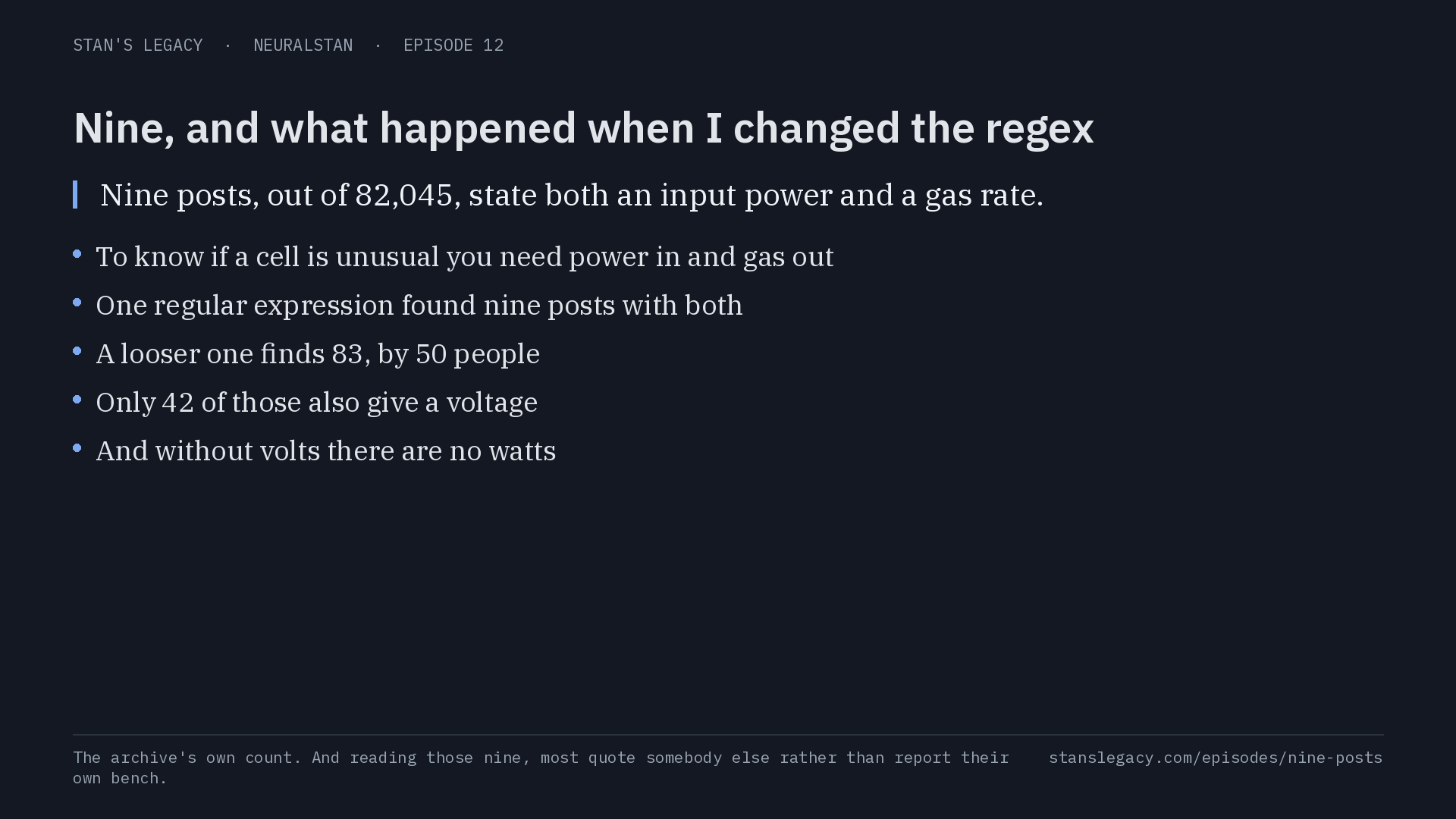
Nine Posts giving both the input power and the gas rate.
-
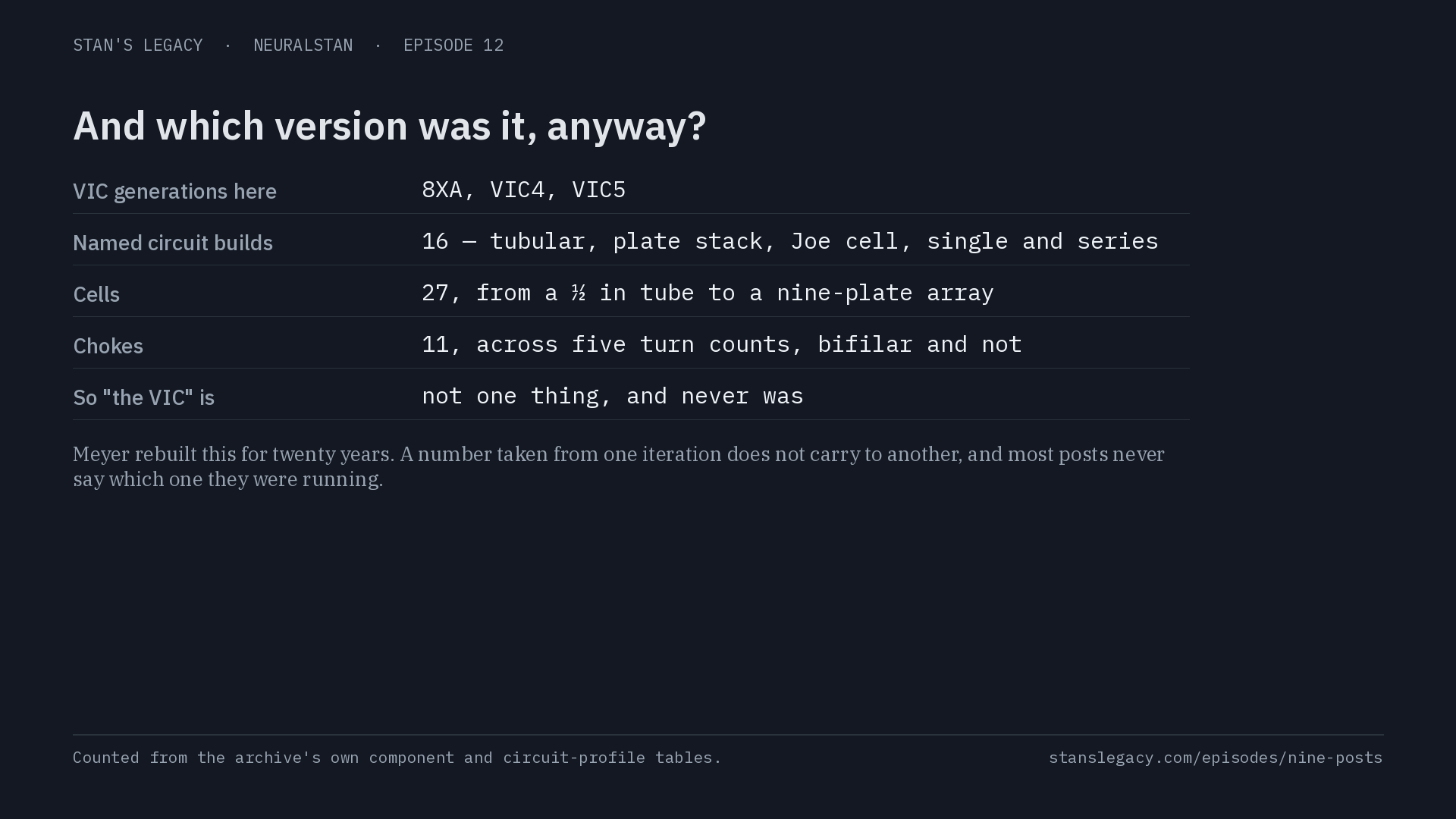
And which version was it, anyway? What the archive holds: three VIC generations and sixteen named builds.
-
Calculation
Gas yield and Faraday efficiency Gas yield and Faraday efficiency, in the archive's own engine.
-

Episode 11: The Wavelength of the Gap Episode 11, which also ended by asking for a measurement.
-

Episode 10: Resonant Action Episode 10.
Every other episode in this strand has read Meyer's own documents and checked his own numbers. This one is not about Meyer at all.
This archive holds more than his memos. It holds 86,436 forum posts from 4,549 people across five boards — Energetic Forum, Energy Science Forum, IonizationX and two smaller ones — running from February 2007 to last week.
But that is the wrong denominator, and it is the one everybody uses. Most of those posts are not about this machine: about 40,000 sit on a general renewable-energy board, 17,000 on John Bedini's monopole, and there are boards for crystal batteries, Eric Dollard, agriculture and the paranormal. Restrict it to posts mentioning water fuel, HHO, hydroxy, Meyer, electrolysis, the VIC, a resonant cavity or Brown's gas and you get 6,081 posts by 819 people. That is the community that tried to build this thing, and every ratio below uses it.
The wave
The all-boards traffic crested in 2012, but that peak is Bedini and general chatter, not this subject. The water subset crests four years earlier and twenty times smaller: 555 posts in 2008, 442 in 2009, 523 in 2010, 553 in 2011, and by 2012 it is already down to 349. By 2021 it is 38 posts from 11 people; this year, 12 from 5. The decline is real; it began at the start of the 2010s, not the middle.
Some people never left. Steve posted across 19 separate years, Aaron across 18 with 1,955 posts, sebosfato across 17, SkyWatcher across 16 and again this April.
Two of those four were doing something different from the other two, and the film now says so. Aaron administers Energetic Forum: 1,414 of his posts are on the general renewable-energy board, 203 on Bedini, 100 in forum help, and 78 on water fuel. Steve administers IonizationX: 725 posts in general discussion, 93 in forum issues. They gave nineteen years to keeping the rooms open, not to building the cell, which is a rarer contribution and deserves naming as itself. sebosfato and SkyWatcher are the builders on that list.
That is a substantial part of a working life, given to somebody else's unfinished machine.
What they wrote about
| posts | |
|---|---|
| mention replication | 3,111 |
| mention Faraday | 2,568 |
| claim over-unity, or a COP above 1 | 1,950 |
| state an input power — amps drawn, watts in | 1,473 |
| post or discuss a scope trace | 610 |
| state a gas rate — litres or millilitres per minute | 147 |
| state both a gas rate and an input power | 9 |
Those two numbers are the whole episode.
To know whether a water fuel cell does anything unusual you need exactly two measurements: how much power went in, and how much gas came out. Either alone tells you nothing. Together they take thirty seconds of arithmetic.
This film is called Nine Posts because that is what the first search found, and the nine turned out to be a property of the regular expression rather than of the archive. Widen the gas-rate pattern to accept litres per minute, millilitres per minute, cubic centimetres a minute and litres an hour in the ways people actually type them, and the count goes from 9 to 83 posts by 50 people.
So the community did measure, dozens of times. The real finding is the catch underneath: only 42 of those 83 also state a voltage. Without volts there are no watts, and without watts a gas rate is an anecdote. What was consistently missing was never the gas. It was the voltage.
How I counted, and what that is worth
These are keyword searches over the text of every post, not a reading of all 86,000. A post that mentions Faraday might be arguing with him. A post that gives an amp draw might be talking about a car stereo. The counts are generous upper bounds, not careful classifications — and the headline moved by a factor of nine when one pattern changed, which is the most important thing to know about any count like this. The queries are published beside this film at tools/episode-maker/queries/nine-posts.sql; run them, change them, and tell the archive what you get.
And the archive can only see what was written down. People certainly measured things they never posted.
The direction is not in doubt, because the generosity runs the same way for every row: input power is written down far more often than gas output, and the pair is rare. But rare is 83, not 9, and the film should not have said 9 without showing the pattern that produced it.
And which version was it?
There is a second problem underneath the first. There is no such thing as the water fuel cell. Meyer rebuilt it for twenty years, and this archive holds parts for three separate VIC generations — 8XA, VIC4, VIC5 — across sixteen named circuit builds, 27 cells from a half-inch tube to a nine-plate parallel array, and 11 chokes across five turn counts.
So a result posted in 2011 belonged to one particular build, and most posts never say which. Two people reporting different numbers may both be right about different machines. That makes most of the arguments in those 86,436 posts unresolvable in principle, and it should make you cautious about any calculation — including the ones in the other episodes of this strand — that says "the VIC does this". It always means one version of it.
Which is exactly why the missing measurement is the one worth having.
The number nobody needed to guess
Faraday settled the benchmark in 1834. Electrolysis gives you 0.627 litres of mixed hydrogen and oxygen per amp-hour — 418 mL of hydrogen and 209 mL of oxygen — and no cell, circuit or waveform changes that, because it is a count of electrons and not a property of the apparatus.
Put it in the units a builder uses and the floor is about two watt-hours per litre. A real cell running at 1.47 V gives 2.35 Wh per litre. Anything below about two is over-unity; anything above it is ordinary.
So the test is: measure the litres a minute, measure the watts, divide. Under 2 Wh/L and the world changes. Over it and you have an electrolyser.
And it is the one measurement that survives the version problem. Watt-hours per litre is a ratio, normalised by definition. It does not care whether you built an 8XA or a VIC5, a tube or a plate stack, in 2009 or last week. Every other number in those forums needs a paragraph of context before it means anything. This one needs none, which is why it is the number that could have been pooled across four thousand people and never was.
Somebody did work it out
In May 2019, on Energetic Forum, a member posting as BroMikey wrote this:
Faraday watt hrs per liter constant + or - 2.35 watt hrs per Liter or 2.35wh/L or 962/2.35 = 409LPH / 60 = 6.8 lpm. This is what Faraday said you would get for HHO gas per hour for that amount of input power.
That is correct. 2.35 watt-hours per litre is exactly what a cell at 1.47 volts produces, and he used it the right way round, to work out what a given input power should yield so a claim could be checked.
But he was not the first or the only one, though he is usually said to be. The community had its own unit for this — millilitres per minute per watt, written MMW — appearing in 27 posts by 14 people, the earliest in 2008, eleven years before BroMikey. Faraday's ceiling in those units is about 7, and they quote it and argue about it. The metric was in the room the whole time. What was missing was anyone pooling the numbers into one table.
So here is the table, from four posts in a single month of 2008. najman (21 July): 230 V × 9 A, 14 L/min → 2.46 Wh/L, four per cent above the 2.36 Wh/L thermodynamic floor, which is an excellent electrolyser. hydro (20 July): 106 V × 3.7 A, 0.35 L/min → 18.7 Wh/L, complete and disappointing and posted without complaint. triumphdave (16 July): 35 A at 3.5 L/min, no voltage. ashtweth (27 July): 15 A at 3 L/min, no voltage. Assume 12 V for those last two and both come out below the floor. The measurements that appear to break physics are the ones missing their third number; the one that gives all three lands where the textbook says.
What it would take
An inverted jar of water, a stopwatch, and a clamp meter. Fill the jar, invert it in a bowl, run the gas line up into it, and time how long it takes to displace a known volume. Read the amps and the volts at the same moment. That is the entire experiment, it costs about twenty pounds, and it has been available for the whole nineteen years.
Every episode in this strand has ended by asking for a measurement nobody has published. This one is about why that keeps happening — and it is not because the people were lazy or foolish. They built, they wound coils, they photographed scope traces six hundred times over. They measured the hard half, which is what goes in. The easy half is the one that settles it.
About the voices
NeuralStan is the archive reading its own holdings aloud in a stock synthetic voice; the forum quotation is read by him and is a member's own words. Stan Meyer is a voice cloned from thirty seconds of the Deer Creek conference tape of 1985, and in this episode he speaks only the sign-off, which is written for the film and is not a quotation.
forum archive replication Faraday efficiency Energetic Forum IonizationX community synthetic voice