

Resonant Action
Particle oscillation as an energy generator: the idea the whole water fuel cell stands on. Meyer gives the frequency, the cavity and the circuit, and the archive's own engine can check all three.
The archive's own copy, 15 September 2026 33 MB
4 views
0 watched live
0 at once
What was shown
-
Document
Resonant Action The Resonant Action chapter of memo WFC 422DA, and the sentences read in this film.
-
Document
Particle Oscillation as a Energy Generator The argument from first principles, in the Steam Resonator memo.
-
Document
RLC Circuit The RLC chapter of memo WFC 418, with the circuit and the twenty thousand volt claim.
-
Document
Dual-inline RLC Network The second choke, and what tuning it is meant to do.
-
Document
Gas Generator Voltage Control Circuit The patent: the control circuit, and the phase-lock loop that tracks the cell.
-
Calculation
Coaxial cell capacitance The cavity as a capacitor, with the dimensions Meyer gives.
-
The cavity, as the engine reads it Capacitance and leak, from Meyer's own dimensions.
-
Calculation
Design a VIC: cell, choke, Q and step charging Cell, chokes, Q and step charging, run on Meyer's own cavity.
-
Where the frequency actually lands The stated band against the loop's actual resonance.
-
In that band, the cell is a resistor Where water stops conducting and starts storing.
-
Everything here that could resonate Four candidate mechanisms, and the band Meyer names.
-
Calculation
Q factor and voltage rise Q factor and voltage rise, for the coil that actually rings.
-
Document
Understanding Resonant Action in the Water Fuel Cell The longer treatment, under Advanced WFC Concepts.
-

Episode 8: The Steam Resonator Episode 8, where the same engine put a number on the heating.
-

Episode 9: The Catalytic Block Assembly Episode 9, the burner on top of the cell.
Resonant action is the idea the whole water fuel cell stands on: that if you pulse the cell at the right frequency, the water's own response reinforces the drive, and you get far more voltage across the plates than you put in. Meyer names it in the WFC 422DA chapter, argues it from first principles in Particle Oscillation as a Energy Generator, gives the circuit in the RLC chapter of WFC 418, and patented the control electronics for it as Gas Generator Voltage Control Circuit.
This episode is unusual for one reason: Meyer gives enough numbers to check. He states the cavity's dimensions, the frequency band, and the circuit topology. The archive's own matrix engine holds calculations for every one of them, so the check is not a matter of opinion.
About the voices. Two speak, and neither is a person. NeuralStan is the archive reading its own holdings aloud in a stock synthetic voice. Stan Meyer is a voice cloned from thirty seconds of the Deer Creek conference tape of 1985; it reads only sentences he wrote or said, each cited below, apart from the sign-off at the end, which is written for the film. Evil Stan is not in this one.
What Meyer means by it
Oscillating and superimposing electrically charged particles unto the electrical polarization process at a given pulse-frequency is, now, herein called Resonant Action.
And the frequency:
The established resonant frequency is most generally in the audio range from 1 kHz up to and beyond 10 kHz; and is dependent upon the amount of contaminants in natural water.
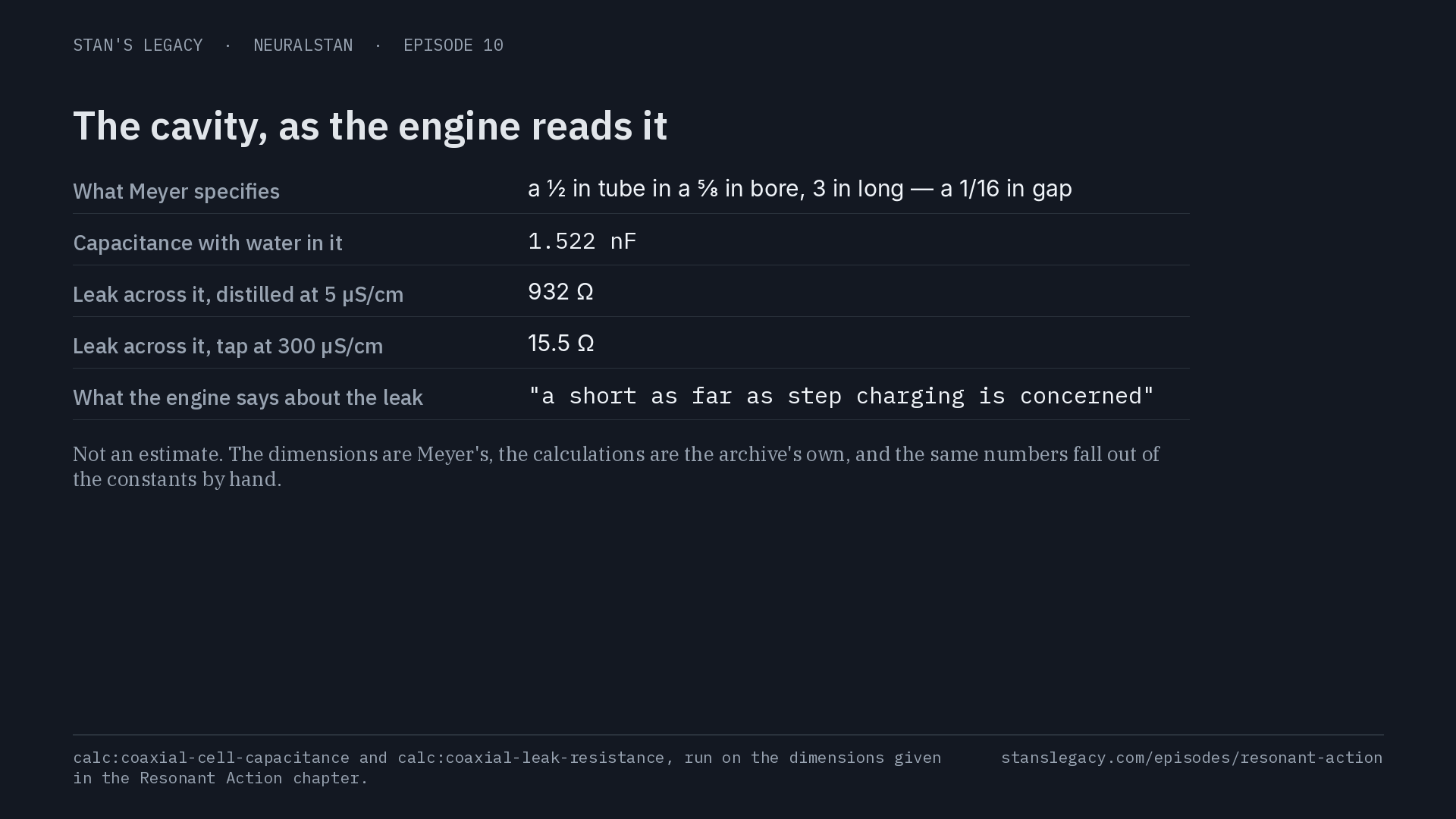
And the cavity: a half-inch tube inside a five-eighths bore, a sixteenth of an inch of water between them, three inches long, working as a longitudinal wave guide.
What the engine says about that cavity
Given those dimensions, Coaxial cell capacitance puts the cell at 1.52 nF with water in it. The leak across it depends entirely on what the water is, and this is the specification the whole chapter turns on:
| Water | Leak | Drains in |
|---|---|---|
| tap, 300 µS/cm | 15.5 Ω | instantly |
| distilled, dirty end, 5 µS/cm | 932 Ω | 1.4 µs |
| distilled, clean end, 1 µS/cm | 4.7 kΩ | 7 µs |
| deionised, 0.055 µS/cm | 85 kΩ | 129 µs |
At 5 kHz the gap between pulses is 200 µs, so on tap water the staircase never starts and on deionised water most of each step survives. Picking 5 µS/cm, calling it distilled and concluding the staircase is impossible is the usual mistake. It is not impossible; it is a water specification, and Meyer states it in his own patent: "Distilled water, like air, having no conductive medium, will inherently inhibit electron leakage", while "sea water with a salt content or natural water with an iron or other mineral content... would have a tendency to draw current... would curtail the operation of the generator."
Those two numbers decide everything else.
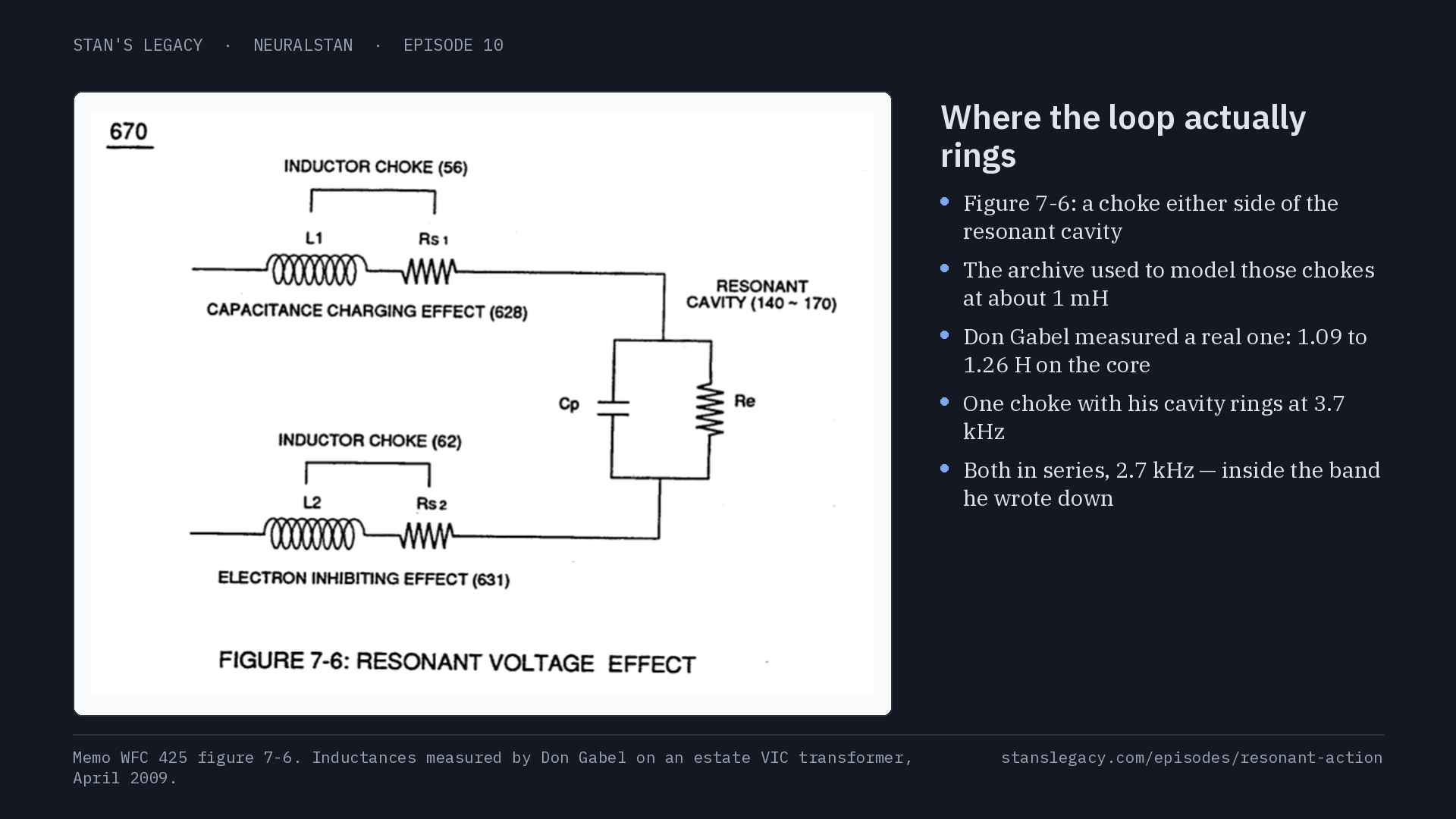
The frequency lands where he says it does, once you use his chokes. Modelling the chokes at about a millihenry, wound in air, puts the loop at 91 kHz, and concludes that the audio band was out of reach. That was wrong on its inputs. Figure 7-6 draws a choke either side of the cavity and figure 3-23 puts them on the same laminated core as the primary and secondary, and nobody in the memos writes down an inductance. But Don Gabel measured one: on the core, choke C1 reads 1.26 H and C2 1.14 H (VIC coil readings, April 2009). With Meyer's 1.52 nF cavity, one choke rings at 3.7 kHz and both in series at 2.7 kHz — inside "1 kHz up to and beyond 10 kHz". That does not prove the water is doing anything. It removes an objection this film should not have raised.
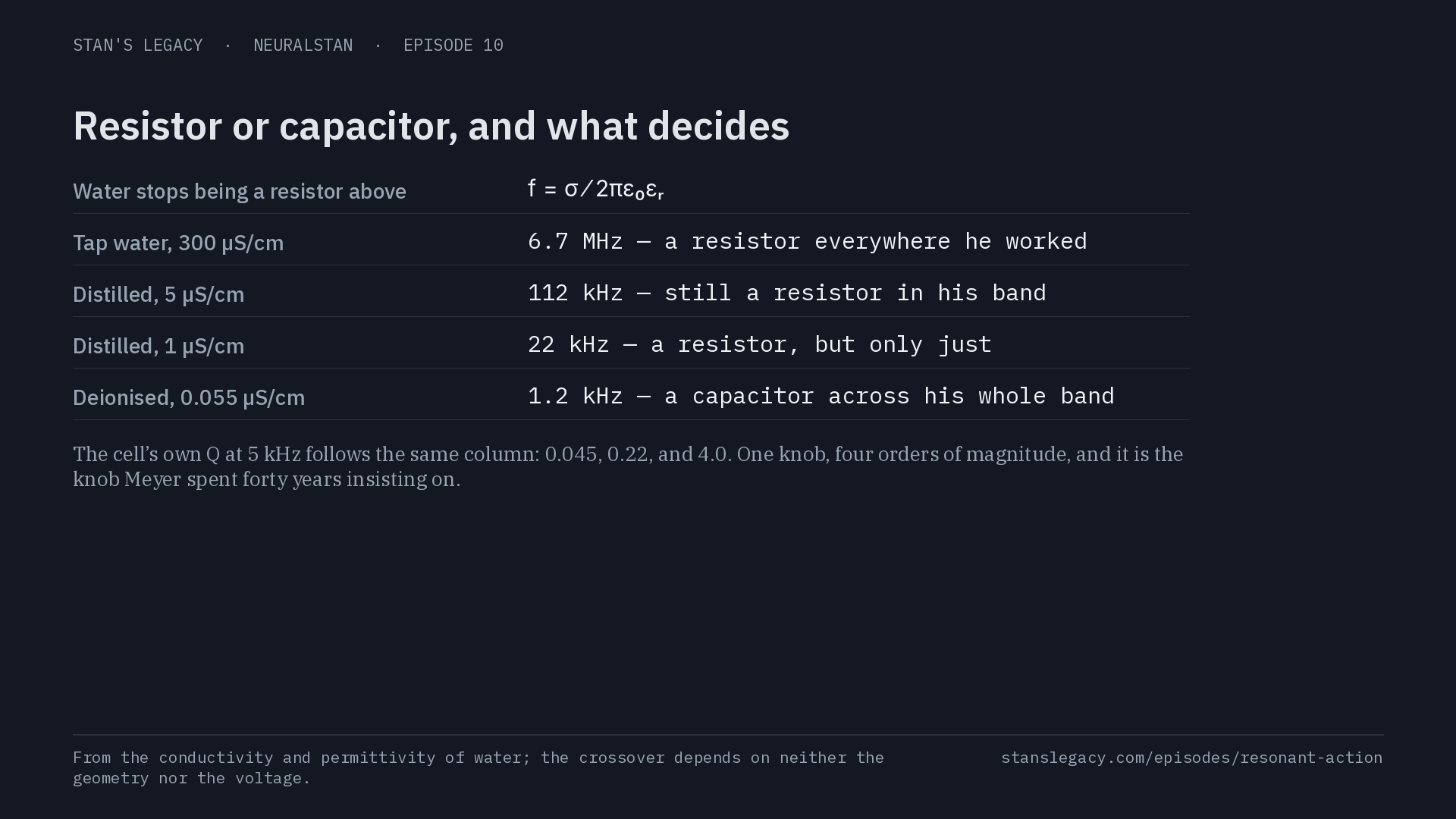
Whether the cell is a capacitor at all depends on the water. Water crosses from resistive to capacitive at f = σ / 2πε₀εᵣ: 6.7 MHz for tap, 112 kHz for distilled at 5 µS/cm, 22 kHz at 1 µS/cm, and 1.2 kHz for deionised — which is, to the digit, the bottom of Meyer's stated band. The cell's own Q at 5 kHz follows: 0.045, 0.22, and 4.0. So a tap-water cell is a resistor everywhere he worked, and a deionised cell is a capacitor across his whole band. Almost every replication in this archive was run on tap water, on the wrong side of that line.
The staircase survives the gap between pulses, or does not, according to the water — see the table above. It is also worth noting that Meyer drew the leak himself: figure 7-6 has Re across the cavity and Rs in series, and the chapter says "dielectric property of water opposes amp leakage (Re)". The archive's discovery was already in his drawing.
Three things that could be resonating, and where each one sits
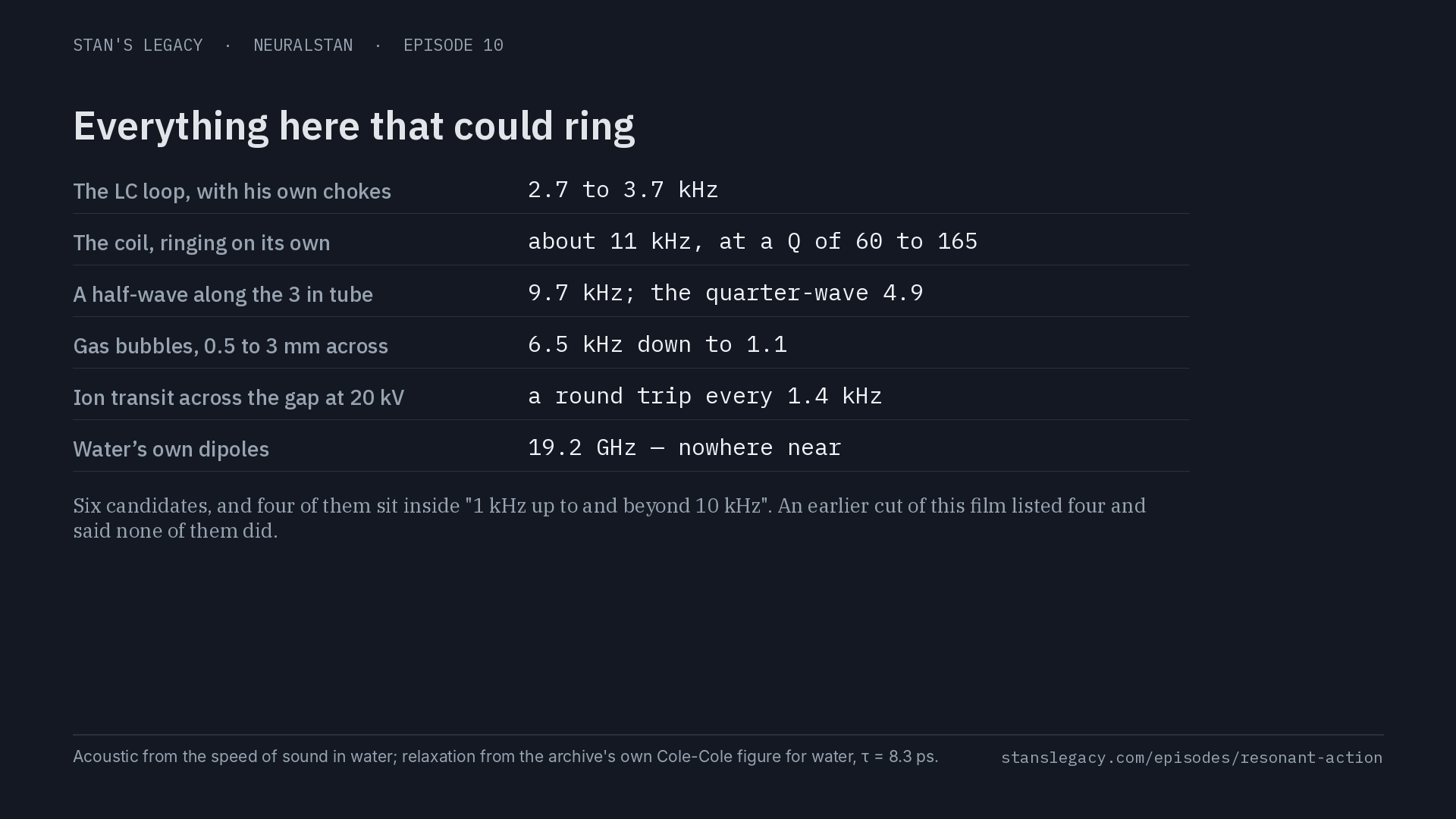
| The LC loop, with his measured chokes | 2.7 to 3.7 kHz |
| The coil, ringing on its own | about 11 kHz, at Q 60 to 165 |
| A half-wave along the 3 in tube | 9.7 kHz; the quarter-wave 4.9 |
| Gas bubbles, 0.5 to 3 mm across | 6.5 kHz down to 1.1 |
| Ion transit across the gap at 20 kV | a round trip every 1.4 kHz |
| Water's own dipole relaxation | 19.2 GHz |
| Meyer's stated band | 1–10 kHz |
Six candidates and four of them are in the band. Note also that the patent says "the physical motion of the hydrogen and oxygen charged atoms": ions, which drift in a field, not neutral molecules, which diffuse. That mechanism is usually answered with a molecule's diffusion time of about nine minutes, which is true and beside the point.
None of them is in the audio range. The patent argues a fourth — that water molecules travelling back and forth between the plates go into resonance when the spacing matches the frequency — but a water molecule does not cross a 1.6 mm gap ballistically; it diffuses, and takes about nine minutes to random-walk across.
What he was probably seeing
One detail in his own sentence is the tell. He says the resonant frequency depends on the amount of contaminants in the water. An LC resonance does not care how conductive the dielectric is — conductivity changes the damping, not the frequency. An RC time constant cares about nothing else. So the frequency that shifted when he changed the water was almost certainly the cell's charge-and-leak time, not a resonance, and he read a real, repeatable, conductivity-dependent effect as the thing he was looking for.
And there is a real resonance in this circuit, just not where the chapter puts it. A VIC coil assembly has its own self-resonance, between its inductance and its winding capacitance, and it is high-Q because it is copper and air rather than water. That is where thousands of volts across the excitor array actually come from — see Coil self-resonance. The coil rings. The cell is the load hanging off it.
Where the patent is right
Gas Generator Voltage Control Circuit is a conventional control circuit: a variable transformer, a regulated supply, an SCR pulser. It contains no phase-locked loop and the word "phase" does not appear in it; the lock is usually credited to the patent, and it belongs to memo WFC 422DA, whose figure 3-1 is captioned "Phase Lock Loop technique of Pulse Indicator circuit (110) is utilized during pulsing operations", and to the tapes, where he describes it scanning and catching ("It automatically scans it right in, locks right in the resonance and holds it there", New Zealand 1989; "a lock light so that when it does capture that resonant frequency, the light will be on", the GMS tape). Whatever the cell is doing, its impedance moves as it gasses, heats and changes conductivity, and a fixed-frequency drive would walk off it within seconds. Locking the drive to the load is the correct instinct and ordinary good engineering; induction heaters and ultrasonic welders have done it for decades. The circuit is sound. What it is locking to is the question.
What is worth building
Measure the cell's impedance across frequency before assuming anything about it — a signal generator, a series resistor and a two-channel scope will give you the magnitude and phase in an afternoon, and it settles this. Wind the coil and find its self-resonance, which is real and worth knowing. And when the drive frequency shifts as the water changes, record the conductivity at the same time; if the frequency tracks conductivity, it is an RC time constant, and the archive would like the measurement either way.
resonant action particle oscillation VIC WFC 422DA WFC 418 patent 4798661 phase lock loop synthetic voice