

The Textbook Behind the VIC, 5: ring or dead-beat
23 September 2026
Part 5 of 6 in The Textbook Behind the VIC: 1 · 2 · 3 · 4 · 5 · 6
Fleming's test
When a condenser discharges through a coil, Fleming shows (§6 of Chapter V, pp. 377–381, part 22) that there are two kinds of motion, and one number decides which you get. He credits the analysis to Lord Kelvin in 1853 and the confirming experiments to Feddersen, who watched Leyden-jar sparks in a spinning mirror.
- If the resistance R of the circuit is greater than √(4L/C), the charge dies away without reversing. Fleming calls this "the dead beat case": the discharge current is "uni-directional".
- If R is less than √(4L/C), it is "the oscillatory case": the charge swings to and fro, "first positive and then negative, but at the same time always decreasing", with successive maxima "gradually diminishing in geometric progression".
- When it oscillates, the period is 2π√(LC), if the resistance is small.
Feddersen's mirror showed exactly this: with a high resistance in the discharge, one smeared band of light; with a low one, a row of separate sparks, one for each swing.
Why it matters for the VIC
Part 3's overshoot — the charge "overreaching" towards twice the pulse voltage — only happens on the oscillatory side of Fleming's line. On the dead-beat side, the capacitor creeps up towards the pulse voltage and stops. So the resistance of the loop decides whether the resonant charging choke is resonating at all.
The numbers, with the archive's measured parts
Use the inductance Gabel measured on the estate VIC's chokes, 1.26 H and 1.14 H on the core, 2.40 H in series (VIC coil readings), and the 1.52 nF the archive's engine gives for Meyer's own cavity dimensions (the figure Resonant Action uses).
| Quantity | Value |
|---|---|
| Ringing frequency, 1/(2π√(LC)) | about 2.6 kHz (3.6 kHz with one choke) |
| Fleming's dividing resistance, √(4L/C) | about 79.5 kΩ |
| Loop resistance, Gabel's copper coils (secondary 72.4 Ω + chokes 76.7 and 70.1 Ω) | about 220 Ω — far below: it rings |
| Loop resistance, Meyer's 1987 pencil pages (secondary 67,340 Ω + chokes 2 × 11,655 Ω) | about 90.7 kΩ — just above: close to dead-beat |
The second row carries an assumption that has to be said out loud: nobody has measured the inductance of the coils in the pencil pages. If they were anywhere near Gabel's, Meyer's resistive build sits almost exactly on Fleming's line. That is interesting rather than damning. Meyer chose resistive wire on purpose, "preventing amp flow still further" (Dual Voltage Resonant "Q"), and a loop on the edge of dead-beat charges the cell without large reversals — which is what a unipolar, diode-fed design wants. The textbook tells you where the trade tips; only a measurement of that coil set can say which side it is on.
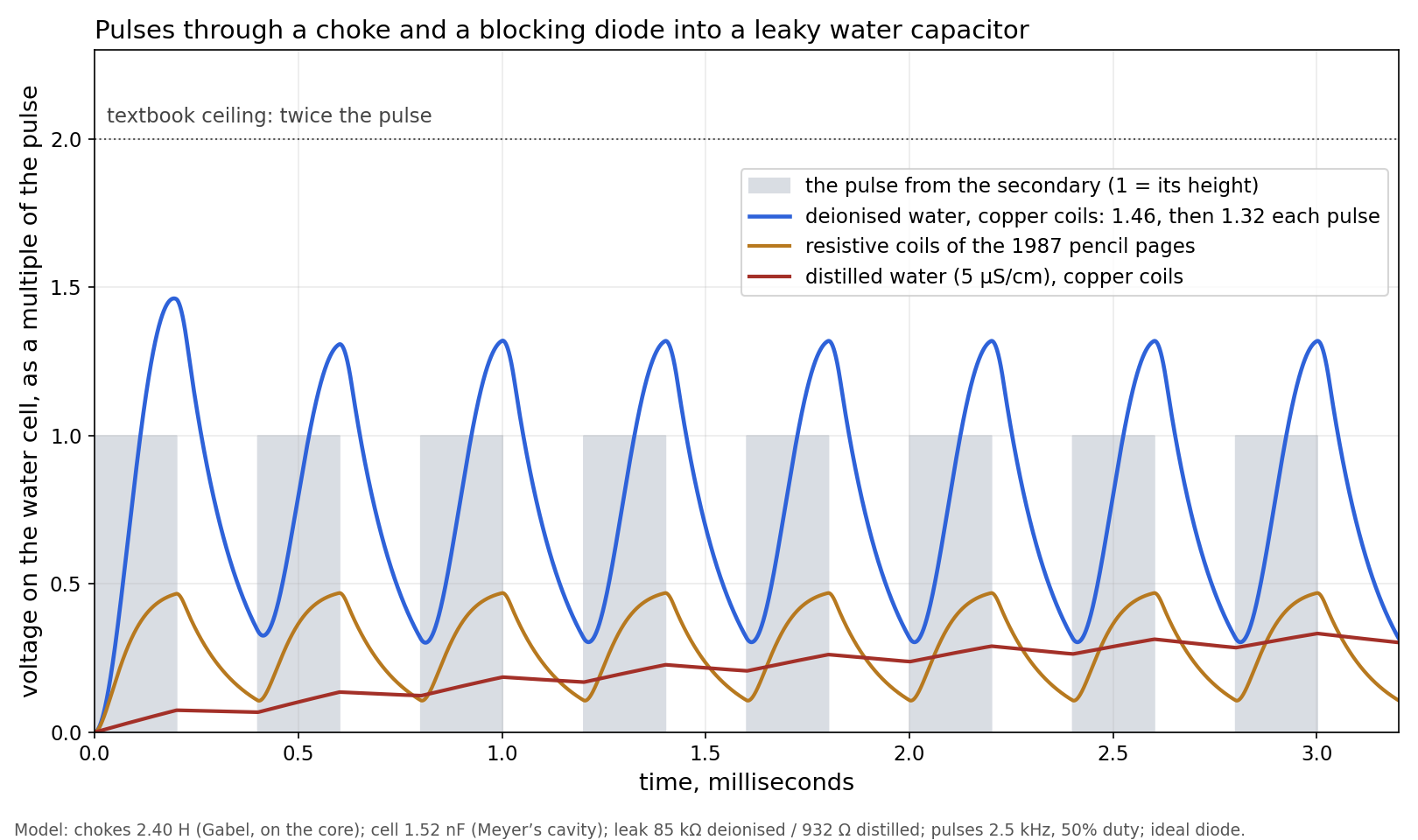
The same model as part 3 shows the cost of the trade. With the resistive coils (and, again, Gabel's inductances assumed), the cell reaches about half the pulse, not more than the pulse, because the loop's resistance and the water's leak divide the pulse between them. Meyer bought amp restriction with cell voltage. Whether that was the right bargain is a bench question.
The leak across the water decides it too
Part 2 showed that the water cell is a condenser with a resistance across it. A leak in parallel damps the ringing just as a resistance in series does. For the loop above, the rule of thumb is that it can ring only if the leak across the cell is more than about half of √(L/C), which here is about 20 kΩ. The four waters in Resonant Action, for Meyer's cavity:
| Water | Leak across the cavity | Can the loop ring? |
|---|---|---|
| Tap, 300 µS/cm | 15.5 Ω | No |
| Distilled, 5 µS/cm | 932 Ω | No |
| Distilled, 1 µS/cm | 4.7 kΩ | No |
| Deionised, 0.055 µS/cm | 85 kΩ | Yes |
This is the same conclusion the archive reached by another route: the water's purity is not a detail of Meyer's specification but the thing the whole circuit depends on. Fleming's criterion, from 1896, says why.
What to measure
- The DC resistance of every winding in the loop, and the inductance of each on the core. Add them up and compare with √(4L/C) for your cell.
- Ring the loop: one short pulse, scope across the cell. A decaying sine means oscillatory; a single hump means dead-beat. Count the swings and time them against 2π√(LC).
- Do it again with each grade of water you have. The ringing should vanish as the water gets dirtier.
Next: part 6, one frequency only.
Provenance
- File
- database/content/pages/textbook-vic-5-ring-or-dead-beat.json
- Rights
- The archive's own tutorial. Quotations from Fleming (1896) and Steinmetz (1900 and later) are from public-domain books in the Reference Library; quotations from Meyer are from his patents, memos, articles and recorded talks in the archive, each linked where it is quoted.