

The Textbook Behind the VIC, 3: a choke can raise the voltage
23 September 2026
Part 3 of 6 in The Textbook Behind the VIC: 1 · 2 · 3 · 4 · 5 · 6
What Meyer wrote
The first claim of Method For The Production Of A Fuel Gas puts the whole idea in one clause:
providing a capacitor, in which the water is included as a dielectric liquid between capacitor plates, in a resonant charging choke circuit that includes an inductance in series with the capacitor
— US 4,936,961, Method for the Production of a Fuel Gas (in the archive)
And in the memo Dual Voltage Resonant "Q" he defined the component by quoting the dictionary:
Said Resonant Charging Choke (43) is a Modulator Inductor which sets up an oscillation of a given charging frequency (voltage pulsing rate) with the effective capacitance of a pulse-forming network in order to charge a line to high voltage. See Modern Dictionary of Electronics 5th Edition by Rudolf F. Graf.
That is the textbook definition of resonant charging, the technique radar pulse modulators use to charge a pulse-forming line to high voltage through an inductor and a diode. Meyer knew exactly which component he was naming.
What Steinmetz wrote
Steinmetz's Alternating Current Phenomena works out what happens when inductance and capacity are in series:
Series inductance in a condenser circuit, and series condensance in an inductive circuit, cause a rise of potential.
…in synchronous motor circuits, choking coils, or reactive coils, can be used for raising the voltage.
— Steinmetz, Alternating Current Phenomena, 3rd ed., 1900, pp. 65–66 (part 4)
And why it happens, in Transient Electric Phenomena:
An oscillation can occur only with the existence of two energy-storing constants, as capacity and inductance, which permit a surge of energy from the one to the other, and therewith an overreaching.
— Steinmetz, Transient Electric Phenomena and Oscillations, §16 (part 2)
"Overreaching" is the word to hold on to. When a pulse is pushed into a capacitor through an inductor, the current does not stop when the capacitor reaches the pulse's voltage; the inductor keeps it flowing, and the capacitor overshoots. With little loss, it overshoots towards twice the applied voltage.
What Fleming wrote: the condenser that doubles
Fleming shows the same doubling from the other side, in the induction coil itself. With a condenser across the primary's break:
…on breaking the primary circuit, the primary current continues to run on into the condenser for a short time; it then rebounds, and is reversed in sign, retaining initially its full strength… Hence, when a condenser is so employed, the inductive electromotive force in the secondary must be just double that which it would be if there were no such rebound of the primary.
— Fleming, §7 of Chapter V, pp. 392–393 (part 23)
The blocking diode, and step-charging
An overshoot on its own swings back. What keeps it is the blocking diode, which Meyer describes plainly:
Blocking diode (b) prevents electrical "shorting" to secondary coil (a) during pulse-off time since the diode "only" conducts electrical energy in the direction of the schematic arrow.
— Energy of the Future, 1990
The patent's other half says the same in its own terms: "a pulsating, uni-polar electric voltage field in which the polarity does not pass beyond an arbitrary ground". Steinmetz describes the general case of pulses delivered through a one-way conductor:
Transient terms may occur periodically and in rapid succession, as when rectifying an alternating current… (as can be done… by unidirectional conductors, as arcs). At every half wave the circuit reversal starts a transient term, and usually this transient term has not yet disappeared… when the next reversal again starts a transient term.
— Steinmetz, Transient Electric Phenomena, §17 (part 2)
Put the pieces together and you have what Meyer drew as his step-charging graph (16A, in the same memo): each pulse, through the choke, pushes the cell's voltage up; the diode stops the charge running back into the secondary; whatever the water has not leaked away is still there when the next pulse arrives.
The textbooks also say where it stops. Charging through an ideal choke and diode carries the capacitor to twice the pulse and no further — but only if the pulse lasts long enough: half of one ringing period of choke and cell, π√(LC). A train of shorter pulses steps the voltage up, each step smaller than the last, but only towards the pulse's own height, because each pulse can push only while it is higher than the cell. Losses and the leak bring the ceiling down further. Steinmetz puts the same limit on a travelling wave: "the maximum value to which the voltage can build up at a single transition point is twice the voltage of the incoming wave" (Transient Electric Phenomena, part 19). So the voltage intensifier's gain is the transformer's turns ratio, times up to two from the choke.
The pulse width decides the doubling
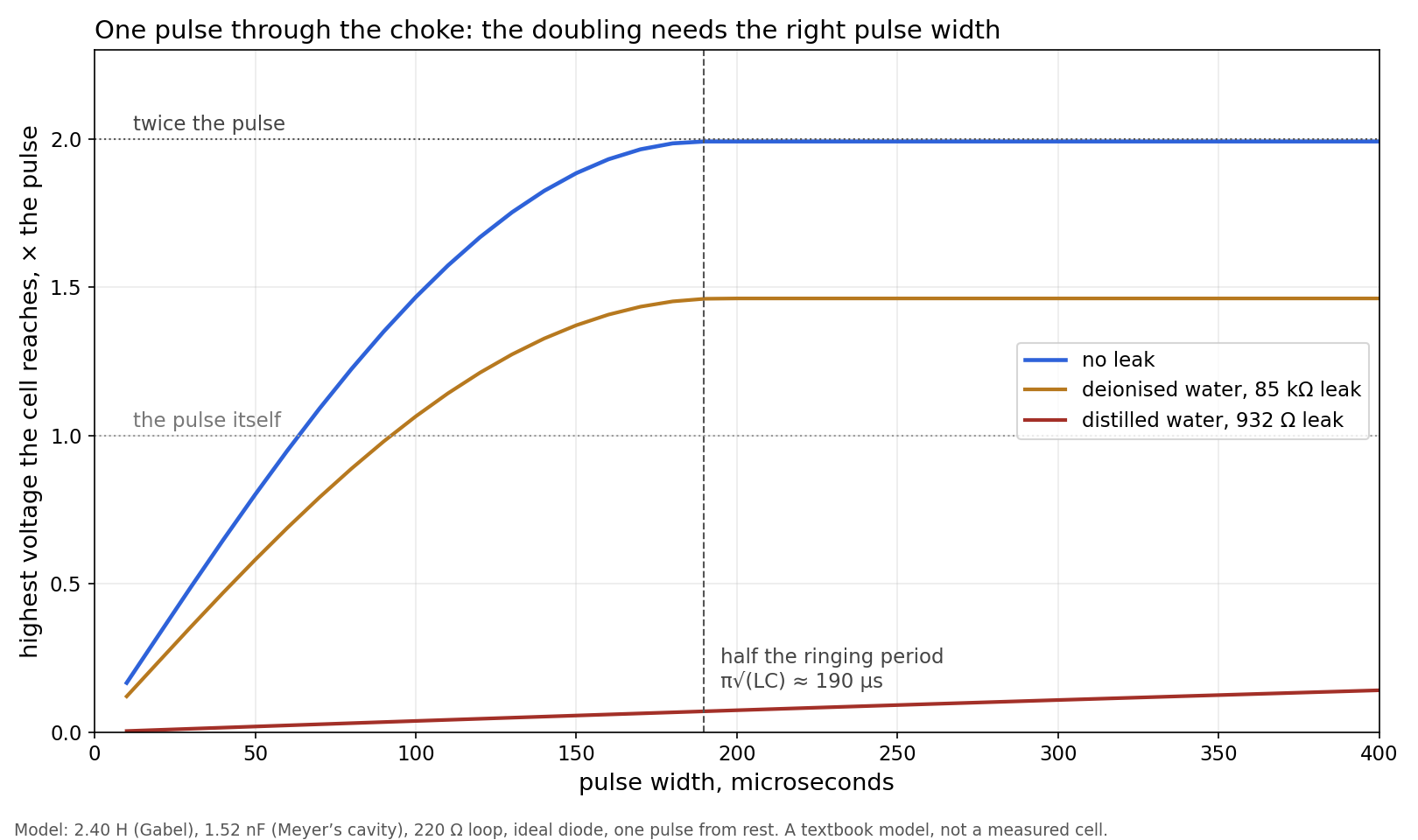This is the condition in Meyer's own definition of the component: an oscillation "of a given charging frequency (voltage pulsing rate) with the effective capacitance". The pulse timing has to be matched to the choke and the cell, and a builder should ring the loop first, measure the swing, and set the pulse width to half of it.
What it looks like with the archive's measured parts
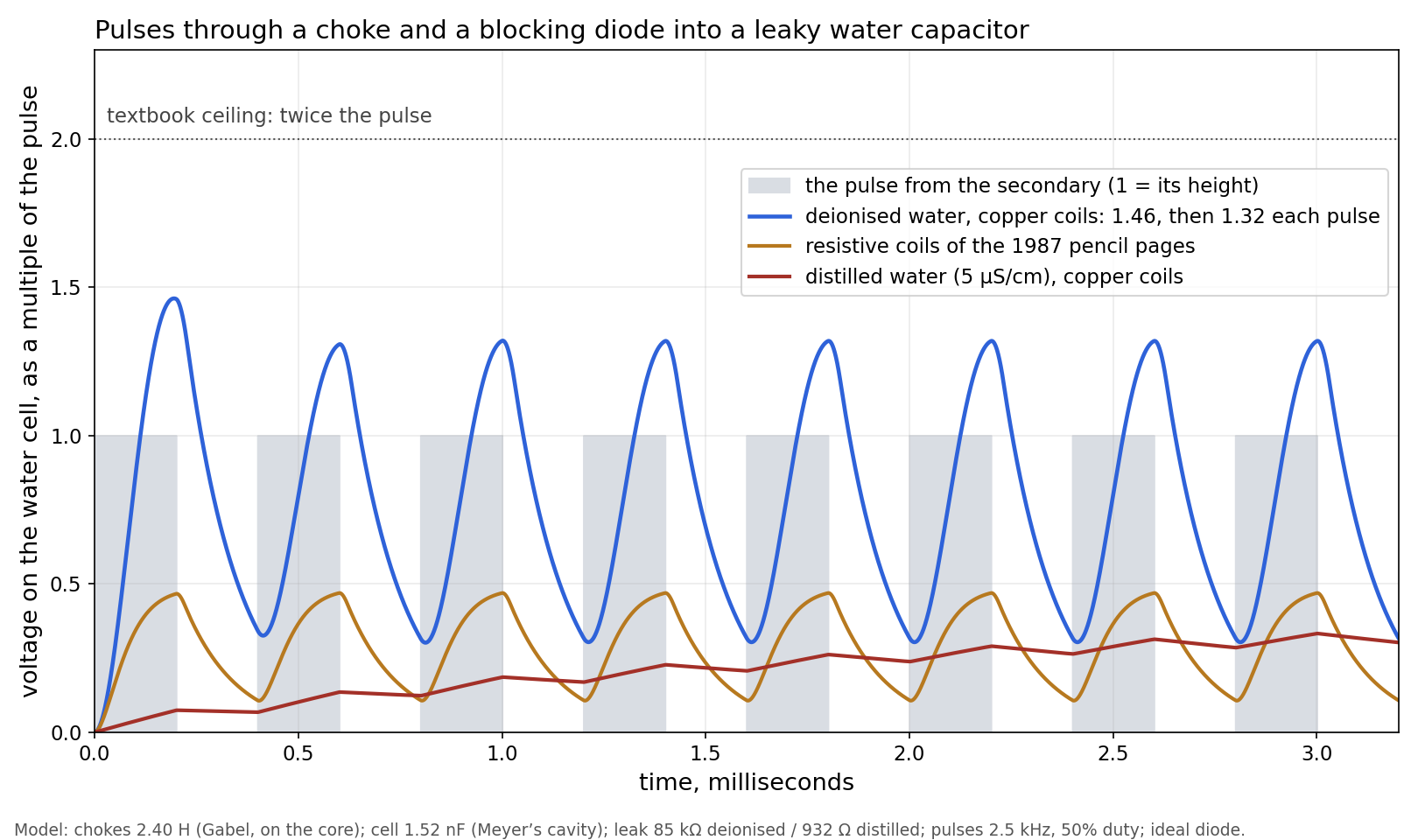Three things show in the model. The overshoot is real: the choke carries the cell well past the pulse, just as Steinmetz says. It is capped: even with deionised water, the leak drains most of each stroke before the next, so the cell settles at about 1.3 times the pulse rather than climbing. And the water decides everything: at 5 µS/cm the cell is little more than a resistor and the charging never gets going. Every step has to survive the gap before the next pulse, and part 2 measured how long a water cell can hold its charge. That is a measurement, not an article of faith, and it is the most useful thing a builder can take from this part.
What to measure
- With a scope across the cell: does the voltage after one pulse exceed the pulse's own amplitude? That is the overshoot.
- With a train of pulses: does each start higher than the last? That is the staircase. Record it with the water conductivity.
- Take the diode out and look again. The staircase should vanish. That tells you the diode, not something else, was holding it.
Next: part 4, the choke under a blow.
Provenance
- File
- database/content/pages/textbook-vic-3-resonant-charging.json
- Rights
- The archive's own tutorial. Quotations from Fleming (1896) and Steinmetz (1900 and later) are from public-domain books in the Reference Library; quotations from Meyer are from his patents, memos and articles in the archive, each linked where it is quoted.