

The Catalytic Block Assembly
The burner Stan put on top of the cell: a quenching disc, a ceramic dome and a condenser that hands you drinking water. He built it because he blew a hole in his own living room floor.
The archive's own copy, 15 September 2026 38 MB
5 views
0 watched live
0 at once
What was shown
-
Document
Catalytic Block Assembly The Catalytic Block Assembly chapter of the extended dealership manual, and the text read in this film.
-
Device
Quenching Circuit The device record.
-
Document
Catalytic Block Assembly The shorter chapter, under WFC 421, Quenching Circuit Technology.
-
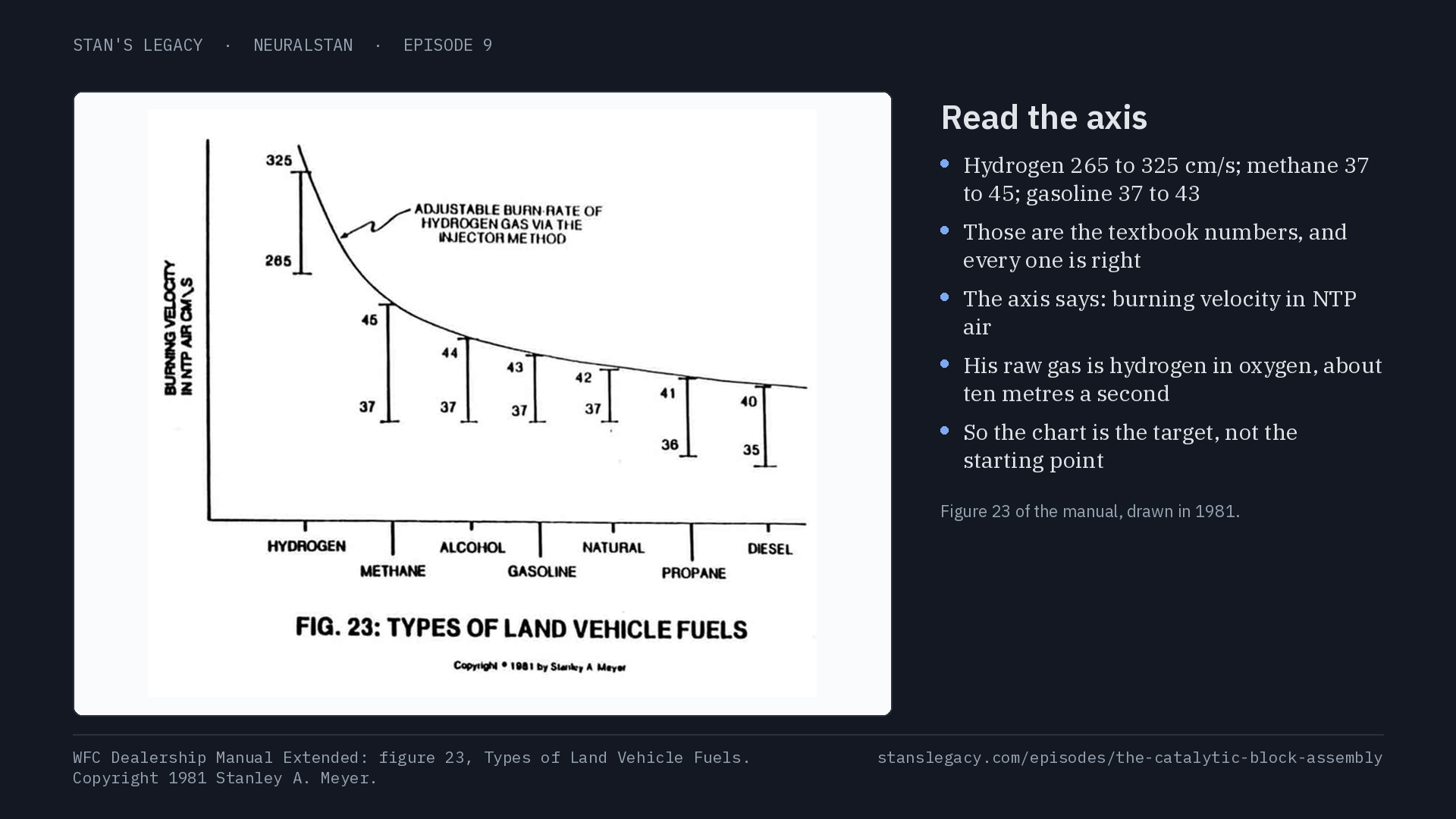
Read the axis Figure 23 is a chart of burning velocity in air.
-
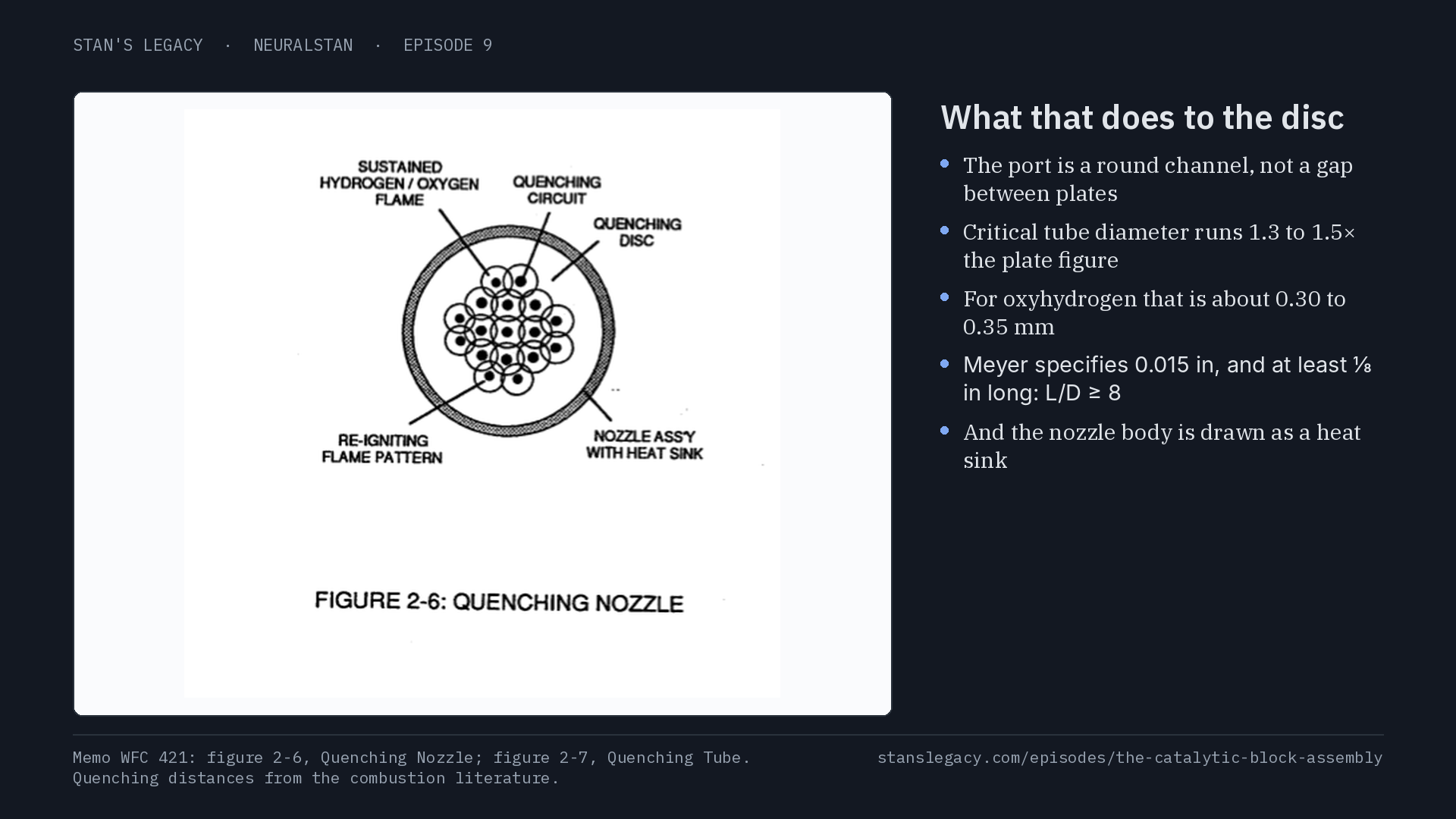
What that does to the disc The quench gap against air and against oxyhydrogen, beside the port Meyer specifies.
-
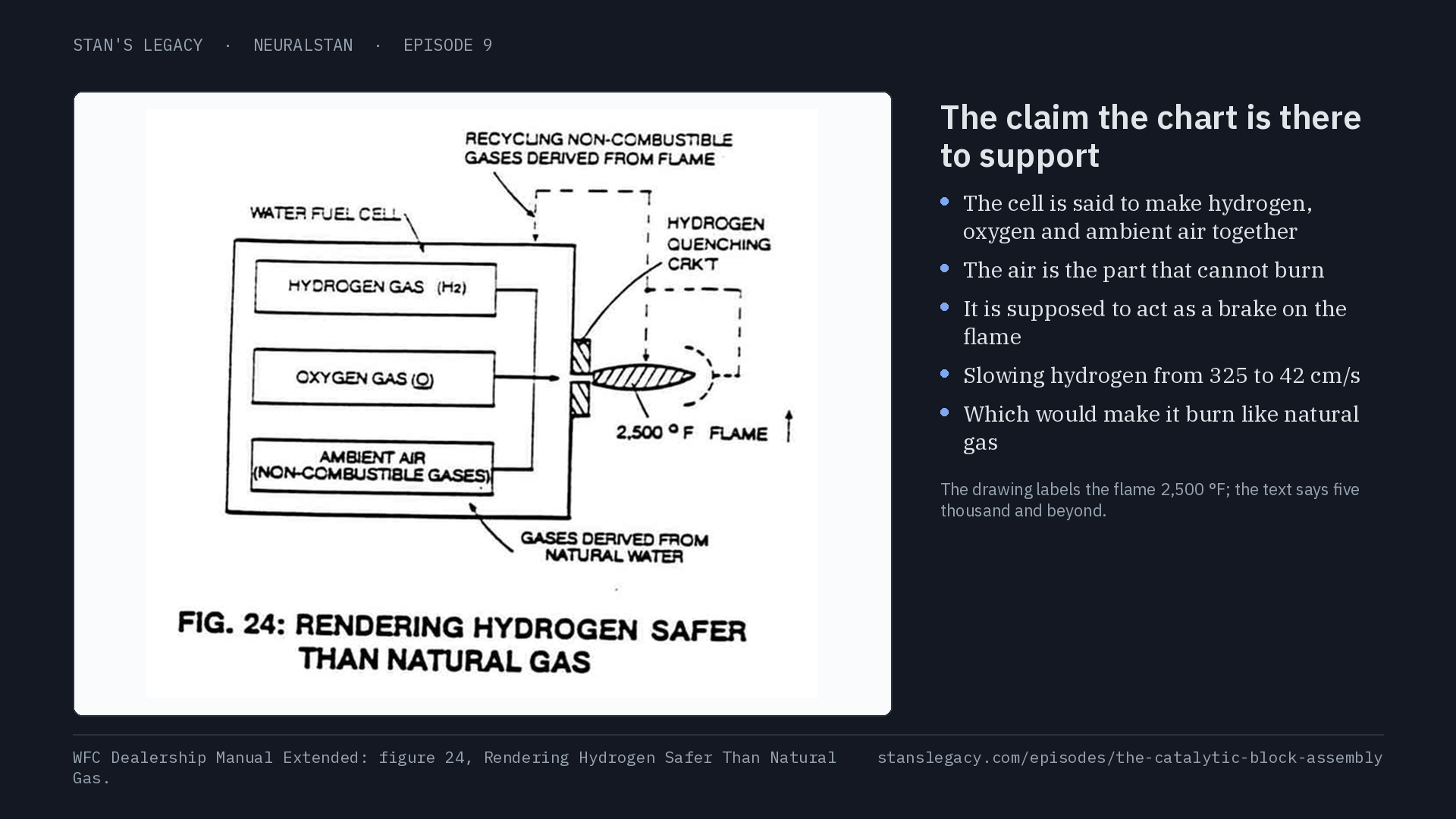
The claim the chart is there to support Figure 24: rendering hydrogen safer than natural gas.
-
Seventeen percent The manual's figure for dissolved air, beside the measured one.
-
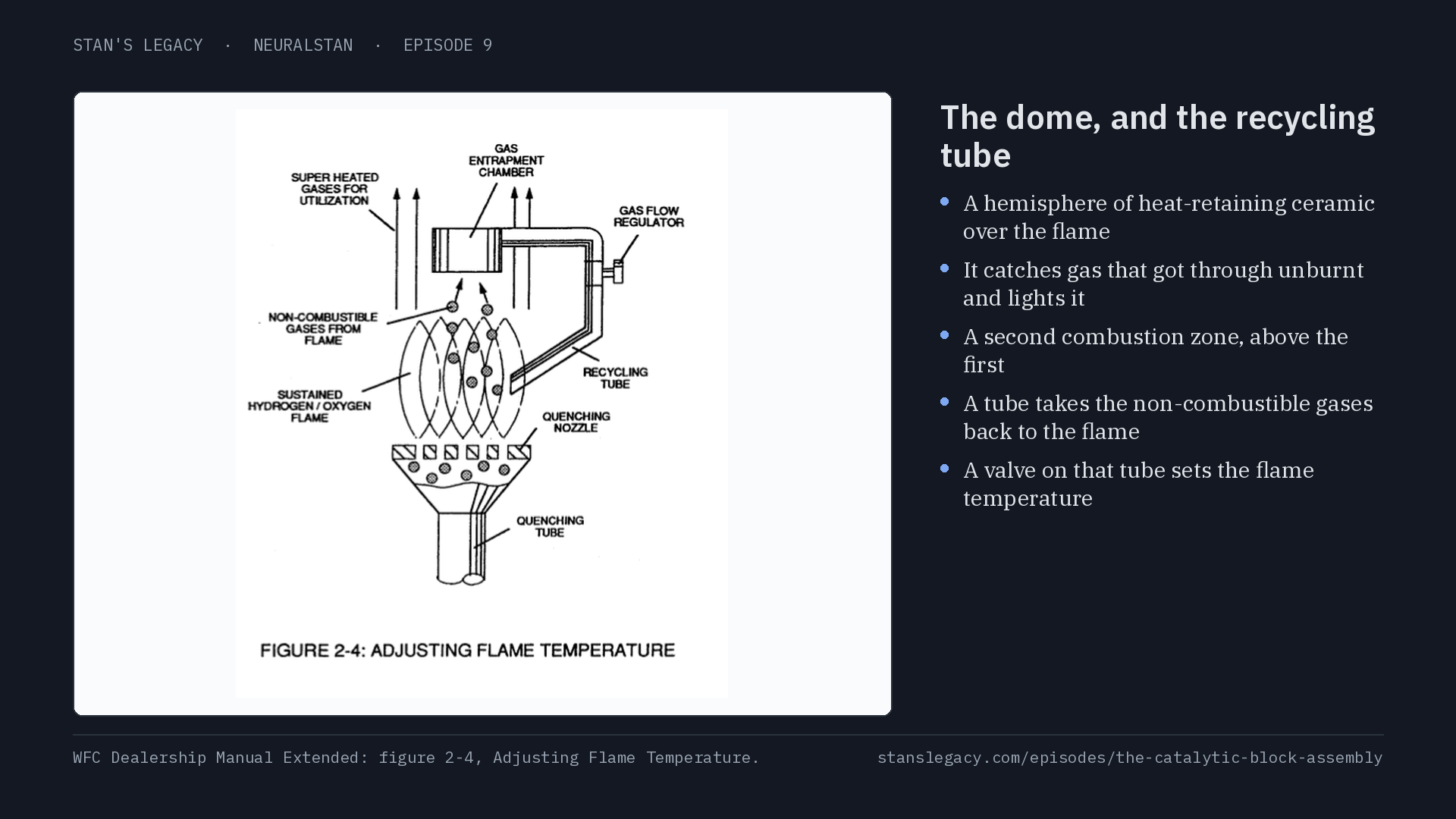
The dome, and the recycling tube Figure 2-4: adjusting flame temperature.
-
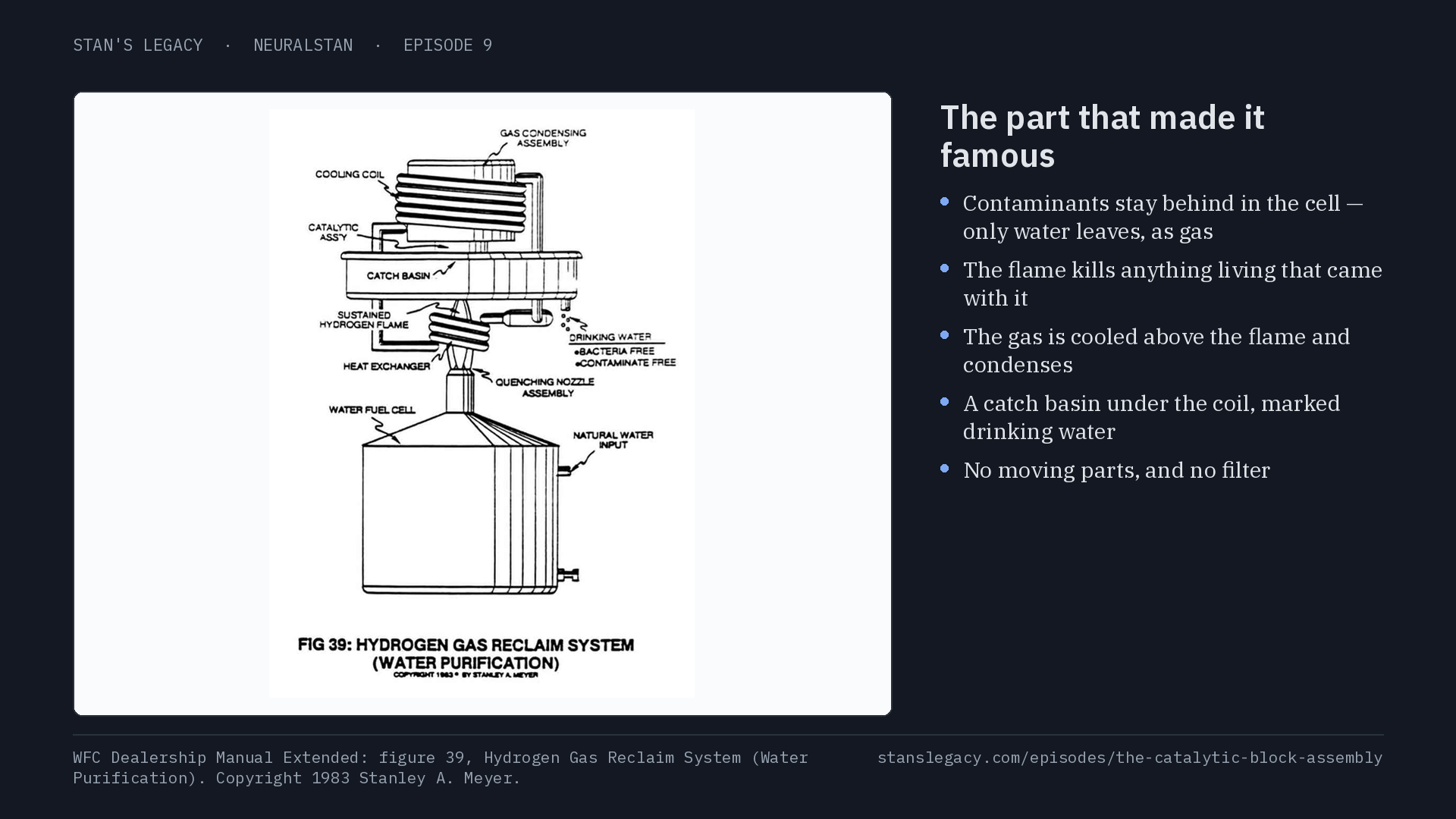
The part that made it famous Figure 39: the hydrogen gas reclaim system, with the condenser and the catch basin.
-
Calculation
Gas yield and Faraday efficiency Gas yield and Faraday efficiency, for putting your own numbers in.
-
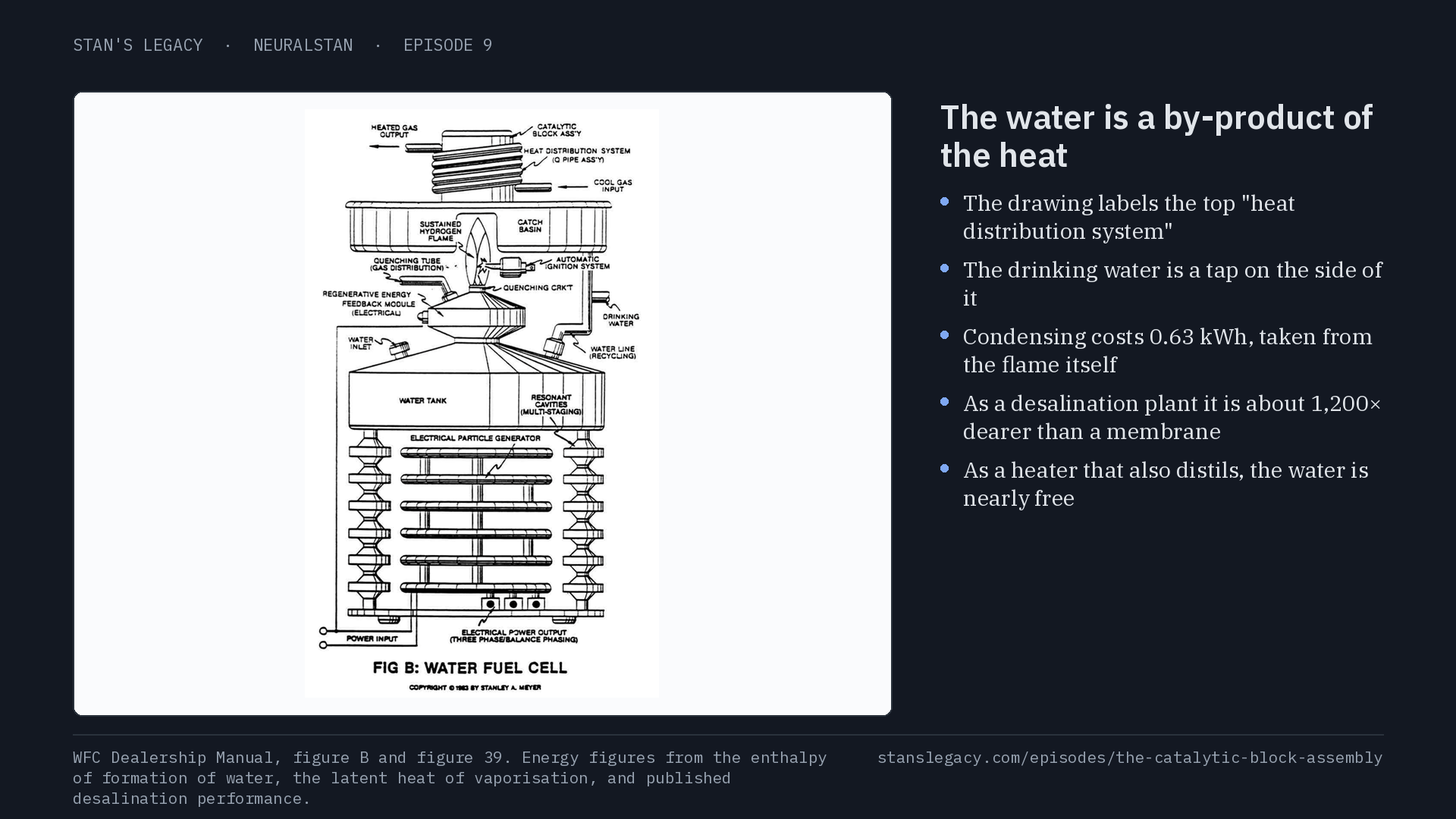
What a kilogram of clean water costs The three routes, side by side.
-
Document
Hydrogen Gas Utilization The sales manual's chapter on burning the gas.
-

Episode 8: The Steam Resonator Episode 8, the same manual read the same way.
The burner that sits on top of the water fuel cell: a quenching nozzle to stop the flame running back down the pipe, a ceramic dome over it to burn what the flame missed, and a condenser above that to catch the water the flame makes. Meyer called the whole stack the catalytic block assembly, and in the extended dealership manual he claims it will hand you drinking water on demand with no filter in the system.
About the voices. Three people speak in this film and none of them is a person. NeuralStan is the archive reading its own holdings aloud, in a stock synthetic voice. Stan Meyer is a voice cloned from thirty seconds of the Deer Creek conference tape of 1985; it reads only sentences he wrote or said, each cited below, apart from the sign-off at the end, which is written for the film. Evil Stan is a character — the archive's sceptic, from the StanBot Discord, who checks the arithmetic and is rude about it. He is given a plainly different voice and a drawing instead of a photograph, so that nothing he says can be mistaken for something Meyer said. His opinions are the archive's, not Meyer's.
What the assembly is
Three parts, stacked on the cell, drawn in figure 2-8 of the manual. The quenching nozzle carries the gas out through a disc of tiny ports. The catalytic dome, a hemisphere of heat-retaining ceramic, sits above the flame. The condensing assembly sits above that, and the drawing labels its outlet drinking water, bacteria free, contaminate free.
The quenching circuit is the part with real engineering in it. A flame cannot propagate down a passage narrower than its own quenching distance, because the walls pull heat out of the flame front faster than the reaction puts it in. That is how every flashback arrestor in industry works, and Meyer specifies it properly: ports under 0.015 inch across and at least an eighth of an inch long, formed in alumina so the ports do not grow as they are cooked. The device record is Quenching Circuit and the shorter chapter is Catalytic Block Assembly.
Where the numbers are right
Figure 23 of the manual is a chart of burning velocities: hydrogen at 265 to 325 centimetres per second, methane 37 to 45, gasoline 37 to 43, diesel 35 to 40. Those are the textbook laminar burning velocities and they are correct. The flame temperature he claims, five thousand degrees Fahrenheit and beyond, is right for hydrogen burning in oxygen — the adiabatic figure is about 3,200 kelvin, near 5,300 °F. And the quenching-distance principle behind the disc is sound.
Where they are not
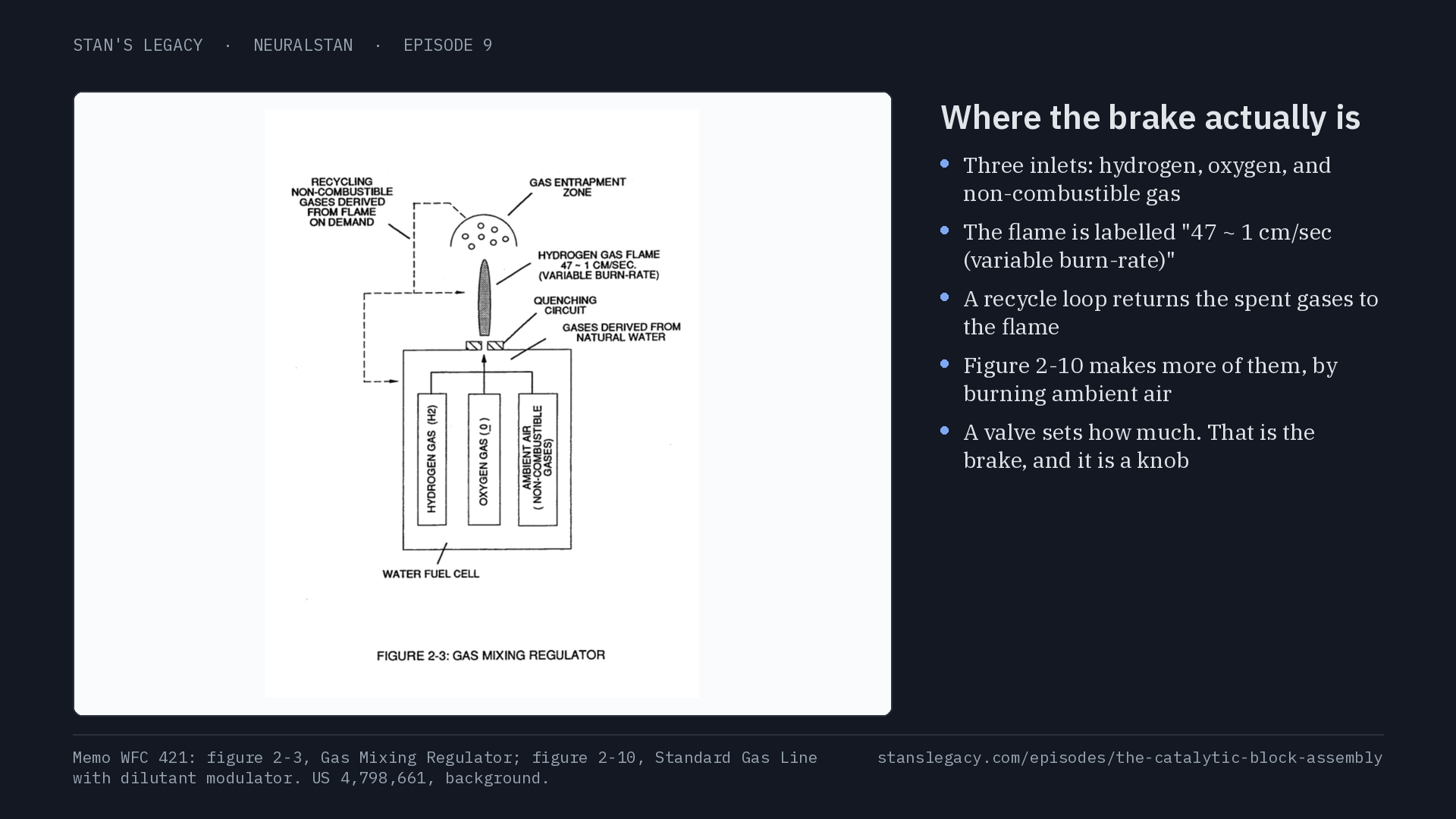
Figure 23 is labelled "burning velocity in NTP air". In air. The raw gas leaving Meyer's cell is hydrogen and oxygen, not hydrogen and air, and hydrogen in oxygen burns three to four times faster, around ten metres a second. That is worth knowing, and the wrong conclusion is easy to draw from it: figure 23 is Meyer's target, not his starting point, and the gas he intends to reach the disc is the diluted mixture, which figure 2-3 labels "47 ~ 1 cm/sec (variable burn-rate)".
On the disc itself, the margin is thinner than it should be but not the way this film first said. A quenching distance is measured between flat plates; the port is a round channel, and the critical tube diameter runs about 1.3 to 1.5× the plate figure, which for oxyhydrogen is roughly 0.30 to 0.35 mm against Meyer's 0.38 mm. He also specifies the channel at least ⅛ inch long (L/D ≥ 8) and draws the nozzle body as a heat sink, and length and cooling are how real arrestors work. So it is just above the line rather than at twice it. Build it anyway, and put a liquid bubbler in the line behind it: the margin is too thin to be the only thing between you and the cell.
"Water contains 17% to 19% per volume of ambient air." It does not. Water at 20 °C dissolves about 18.5 millilitres of air per litre, which is 1.85% by volume, a tenth of the figure in the manual and the same digits. It reads like a dropped decimal point, and measured against the gas the cell evolves the dissolved air is about a thousandth of one percent.
But it does not carry the burn-rate argument, and this film used to say it did. Every document puts the brake somewhere else: on non-combustible gas that is added. The cited chapter says to "capture and recycle the non-combustible gases being expelled from said sustained hydrogen flame", which are "flow-regulated and transferred back". Figure 2-10 draws a small open-flame assembly with an ambient-air inlet whose only job is to make more of them, a burnt-air generator Meyer calls a dilutant modulator. The patent's background says "there is added to the mixture other non-combustible gasses in a controlled amount". And Don Gabel, describing the buggy in 2008, says "he's putting in a lot of non-combustible gases along with some ionized air... he also sends in some exhaust recirculation back into the intake. That's all to control the burn rate." The dissolved air is Meyer's wrong explanation for why his raw flame looked soft; it is not the mechanism the machine uses, and correcting it takes nothing away from the machine.
This also resolves what looks like a contradiction over flame temperature. The manual: "a sustained hydrogen-oxygen flame well over 2,500 degrees Fahrenheit without any spark-back... If for some reason you need a flame temperature greater than 2,500 degrees F., simply reduce the amount of non-combustible gases... If you need the flame temperature to be lowered, simply recycle the expelled flame gases." 2,500 °F is the diluted working flame; 5,000 °F is the undiluted one. The valve is the control.
"The superheated gases prevent Nitrous Oxide (N₂O) formation." Loosely worded: thermal nitrogen oxides are NO and NO₂ rather than N₂O, and they form faster as a flame gets hotter, not slower. But the conclusion is right, and so is his reason, which he is usually said never to have given. He gives it in the Hydrogen Gas Utilization chapter: "Once the oxygen and hydrogen atoms are completely locked into the water molecule formation, the atoms are consumed and cannot unite with other ambient air gases. For example, Nitrous Oxide (N₂O) cannot form since there are no oxygen atoms available to unite with the non-combustible nitrogen gas to form an oxide gas." Thermal NOx needs spare oxygen and spare nitrogen in the same hot place, and a stoichiometric flame under a dome that consumes the escaped oxygen has neither. Wrong name for the gas, right physics.
What it costs to purify water this way
Splitting one kilogram of water takes 15.9 megajoules, 4.41 kWh, and that is a thermodynamic floor. Boiling the same kilogram takes 0.63 kWh; a reverse-osmosis membrane takes about 0.0035 kWh. On those numbers the stack is seven times dearer than a kettle and roughly 1,200 times dearer than the membrane, and if you want water that is the end of it: boil it, or buy a membrane.
But that charges the whole splitting energy to the water and none of it to the heat, and heat is what the machine is for. Figure B labels the top of the unit heat distribution system (Q pipe ass'y); the drinking water is a tap on the side of the catch basin, and the text says the collected water is "drained off for drinking water or re-routed back to the Fuel Cell for hydrogen reuse". The condenser is an absorption cycle with no moving parts: a first-stage exchanger in the flame heats a cycling gas, the gas expands, and the expansion cools a second exchanger. Meyer compared it to a gas-fired refrigerator himself at Einsiedeln. So the water is condensed by heat that was otherwise going up the flue, and if you wanted the heat anyway it is very nearly free.
The number that would settle it has never been published: the coefficient of performance of the whole stack as a heater, and the litres of water caught per kWh of useful heat delivered. See Coefficient of performance and Gas yield and Faraday efficiency.
Sources
Everything put on screen is listed under What was shown, in the order it came up, and each of those records links back here. The transcript beside the recording is the script the voices read, with the clock on every line.
catalytic block assembly quenching circuit WFC 421 dealership manual hydrogen safety synthetic voice Evil Stan