

The Wavelength of the Gap
The claim at the centre of it all: that a water molecule bounces between two electrodes, faster and faster, for as long as you drive it. Meyer knew the water would fight that, and said resonance would beat the water. His own numbers give 1,439 hertz — inside the band he said it would be.
The archive's own copy, 15 September 2026 35 MB
11 views
0 watched live
0 at once
What was shown
-
Document
Resonant Cavity Hydrogen Generator That Operates with a Pulsed Voltage Electrical Potential The Canadian patent: the resonant cavity, and the mechanism in full.
-
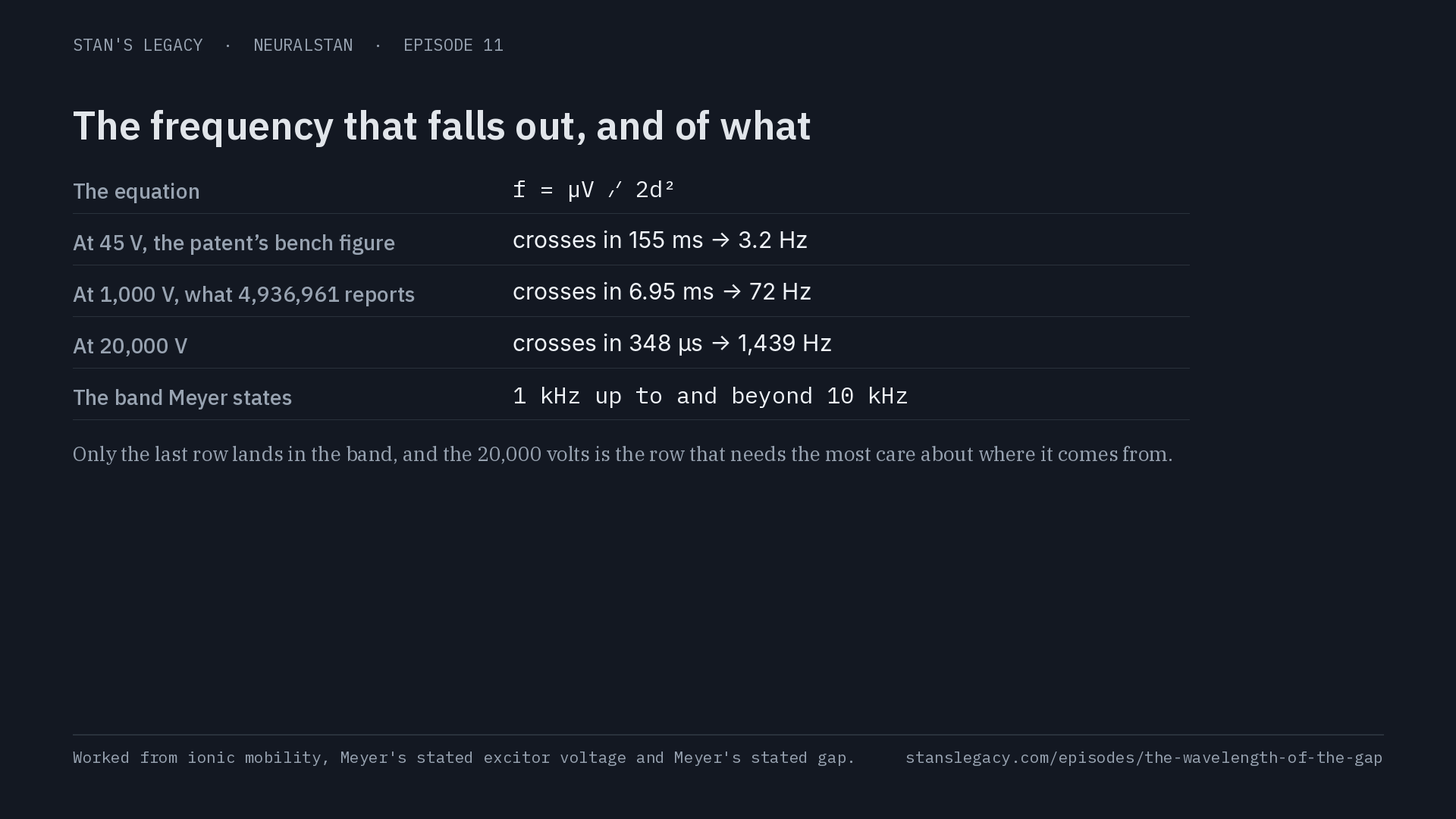
So here is his frequency Meyer's own voltage and his own gap, through his own mechanism.
-
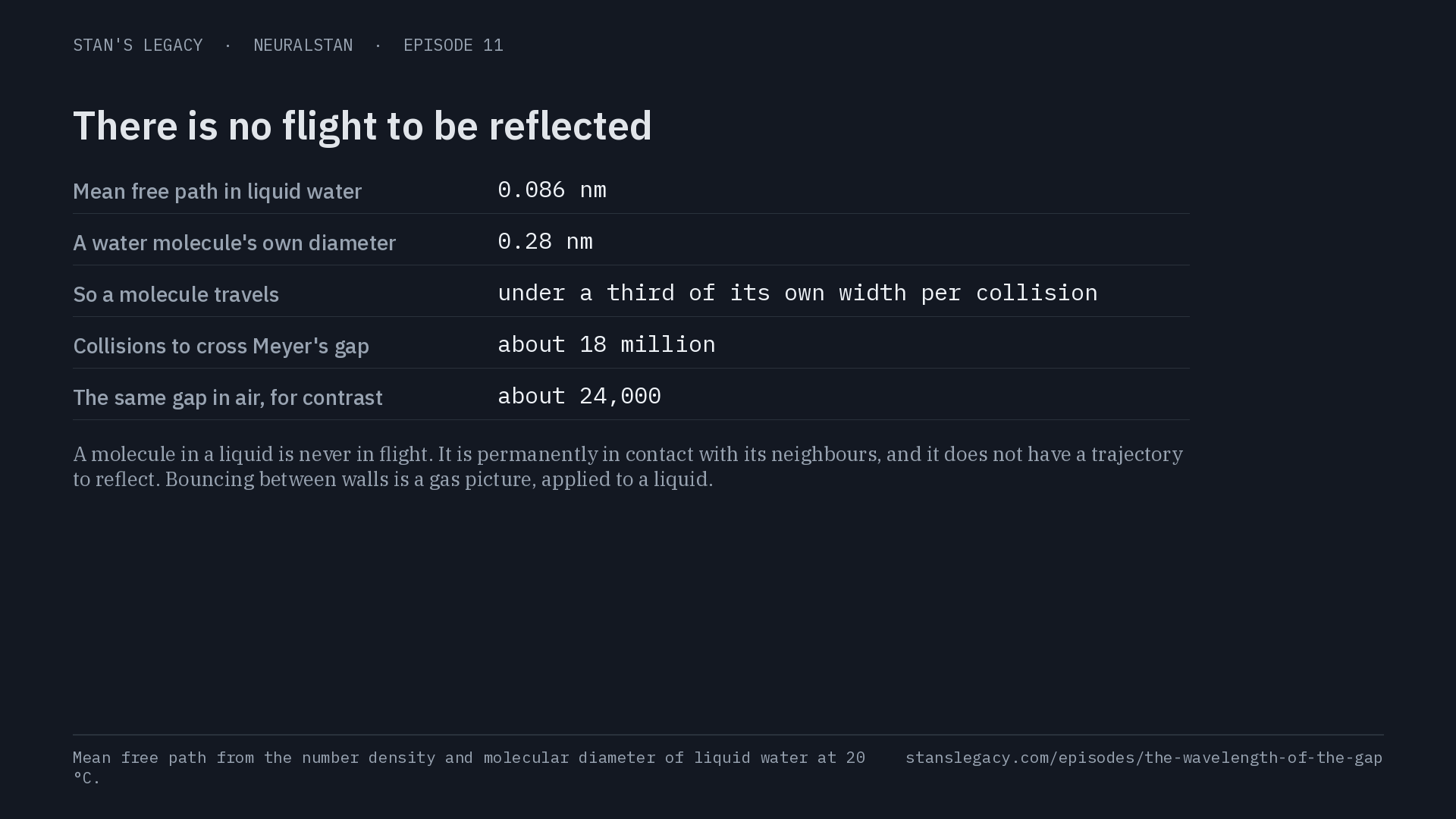
There is no flight to be reflected How far a water molecule gets before it hits another one.
-
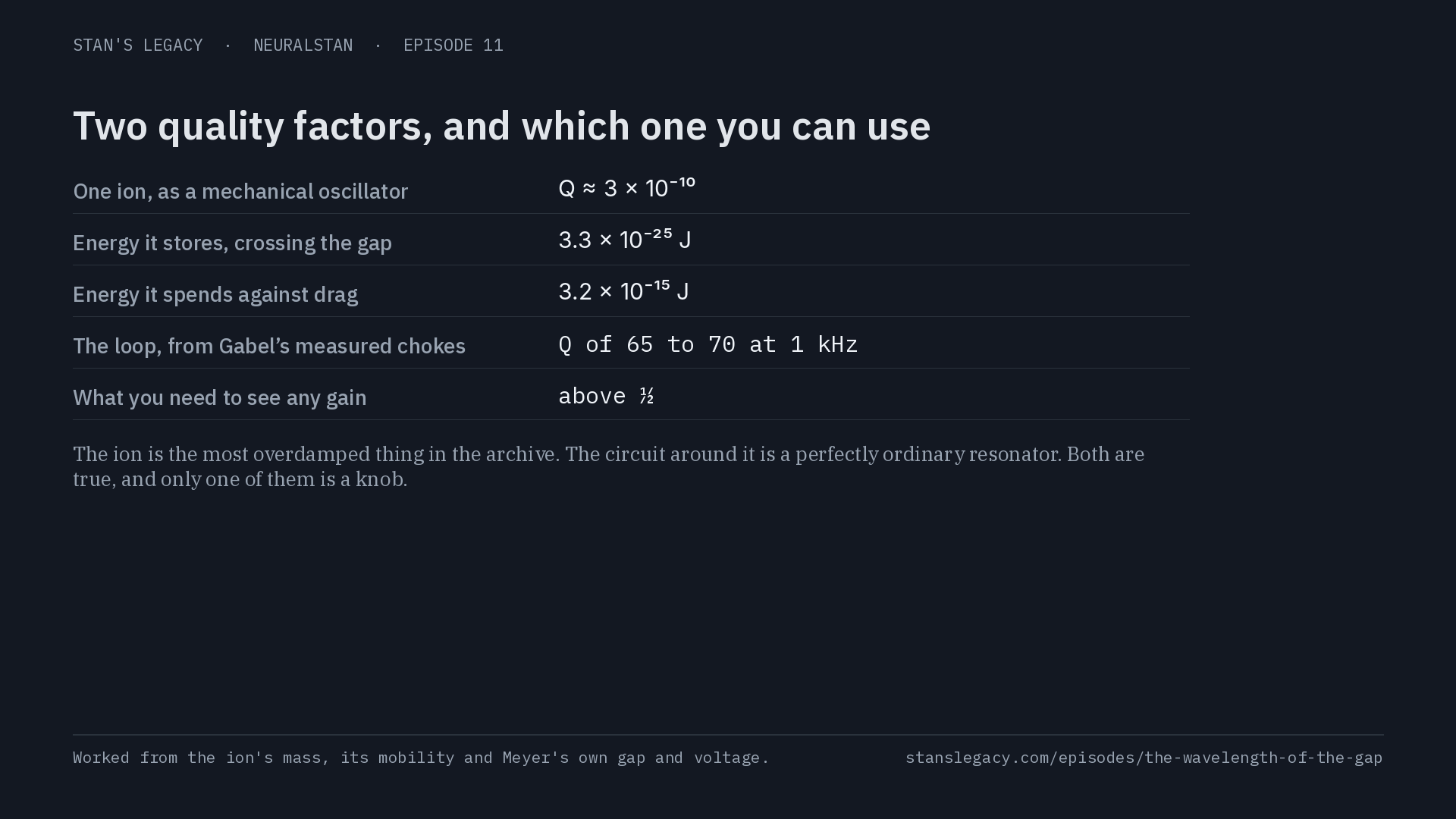
The number that settles it Energy stored against energy spent, for one ion crossing one gap.
-
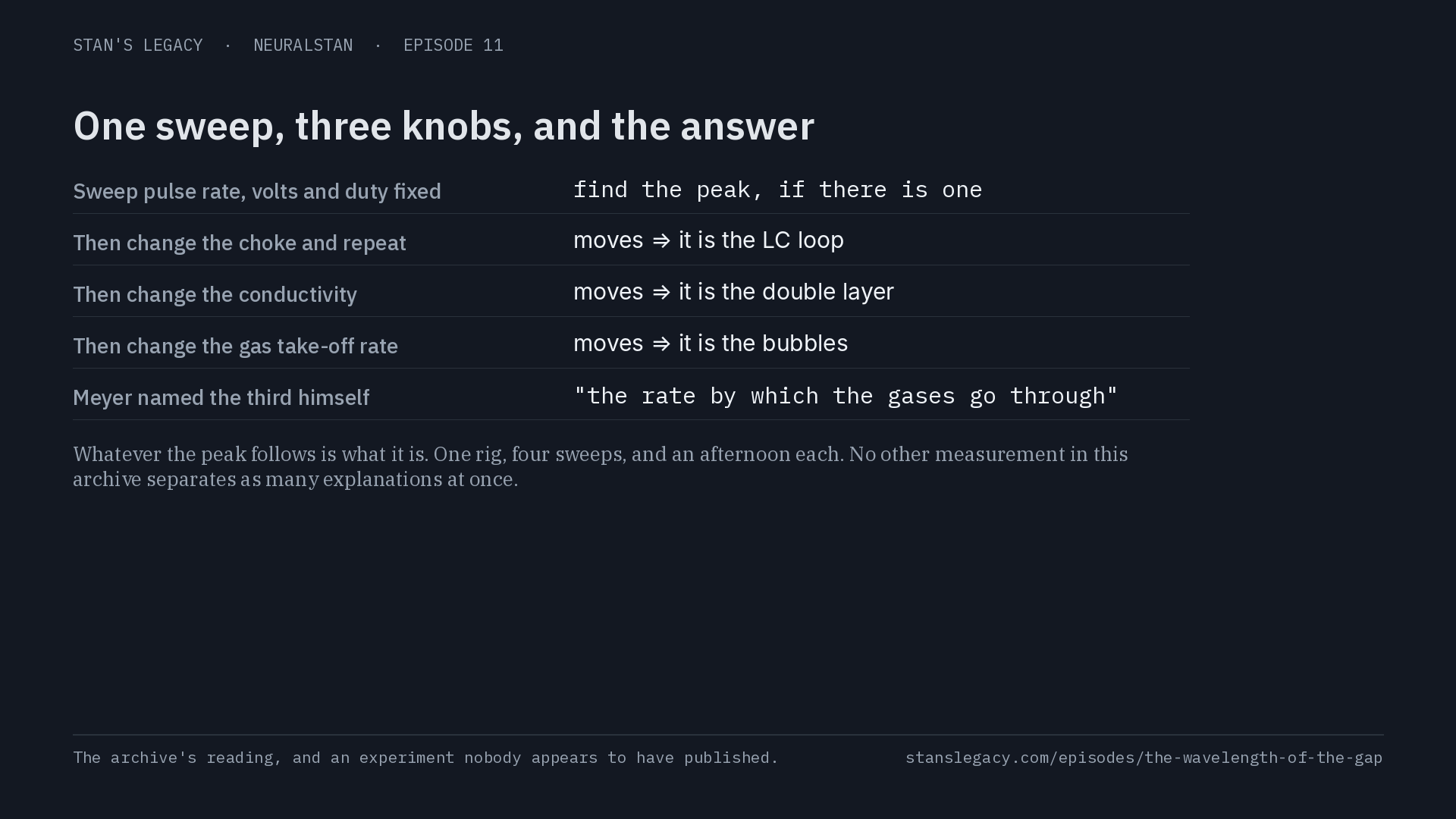
The two models predict different shapes How to tell a resonance from a transit time with one frequency sweep.
-
Document
Particle Oscillation as a Energy Generator Meyer's own argument from first principles.
-

Episode 10: Resonant Action Episode 10: the same claim, as an electrical circuit.
Episode 10 looked at resonant action as an electrical circuit and found the frequency in the wrong place. This is the other resonance, and it is the one Meyer actually cared about: the claim that a water molecule travels back and forth between two electrodes, faster and faster, for as long as you drive it.
The fullest statement of it is not in the American patent at all. It is in the Canadian one, filed in 1983, whose figure 1 draws a sphere inside a sphere with the molecules' flight paths marked as arrows across the gap.
It has been found that the distance between plates of the exciters will have, or can be adjusted to have, a wavelength or partial wavelength, or a multiple wavelength, related to the motion of the water molecule in travelling from the one plate to the other. When the wavelength is matched with a physical force equal in frequency to that wavelength the inner area becomes a resonant cavity.
And he raises the obvious objection himself, which is what makes it a serious claim rather than a vague one:
Considering a single molecule, the water molecule's motion will under normal conditions be impeded by the water.
He knows water is thick. His answer is that resonance beats it:
The molecule, upon striking the inside surface of the outer sphere, will be reflected and directed to an angular surface where it again will be reflected. This action continues indefinitely and will continue until the applied energy is terminated. Thus, a resonant cavity causes the water molecule to travel back and forth continuously and at a velocity that increases geometrically.
That is the whole thing, in his plainest words, and every part of it can be checked.
The frequency is right
Ions in water have measured mobilities. A hydronium ion moves at 3.63 × 10⁻⁷ m²/V·s, and in a field E it drifts at v = µE. Put the applied voltage across Meyer's own sixteenth-of-an-inch gap and the time to cross is d²/µV, so the frequency at which that gap is half a wavelength of the motion is
f = µV ⁄ 2d²
| Voltage across the gap | Drift speed | Time to cross | Frequency |
|---|---|---|---|
| 45 V (4,798,661's bench run) | 0.010 m/s | 155 ms | 3.2 Hz |
| 1,000 V (4,936,961, this cell) | 0.23 m/s | 6.95 ms | 72 Hz |
| 20,000 V | 4.57 m/s | 348 µs | 1,439 Hz |
And that 20,000 V is the wrong number. It comes from the RLC chapter of WFC 418, and is usually taken as Meyer's figure for the excitor array, and presented 1,439 Hz landing inside his stated band as the strongest result in the archive. That was wrong. The RLC chapter is not about the water cell: its figure 1-1 is a gas resonant cavity with a gas input and a laser energy injection, and the chapter ends "where RE is the dielectric constant of Argon (Ar)"; the neighbouring Circuit Component Interaction chapter says outright that argon between the plates forms the capacitor. The 20 kV belongs to the gas processor.
The document that actually gives this cell its 1/16 inch gap, US 4,936,961, gives its voltage in the same paragraph: "Resonance in the circuit was achieved at a 26 volt applied pulse to the primary coil of the toroid at 10 kHz", with the cell rising "to about 1000 volts and more". At 1,000 V the same equation gives 72 Hz, a factor of 140 below the 10 kHz that patent reports. Meyer does say 20,000 V about the water cell elsewhere (the lecture extract, and the evening workshop's "taking like 12 volts and amplifying it to 20,000 volts"), but those describe a current-blocked circuit, not a measured field across conducting water during a pulse.
So the honest position: the equation is sound, the mobility is a table value, the gap is his, and the voltage is the unknown nobody has ever put a probe on. That is a measurement waiting to be made, not a prediction confirmed.
The mechanism is not
There is no flight to reflect. A molecule in liquid water travels 0.086 nm between collisions — under a third of its own diameter. Crossing Meyer's gap would take about 18 million collisions; the same trip in air takes 24,000. A molecule in a liquid is permanently in contact with its neighbours. It has no trajectory to reflect and no wall to bounce off that it is not already touching. Reflecting between surfaces is a picture borrowed from a gas.
There is no restoring force. The field drags the ion one way until it reverses, then drags it back. Nothing pulls it toward a centre. That is not a pendulum; it is a spoon pushed through treacle, first one way and then the other.
And nothing survives a cycle. An ion's momentum relaxes against the water in 0.07 picoseconds. Crossing the gap at 20 kV it carries 3.3 × 10⁻²⁵ joules of kinetic energy and does 3.2 × 10⁻¹⁵ joules of work against drag getting there — it spends about ten billion times more than it stores, putting the quality factor of this "resonator" at roughly 3 × 10⁻¹⁰. You need above ½ to see any resonant gain at all.
So the impediment of water cannot be overcome by resonance, because the impediment of water is precisely the thing that prevents there being a resonance. Velocity cannot increase geometrically; it reaches terminal velocity in under a picosecond and stays there.
What the number actually is
The natural answer is a transit time. That answer does not survive either, and the reason is instructive. The transit picture needs the field to reverse and turn the ion round, and every drive in every cited document is unipolar: CA 1234773 claim 8(c) "pulsating the same, without any change of polarity"; US 4,798,661 "uni-polar pulse d.c. voltage" throughout; this film's own figure 4 never goes below zero. Under a unipolar train the ion drifts during on-time and stops during off-time. It never turns back, so it always arrives, and its mean speed is µE times the duty cycle whatever the pulse rate. There is no shelf at the transit frequency because there is no transit frequency.
But there is a spring, and it is in the wiring. The cell is a capacitor (about 1.5 nF with water in it) and the charging chokes are inductors, and that loop has all three ingredients. Don Gabel's 2009 measurements of an estate VIC (VIC coil readings) put the chokes at 1.1 to 1.3 H on the core at Q 65 to 70, which with a 1.5 nF cell rings at 2.6 to 3.7 kHz — inside Meyer's band. His own later patent says as much: "Resonance in the circuit was achieved."
And he drew what he expected, three times, and it is not a peak. In the Resonant Cavity Mode of Operability chapter, figure 13 plots gas yield against pulses per second rising to a "RESONANT-ACTION (mega gas-yield)" point; figure 15 holds the pulse rate and ramps the voltage for a "GEOMETRICAL GAS-YIELD PROGRESSION"; and figure 14 shows a RESIDUAL GAS-YIELD decaying through the off-time after the pulses stop. A knee, and a memory after switch-off. Nobody has plotted either against a DC control at the same mean current.
The experiment that separates the candidates. Sweep pulse rate at constant cell voltage and duty, and find the peak if there is one. Then change one thing at a time: the choke (moves ⇒ the LC loop), the conductivity (moves ⇒ the double layer), the gas take-off rate (moves ⇒ the bubbles). Meyer named the third himself, in New Zealand in 1989: "the other factor that affects resonance is the rate by which the gases is going through the resonant cavity." Whatever the peak follows is what it is.
And this part he simply had right
An increase in the spacing will result in less generation, whereas a decrease in the spacing of the plate exciters will result in an increase in gasses.
True, and needing no resonance at all: a smaller gap at the same voltage is a bigger field over a shorter path, so more current and more gas. He observed it correctly and reached past the ordinary explanation for a more exciting one, which is the pattern of this whole archive and a more interesting kind of mistake than being wrong.
About the voices
Two speak, and neither is a person. NeuralStan is the archive reading its own holdings aloud in a stock synthetic voice. Stan Meyer is a voice cloned from thirty seconds of the Deer Creek conference tape of 1985; it reads only sentences he wrote or said, each cited here, apart from the sign-off, which is written for the film.
particle oscillation resonant cavity CA1234773A1 patent 4798661 ion mobility transit time mean free path plate spacing synthetic voice