

Prior Art
Two United States patents of 2022 and 2023 draw Stan's circuit, his chokes, his cell to the thousandth of an inch and his LED array under new names, and their front pages cite no Meyer patent. The drawings side by side, the claims against the physics, and what an expired patent is worth.
The archive's own copy, 21 September 2026 44 MB
3 views
0 watched live
0 at once
What was shown
-
Document
Method For The Production Of A Fuel Gas US 4,936,961, granted 26 June 1990, expired 5 August 2007.
-
Document
A control and driver circuits for a hydrogen gas fuel producing cell WO 92/07861: the VIC's control and driver circuits.
-

Episode 19: He Chose the Losses Episode 19: the same circuit, read for its losses.
-
Document
Voltage Performs Work Meyer's memo: Voltage Performs Work.
-
Document
Inductance Reactance (Rs - Cd - FL) 'Electron Inhibiting Effect'.
-
Document
Electron Extraction Process The Electron Extraction Circuit, WFC 418.
-
Document
Circuit Resistance Meyer's Circuit Resistance memo: the matrix, with Rs, Cd and Rp.
-
Document
Resistance (Rs) Stainless wire, and why.
-

Episode 32: Four Windings Episode 32: the stainless choke, worked.
-
Calculation
Coaxial cell capacitance The cell as a capacitor, on the engine.
-

Episode 11: The Wavelength of the Gap Episode 11: what sets the frequency.
-

Episode 14: Amp Leakage Episode 14: where the volts go in a water cell.
-
Document
Resonant Cavity Mode of Operability FIG. 20YAA, 1982: the coils wound round the cavity, the light module on it.
-
Document
Transformer Action Meyer's Transformer Action: the chokes as windings on one core.
-
Document
Controlled Process For The Production Of Thermal Energy From Gases And Apparatus Useful Therefore US 4,826,581, 1989: the Hydrogen Gas Gun.
-
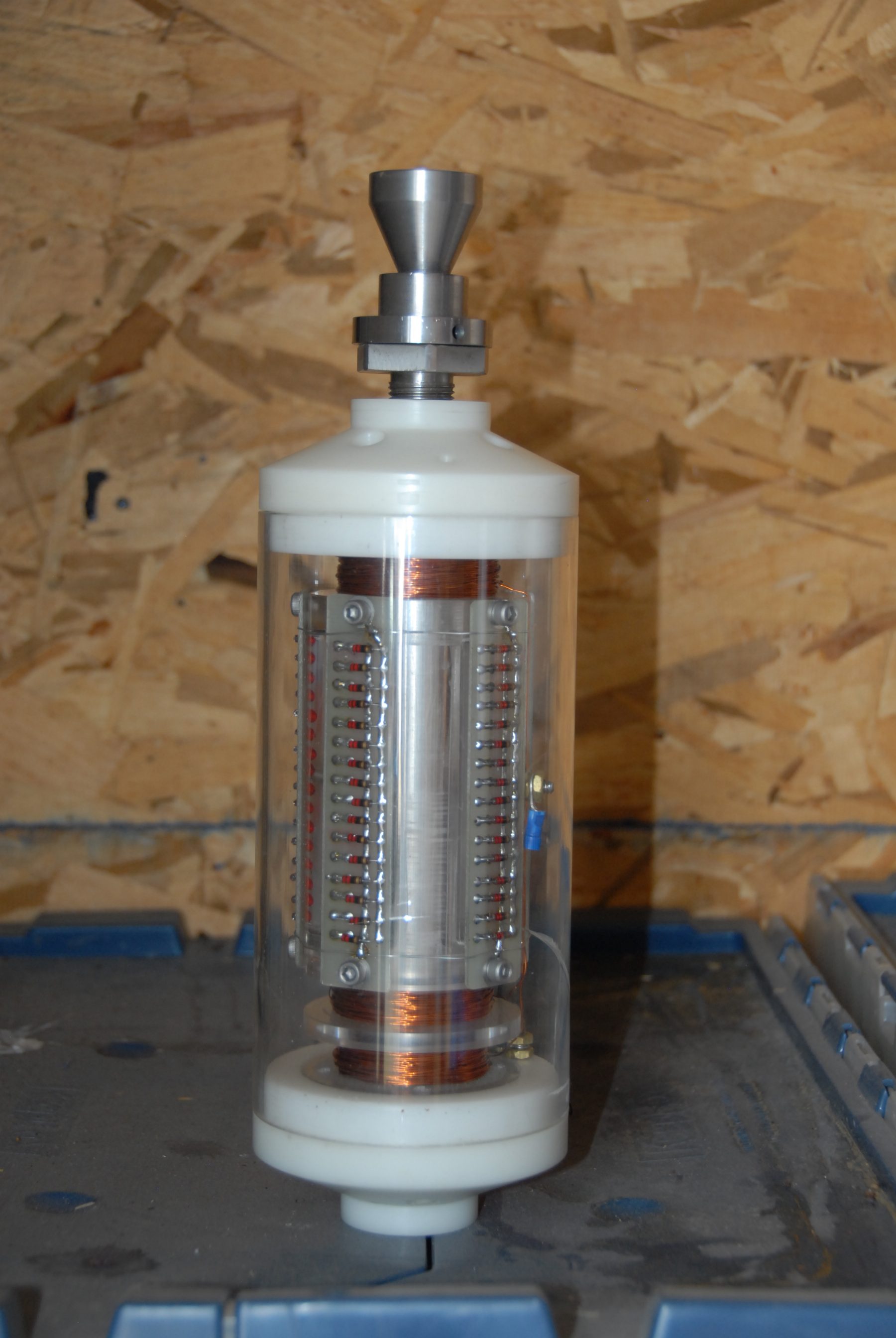
Hydrogen Gas Gun 3 The gas gun itself, from the estate.
-
Calculation
Coil inductance (Wheeler) Wheeler, on the engine.
-
Calculation
Q factor and voltage rise Q, on the engine.
-
Document
LASER INTERACTION WFC 418: the LED cluster array.
-

Episode 30: Atom-Size Episode 30: what an LED does, and does not do.
-

Episode 29: Micro-Size Episode 29: Battelle on the EPG shelf.
Two United States patents, US 11,233,421 (Quantum Kinetic Well, granted 25 January 2022) and US 11,788,194 (Quantum Kinetic Fusor, priority 21 November 2019, granted 17 October 2023), with two Canadian grants of the same two inventions (CA 3,099,989 C, Pulsing Resonant Cavity for Electrolysis, granted 28 February 2023 off the Fusor's own US application 17/005,663 and provisional 62/938,630; CA 3,114,793 C, granted 31 October 2023) and a second Canadian filing of the Well that was never examined and was deemed abandoned on 12 October 2023 for an unpaid maintenance fee (CA 3,114,593), draw a circuit and a cell the archive holds in Stan's hand from 1981 to 1990. This film puts the drawings side by side, reads the claims against the numbers in their own specifications, lists the references their front pages cite, and says what an expired patent is worth. It is about two public documents and the documents they do not mention; it says nothing about intent, which the archive cannot know.
About the voice. Where you hear Stan Meyer in this film, you are hearing a synthetic voice built by a machine from thirty seconds of his voice on the Deer Creek conference tape of 1985. It reads seven lines, each his own words from his patents and memos and each cited below. The narrator is a stock voice and nobody in particular. Treat both as a reading, not a recording.
The wider portfolio. The same inventor holds two further US grants under the Quantum Kinetic name, an Injector (US 11,692,516, 4 July 2023) and an Oscillator (US 11,871,501, 9 January 2024), with a Canadian Injector at pre-grant (CA 3,250,735, final fee paid 20 July 2026) and a fresh Well application published on 12 February 2026 (US 2026/0045374, Quantum kinetic well (omnibus)). This film reads the two that draw Stan's circuit and his cell. Canadian status is as the Canadian Patents Database printed it on 21 September 2026.
What is assumed. The Well's choke inductance is taken from 1,300 turns on a 65 × 50 × 6 mm ferrite ring at a relative permeability of 2,000 (about 1 H; 0.8 to 2.7 H across plausible ferrites); its ring cell as a coaxial capacitor 0.15 in long with a 0.66 to 0.75 in gap (about 2 pF in air, 130 pF in water). The Fusor's secondary is 400 turns of 30 AWG 430FR on a housing about 1 in across, single layer, air core: about 32 m of wire, 375 Ω at 60 µΩ·cm or 490 Ω at 78, and 0.8 mH by Wheeler. The detector window is 25 µm of beryllium with tabulated attenuation. E/N is at one atmosphere and 20 °C. The script that drew the two charts and composed the five pairs is in the repository beside this film.
The drawings, side by side
- The circuit. The Well's FIG. 2C (transistor, diode, 'frequency bypass coil', cell, 'amp inhibiting coil' to ground, unipolar pulse) against Meyer's US 4,936,961 FIGURE 1 (pulse generator, primary on a toroidal core, blocking diode, resonant charging choke, variable inductor, water capacitor).
- The chokes. The Well's FIG. 3C, a 'T.C.T. resistive coil wire matrix' of two bifilar wrapped coils and a diode, against Meyer's Figure 7-8, the VIC Matrix Circuit (memo WFC 426).
- The coil assembly. The Fusor's FIG. 1E, coils C1, S, P, C2 on the housing with the electrodes on the axis, against Meyer's FIG. 20YAA (Resonant Cavity Mode of Operability, copyright 1982): the two resonant charging chokes and the voltage intensifier wound round the resonant cavity, with a 'laser or light module ass'y... with or without color lens' on it; and Figure 6-1, the VIC Coil Assembly (memo WFC 422). Claim 1's 'primary and secondary coils retained centrally between first and second exterior coils' is that assembly without the word choke; the exterior coils are specified in 430FR stainless, the alloy of Meyer's memo.
- The cell. The Fusor's FIG. 3C, a housing with enter and exit ports, coils C1 and C2 at each end and LED arrays down the sides, against Meyer's FIG. 2 of US 4,826,581 (1989), the Hydrogen Gas Gun, and the estate's photograph of the gun itself: clear housing, a coil at each end, two rows of resistors and diodes, nozzle on top. The Fusor's electrodes: outer tube 4 in long, 0.75 in OD, centre 0.50 in, gap 'approximately 0.0625 inches'. Meyer's example (US 4,936,961): 'two concentric cylinders 4 inches long... the outside cylinder was 0.75 inch in outside diameter; the inner cylinder was 0.5 inch... spacing... was 0.0625 inch'. Episode 14's 2,029 pF.
- The light. The Fusor's FIG. 3B LED cluster array (42 × 5 mm at 660 nm, 220 Ω, synced to the unipolar pulse) against Meyer's Figure 1-6 Led Cluster-Array of 1981 (WFC 418), pulsed 1 to 65 Hz.
The words
'Electrolysis using merely voltage, not amperage' (the Well, [0002]) against Meyer's 'Voltage Performs Work' and WO 92/07861's 'electron flow is not permitted'; 'amp inhibiting coil' against the 'Electron Inhibiting Effect'; the Well's FIG. 2G 'Electron Extraction' against the Electron Extraction Circuit of WFC 418 (Figure 1-7, 1981); 'unipolar', 'gated', 'bifilar... side by side' against 'pulsating, uni-polar', 'gated pulse train', 'dual resonant coils, bifilar spiral wrap'; 'resistance values can be set to 11.4 KOhms' against 'typically 11.6 KΩ'.
The numbers, against their own specifications
11.4 kΩ. The Well's chokes are 1,300 turns of 30 AWG copper on a 65 mm ferrite: about 260 m, about 88 Ω. 11.4 kΩ in 1,300 turns needs stainless of about 39 AWG. Meyer's 11.6 kΩ is 715 ft of .0047 in 430 stainless (episode 32). The number belongs to the wire in the memo, not the wire in the Well.
115 kHz. About 1 H on that ring resonates at 115 kHz against about 2 pF, which is the ring cell with air in it. With water, about 130 pF and 14 kHz, in Meyer's stated band. The Well is drawn for air, vacuum and mist.
The stage table. Stages in 'eV' from 0 to 2,000 track the supply's 0 to 2,000 V. 2,000 V across the 1.52 mm gap in air is 1.3 MV/m, 53 Td; a self-sustaining Townsend discharge in air needs about 100 Td. Stage 6, 'Townsend cascading self-maintained discharge, 120 to 2,000 eV', cannot begin in the gap drawn.
The X-rays. FIGS. 5A to 5D on an Amptek XR-100CR: 'super-soft luminous X-rays (6 eV to 2 keV)'. The 25 µm beryllium window passes 6 % at 1 keV and nothing below a few hundred eV; 6 eV is near-UV and never reaches the silicon. The left-edge pile is the same at 20 V (5A) and 40 V (5B). No drive-off spectrum with the same cabling. 'FWHM = 0.3 %' at 5.96 keV would be 18 eV; a Si-PIN delivers 150 to 200 eV. The 2022 paper: 'the radioactive 55Fe calibration sample has similar overall total emissions as the device while ON'.
The Fusor's coils. Secondary 400 turns of 30 AWG 430FR, air core: 375 to 490 Ω, about 0.8 mH; Q from 0.01 at 1 kHz to 0.7 at 50 kHz. 26.5 V × 4 = 106 V; the claim is 17,000 V, a further gain of 160 from a Q below one. The Well's 1,300 turns of copper on ferrite is the opposite design. Resistance and turns are independent knobs (episode 32).
Four more lines. 'Water resonant frequency: 2.4 GHz' (the ISM band; water's absorption peaks above 17 GHz). Magnetite as a 'fused atomic structure' (iron oxide from 304 stainless electrodes in water; no platinum or graphite control in the patent or the paper). No gas rate stated anywhere. The paper: 42.75 mA at 40 V, 1.9 W, stainless and aluminium electrodes, arsenic down 93.7 % in one run; second author at PNNL, four PNNL staff thanked; PNNL is operated by Battelle for the DOE, a coincidence the film names and draws nothing from.
What is new
Water in the gas gun's housing (Meyer ran gas through it); an H11D1 optocoupler between the 5 V pulse and the HV rail; eight transistors on a radial board (FIG. 2A1); a wiper-tap choke (FIG. 2B1); the LED ring and acrylic lens, which are the claim's novelty (FIG. 20YAA drew the light module 'with or without color lens' in 1982) and optically a window at 660 nm (1.88 eV against a 4.8 eV bond; PMMA cuts below ~375 nm); and the water-purification framing.
References cited
The Fusor's front page: six references, all examiner-cited (Davidson US 2009/0224545; New Energy AG US 2012/0222954; Britt US 2019/0136391; Duran US 9,464,358; H2Win US 2016/0230292; FisherH2O US 2019/0382290). The Well's: four (Emerson US 2009/0128972; Shumaker US 2014/0070871; Reno Technologies US 2016/0065207; the Fusor). The Canadian Well: the same three and the Fusor. The archive has not obtained the examiner's citations for CA 3,099,989. No Meyer patent on any of them. Meyer's US 4,936,961, in the Fusor's own classes C25B1/04, C01B3/042 and C25B9/65, is cited by 51 later patents; these are not among them. The archive read the front pages as Google Patents prints them and has not obtained the file wrappers, which are public at the USPTO's Patent Center (applications 17/005,663 and 17/228,925).
What follows
Meyer's method patent expired on 5 August 2007; the circuit is public domain and cannot be taken from anyone. Whether a 2023 claim reads on a 1990 disclosure is an examiner's or a court's question; this film is not legal advice. The Fusor's claim 1 requires the LED cluster array and the acrylic lens, so a rig without them is not what it claims. Three tests: the file wrappers; the cell with platinum or graphite electrodes; the detector with the drive off and the cabling unchanged.
prior art US 11,233,421 US 11,788,194 CA 3,114,793 Quantum Kinetic Well Quantum Kinetic Fusor US 4,936,961 WO 92/07861 VIC patents synthetic voice