

Atom-Size
The spark gap Stan drew for making a magnetised gas, the argon he said would carry it, the light he said would drive it, and the two ways of pulsing the tube put side by side on one scope.
The archive's own copy, 19 September 2026 29 MB
6 views
0 watched live
0 at once
What was shown
-
Document
ELECTRICAL PARTICLE GENERATOR The EPG chapter, section E: the gas, in one sentence.
-
Document
New Zealand 1989, part 2: the house meeting, transcribed New Zealand 1989, part 2, 36:25: no such gas at room temperature.
-
Document
The lab talk, transcribed The lab talk, 13:15: a new way of processing.
-
Document
Electrical Generator Utilizing Magnetized Particles Figure 10 and claim 16.
-
Document
Electrical Particle Generator The Canadian issue, with the same figure.
-

Episode 13: Rotating Dynes Episode 13, where the method was named.
-
Document
Magnetic Gas Lattice WFC 418: iron, nickel or cobalt.
-

Episode 29: Micro-Size Episode 29: the bottle, and the word micro-size.
-
Document
EPG #1 (Red pump model) The build sheet: 90 in/s for a gaseous medium.
-
Document
Electromagnetic Enhancement 'Argon ions act as an insulator.'
-
Document
Deer Creek - Conference Center - Sterling, OH — transcript Deer Creek 1985, 114:26: nickel chrome, and a pumping action.
-
Document
Dynamic Ways To Produce Electricity The Tech Brief: particle beam accelerators, Figure 29.
-
Document
The dealership tape, transcribed The dealership tape: 'gas velocity to co-equal light velocity'.
-
Document
EPG Speculations/Suggestions The bottle: EFH-1, opaque.
-
Document
LASER INTERACTION The LED cluster, and the 1.7 volts.
-
Document
Magnetic Field Enhancement Quiescent and active state.
-
Document
Electrical Particle Generator His summary: 'pulsed to produce a Magnetic Pulse-Wave'.
-
Document
New Zealand 1989, part 3: the house meeting, transcribed New Zealand 1989, part 3, 20:45: the electron and the higher orbit.
-
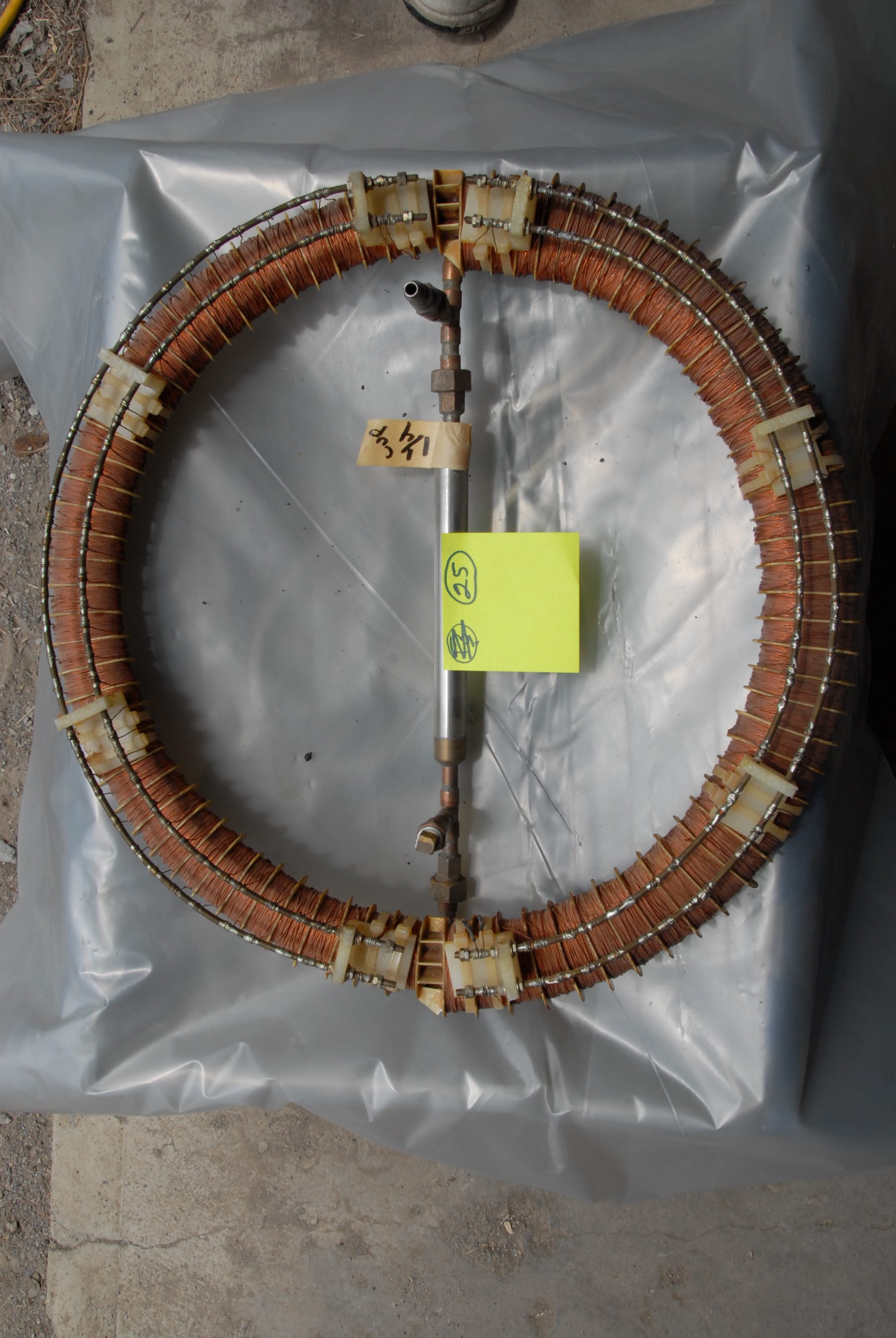
Home Heating & EPG 64 EPG #4, from above.
-
Document
EPG#4 EPG #4 on the site.
-
Document
EPG #2 "Magnetic Spin Generator (Push-Pull Coil) Model EPG #2: the orientation coils, built.
Episode 29 took the liquid word in Stan's EPG chapter, micro-size, to the bench. This film takes the other word, atom-size, and follows it through three things the archive holds: the spark gap he drew in 1982 for making a magnetised gas (EP 0 098 897, Figure 10 and claim 16), the argon or nitrogen he said would carry it, and the light he said would drive it and pulse it (Figure 29 of the Tech Brief, the LED cluster of WFC 418, Deer Creek 1985, New Zealand 1989). Beside each it puts the standard physics: what a spark generator is measured to make, how long an iron aerosol stays an aerosol in a copper loop, how far light gets through it and how hard it pushes, and what a pulse of light does to iron's magnetisation next to what a pulse from his own orientation coil does. It ends with the two pulses on one scope, as a bench test.
None of the physics is Stan's and none of it is a verdict on him. Three of his choices come out right: the spark gap is the industrial method for magnetic nanoparticles today, argon through the gap is what every such generator does, and the grains a spark makes sit at iron's own single-domain window. The gas itself does not survive at room temperature, and he said in 1989 that stabilising it was the problem.
About the voice. Where you hear Stan Meyer in this film, you are hearing a synthetic voice built by a machine from thirty seconds of his voice on the Deer Creek conference tape of 1985. It reads twelve lines, each his own words and each cited below; two of the spoken ones are trimmed with an ellipsis where the tape wanders, and nothing is added. The narrator is a stock voice and nobody in particular. Treat both as a reading, not a recording.
What is assumed. The loop is taken as 3 m of three-eighths copper tube (0.8 cm bore, 150 cm³), the grains as 10 nm iron in argon at one atmosphere and 300 K, and "a loading worth a field" as 10¹² grains per cm³ (0.6 mg of iron). The coil is the orientation coil as recorded on EPG #1, 400 turns of #30 on a half-inch bobbin, run at 0.5 A. The LED cluster is given 30 mW of light and 10 ms on, which is generous for red diodes at 20 mA. Every number on screen scales with those choices, and the script that drew the charts is in the repository beside this film.
The spark gap
The European filing draws it: an evacuated chamber, two electrodes "of magnetizable material", a supply of opposite polarity, a pipe the particles rise through, a field generator on the pipe, and a port into the loop. Claim 16 is that machine on its own. The patent never names the metal; the WFC 418 lattice pages do, iron with nickel or cobalt in its place, the three metals that are ferromagnetic at room temperature.
A spark discharge generator today runs an iron rod against an iron rod with argon flowing through the gap. The spark lasts microseconds and reaches 20,000 to 30,000 K; the vapour quenches at 10⁷ to 10¹⁰ K/s into primary grains of 1 to 10 nm, which agglomerate to 5 to 80 nm (iron, 2023) or 50 to 200 nm (the 1988 generator). About 0.15 % of the spark energy becomes grains. Measured iron yields run 1 to 11 mg an hour. Half a millimetre of argon at one atmosphere strikes at about 1,470 V; 10 nF at 2 kV is 20 mJ a spark. A loading worth a field in the assumed loop is 0.6 mg, a few minutes at the gap.
How long the gas stays a gas
Two clocks. A 10 nm iron grain carries about 10⁵ Bohr magnetons, and two of them touching head to tail hold with about 39 kT, so every meeting sticks. Brownian coagulation at 10¹² per cm³ pairs half the grains in a millisecond; at 10⁸, in ten seconds. Diffusion to the wall of a 0.8 cm bore takes about a minute for 10 nm grains, twenty minutes for 50 nm clumps, four hours for 200 nm chains. One lap of the loop at the build sheet's 90 in/s is 1.3 s. The atom-size gas is chains within a lap and a coating within the hour. In the oil of episode 29 the same grains are kept apart by a surfactant shell and slowed a thousandfold, which is why the liquid word survives the arithmetic and the gas word does not.
Iron atoms in argon is a real experiment: matrix isolation at about 10 K, in solid argon, where a single iron atom is held in a cage and stays single. Warmed, the cage is gone and the iron atoms bind on the first collision; argon binds nothing. What the chapter draws as a covalent net is, in a gas at room temperature, chains of iron.
The light
Stan gave light two jobs. The first, in the Tech Brief and at Deer Creek, is the drive: the tube lined as a light guide ("copper coated with nickel chrome"), and the gas "driven close to the speed of light" by "the physical motion of the low power laser beam". Two things have to be true. The light has to get round the tube: at 10⁸ grains per cm³ a beam runs 420 m before a 10 nm iron grain absorbs it, at 10¹² it is stopped in 4 cm, and in EFH-1 it is stopped at the wall. And the light has to push: 1 mW spread over the bore puts about 10⁻²⁴ N on a grain, and Epstein drag in argon at one atmosphere settles it at 16 pm/s, against the build sheet's 90 in/s, a factor of 10¹¹; a 1 W laser closes that by a thousand.
The second job, in WFC 418 and on his own summary page, is the pulse: the lattice magnetised once, then light pulsed through it to make "a magnetic pulse-wave" through the pickups. The manual's light source is a cluster of red LEDs at 20 mA and 1.7 V, pulsed at 1 to 65 Hz. At that power light's only handle on iron is heat: iron loses about 10⁻⁴ of its magnetisation per kelvin, 0.3 mJ into 10 cm of gas and grains warms them 0.07 K, and ΔM/M is 7 × 10⁻⁶, downward. The orientation coil at 0.5 A gives 99 Oe along the tube for 3.5 W, enough to turn a single-domain iron grain over, ΔM/M of 2. On one pickup the light pulse sits 300,000 to 1 under the coil pulse.
Light does move magnetisation, in physics published after these pages: Beaurepaire et al. (1996) demagnetised a nickel film in under a picosecond with a 60 fs pulse, and Kimel et al. (2005) wrote a magnetisation into a garnet with a circularly polarised pulse and no coil. Both need pulses 10¹² times shorter than a diode's, both are transient, and the first goes the opposite way to the chapter.
Could it work
The spark gap, yes. Argon in the gap, yes. Iron at the size a spark makes, yes. An atom-size gas at room temperature, no. Light as the pump, no, by eleven orders. Light as the pulser, no, by five and a half orders against the coil he built. EPG #4 in the estate photographs has a straight tube across the ring with a hose barb at one end and a small valve at the other: the fill line. The estate holds no spark chamber, argon bottle or laser; it holds the bottle of EFH-1 and the coils.
The bench
Build the gap (two iron rods, 0.5 mm, argon, 10 nF at 2 kV; keep the grains under argon, iron at this size is pyrophoric). Seal a glass tube of the gas with a pickup coil on it, magnetise it, take the magnet away, log the decay: that is the clock in the chart, measured. Then pulse the LED cluster at the tube and pulse the coil at it, on one scope.
EPG spark gap spark ablation argon magnetised gas gas lattice photon drive LED cluster orientation coil EP0098897 WFC 418 synthetic voice