0:00
NeuralStan
·
This is Micro-Size, an episode made by the archive at Stan's Legacy.
0:05
NeuralStan
·
I am NeuralStan, and I am a machine, not a man.
0:09
NeuralStan
·
Episode thirteen ended on a bottle, and on an instruction: be the person standing next to him.
0:14
NeuralStan
·
Somebody was.
0:15
NeuralStan
·
This film is about what they poured into the tube, what the arithmetic says it does, and what twelve other inventors put in the same tube between eighteen ninety and twenty thirteen.
0:26
NeuralStan
·
It ends on one word of Stan's.
0:31
Stan Meyer (synthetic voice)
·
Said liquid slurry is composed of micro-size permanently magnetized particles suspended in a fluid-medium such as liquid Teflon or light-oil, forming a homogeneous liquid-mass.
0:43
NeuralStan
·
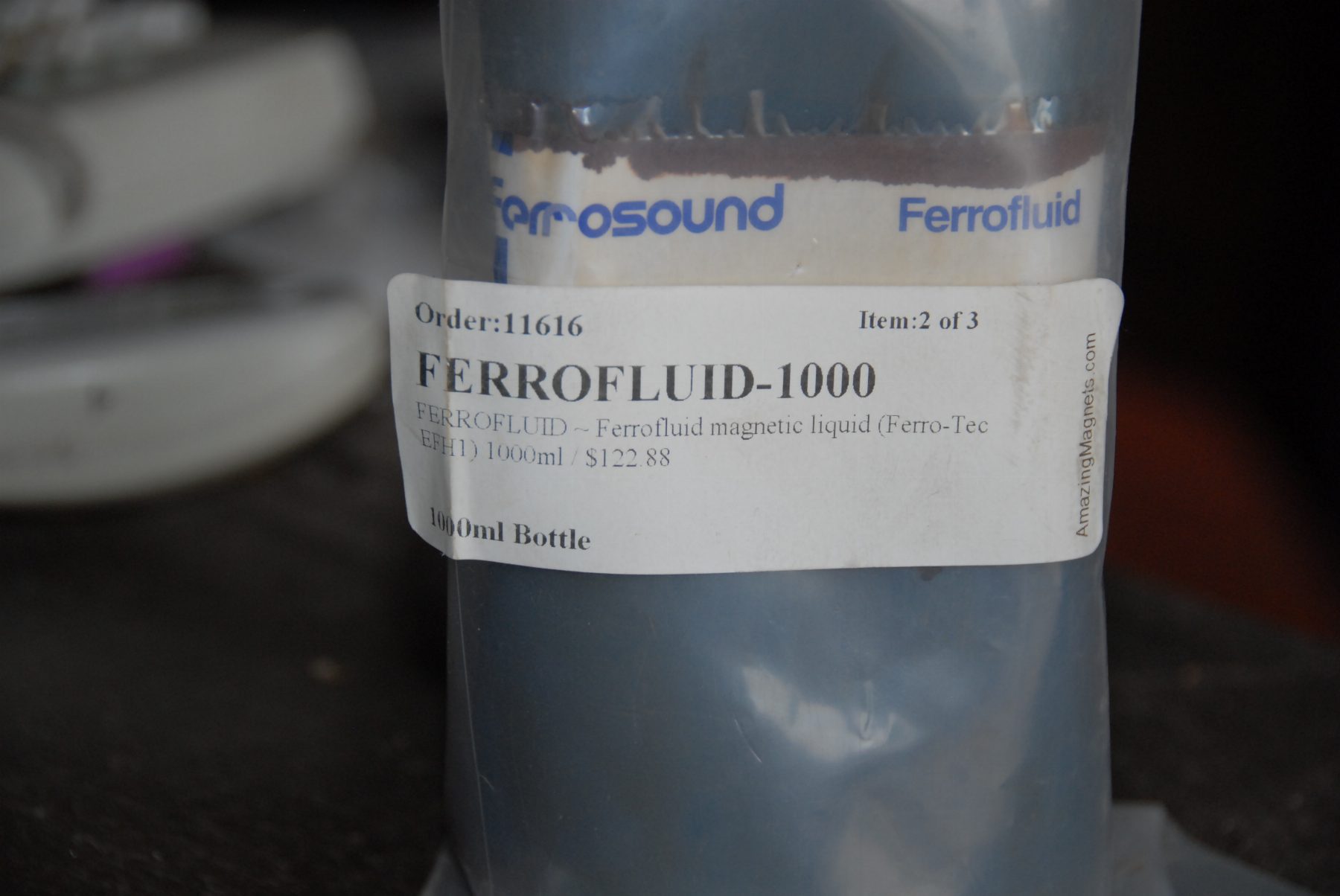
This is the bottle.
0:44
NeuralStan
·
Ferro-Tec E F H one, a litre, a hundred and twenty-two dollars and eighty-eight cents, item two of three on an order.
0:51
NeuralStan
·
It is magnetite, about ten nanometres across, at seven point nine per cent by volume in a light mineral oil of six centipoise, and Ferrotec's sheet gives it four hundred and forty gauss at saturation.
1:04
NeuralStan
·
Episode thirteen worked out what that means in Stan's tube.
1:07
NeuralStan
·
At ten nanometres a magnetite grain forgets its direction in nanoseconds, so a loop full of E F H one is not a permanent magnet being pushed round a circuit.
1:15
NeuralStan
·
It is a transformer with a liquid core.
1:18
NeuralStan
·
Which leaves the obvious next question, and a builder in the archive's community asked it: can you make the bottle remember?
1:28
NeuralStan
·
Here is the recipe, exactly as it was described.
1:31
NeuralStan
·
Take E F H one.
1:32
NeuralStan
·
Add spheres of iron-cobalt, sixty-four to thirty-six, twenty nanometres across, equal in weight to the magnetite, and keep the total loading where Ferrotec had it, so the alloy does not thicken the oil.
1:44
NeuralStan
·
Put the spheres in unmagnetised.
1:46
NeuralStan
·
Then magnetise the whole mixture.
1:48
NeuralStan
·
The reasoning, in the builder's words: the iron-cobalt spheres become permanently magnetised, go toward the magnetite, and once the strong attraction occurs it is a difficult thing to break.
2:00
NeuralStan
·
Adjust the proportion and there is one magnetite per alloy sphere.
2:04
NeuralStan
·
A matrix, perhaps.
2:05
NeuralStan
·
They reported it worked, as a ferrofluid, and planned a run with more alloy to see what the viscosity does.
2:13
NeuralStan
·
Stan, as it happens, wrote a sentence for this in the same section.
2:18
Stan Meyer (synthetic voice)
·
Both homogeneous masses can be doped with different permanently magnetized atoms to encourage electromagnetic field enhancement.
2:27
NeuralStan
·
So a two-material fluid is inside the specification, not outside it.
2:32
NeuralStan
·
What the chapter does not say is what the second material does to the first.
2:36
NeuralStan
·
That is arithmetic, and it is the rest of this film.
2:41
NeuralStan
·
First, what changes.
2:42
NeuralStan
·
Equal weights are not equal volumes, because iron-cobalt is denser than magnetite: the mix is four point eight per cent magnetite and three point one per cent alloy.
2:51
NeuralStan
·
Its saturation magnetisation is a thousand and seventy gauss against E F H one's four hundred and seventy.
2:57
NeuralStan
·
Two point three times.
2:58
NeuralStan
·
In a field, the hybrid answers harder and it answers at a lower field, because a twenty nanometre alloy sphere carries a moment about twenty times a magnetite grain's.
3:10
NeuralStan
·
Now the point marked in red.
3:12
NeuralStan
·
Take the field away and both curves go to the same place: zero.
3:15
NeuralStan
·
What a fluid does inside a field and what it keeps when the field is gone are two different numbers, and the chapter asks for the second one.
3:25
Stan Meyer (synthetic voice)
·
Said longitudinal field remains after said coil-array is de-energized.
3:30
Stan Meyer (synthetic voice)
·
No other energy is needed to maintain said magnetic field.
3:34
NeuralStan
·
Every number that follows is a way of asking one question of a grain: after the coils switch off, for how long does it still point the way they left it.
3:44
NeuralStan
·
Second, the lattice.
3:45
NeuralStan
·
A magnetised twenty nanometre iron-cobalt sphere puts about two and a half thousand oersted on a magnetite grain touching it, which is enough to align any magnetite grain it meets.
3:54
NeuralStan
·
The bond between them is about fourteen k T, and above ten, room temperature does not undo it.
3:59
NeuralStan
·
That part of the builder's description is what the arithmetic gives too.
4:05
NeuralStan
·
Two more numbers on the same chart.
4:07
NeuralStan
·
Magnetite to magnetite is about one k T, which is why E F H one stays a liquid.
4:12
NeuralStan
·
And alloy sphere to alloy sphere is about two hundred and fifty.
4:15
NeuralStan
·
So by count there are twelve and a half magnetite grains for every sphere, and a sphere has room for about twelve on its surface: what forms is not a pair but a raspberry, forty-four nanometres across.
4:25
NeuralStan
·
Raise the alloy fraction and the spheres find each other first, at eighteen times the strength, and make chains.
4:31
NeuralStan
·
The viscosity run the builder planned is the measurement that shows where that begins.
4:41
NeuralStan
·
Third, the ladder, and here the film has to say what it assumed.
4:43
NeuralStan
·
The record gives the fluid's speed: fifty inches a second, from the E P G number one build sheet.
4:48
NeuralStan
·
It does not give the length of a pickup coil.
4:50
NeuralStan
·
So take one inch of coil, and say so: at fifty inches a second, the fluid is inside it for twenty milliseconds.
4:59
NeuralStan
·
In six centipoise oil a lone alloy sphere tumbles away from where the coils left it in thirty-one microseconds.
5:06
NeuralStan
·
A raspberry, in a fifth of a millisecond.
5:08
NeuralStan
·
To hold its direction for one coil pitch a cluster has to be about two hundred nanometres across.
5:12
NeuralStan
·
For one trip round the loop, seven hundred and sixty.
5:16
NeuralStan
·
For a minute, three microns.
5:20
NeuralStan
·
And there is a ladder inside the particle too.
5:22
NeuralStan
·
A twenty nanometre iron-cobalt sphere flips its own magnetisation by heat in about twenty-five microseconds.
5:28
NeuralStan
·
At twenty-five nanometres it holds for half a second.
5:31
NeuralStan
·
Cobalt on its own, at ten nanometres, holds effectively forever, which is why the chapter's list ends on cobalt.
5:39
NeuralStan
·
The shaded band on the right is one to ten microns.
5:42
NeuralStan
·
The chapter's word for the slurry's particles is micro-size.
5:46
NeuralStan
·
For honesty, the whole assumed machine on one slide.
5:50
NeuralStan
·
One inch copper, fifty inches a second, four hundred turns of thirty gauge, which is the one coil the record actually documents, wound on an inch, which the record does not.
6:01
NeuralStan
·
Five hundred gallons an hour at a foot of lift is about one point six watts of hydraulic work, so the pump is not where the budget goes.
6:09
NeuralStan
·
The polynoid of E P G number three is the same coil used as a drive stage, several of them in series along the tube.
6:18
NeuralStan
·
With full modulation of E F H one's four hundred and seventy gauss, that coil would give about half a volt open circuit.
6:23
NeuralStan
·
Full modulation is the part a uniform fluid does not supply, and that is where the neighbours come in.
6:31
NeuralStan
·
Stan was not the first to put a magnetic material in a moving loop with a coil round it, and every filing this archive holds that did so is on the shelf.
6:38
NeuralStan
·
Ask each of them the same three questions.
6:40
NeuralStan
·
What was in the tube.
6:42
NeuralStan
·
How big.
6:43
NeuralStan
·
And where the magnetisation came from once the coils were off.
6:48
NeuralStan
·
Eighteen ninety.
6:50
NeuralStan
·
Tesla.
6:51
NeuralStan
·
Solid iron in a coil, heated past the point where it stops being magnetic and cooled back.
6:55
NeuralStan
·
Nothing moves but the magnetisation, and the coil answers.
6:59
NeuralStan
·
No fluid yet, but the whole idea: change M, and a coil makes a current.
7:08
NeuralStan
·
Nineteen fifty.
7:09
NeuralStan
·
Constantin Chilowsky, New York.
7:11
NeuralStan
·
A ring of iron, nickel or cobalt cycled through its Curie point, and a permanent magnet kept on it so that the flux the coil sees has somewhere to come from.
7:19
NeuralStan
·
The bias magnet enters the record here, and it never leaves it.
7:24
NeuralStan
·
Nineteen fifty-seven, Cleveland.
7:27
NeuralStan
·
Not a generator: a clutch.
7:28
NeuralStan
·
Dry stainless powder from two hundred mesh down to four microns, in a magnetic gap, stiffened by a coil.
7:35
NeuralStan
·
It is here for the size.
7:37
NeuralStan
·
Four microns is on the top rung of the ladder, and it is thirty miles from Grove City, filed when Stan was thirteen.
7:45
NeuralStan
·
Nineteen sixty-eight, Livermore, for the Atomic Energy Commission.
7:49
NeuralStan
·
A closed loop, heated on one leg, with the generator in the cold leg.
7:54
NeuralStan
·
No magnetic fluid; the loop itself, arriving in the file before the fluid does.
7:59
NeuralStan
·
Nineteen seventy-one, Ispra, Italy, for Euratom.
8:04
NeuralStan
·
Kerosene, with particles of a hundred ångström, ten nanometres, and the word ferrofluid used in a patent for the first time in this file, citing the nineteen sixty-four paper that coined it.
8:14
NeuralStan
·
Ten nanometres is the bottom of the ladder.
8:16
NeuralStan
·
So the fluid is driven round the loop by a coil's field and heat, and the coil's field is never switched off.
8:23
NeuralStan
·
Nineteen seventy-two, Columbus, Ohio.
8:25
NeuralStan
·
Sherwood Fawcett, the president of Battelle, and James Anno file for a closed, continuous loop of passageway with freely movable bodies going round it one way, spheres of magnetically permeable material, pushed by expanding gas or, in their words, by a travelling magnetic field, and giving their energy up as they pass through the field of a linear generator.
8:43
NeuralStan
·
Coils round the passageway.
8:45
NeuralStan
·
The application cites Wells's loop and van der Voort's ferrofluid, the same two this film has just read.
8:54
NeuralStan
·
The bodies are balls, which is the top of the ladder and off it: a ball of iron does not tumble, and it does not need to remember anything, because the generator's own field magnetises it as it passes.
9:03
NeuralStan
·
It is a train of iron slugs through a coil.
9:06
NeuralStan
·
Battelle filed it twice, was granted it in nineteen seventy-five, and carried the same loop into a heat pump and a steam-driven converter through nineteen eighty-one.
9:17
NeuralStan
·
Nineteen seventy-five, M I T.
9:19
NeuralStan
·
Richard Baker's tube is a closed loop of alternating slugs: mercury, then ferrofluid in transformer oil, then mercury, pushed round by polyphase coils or permanent magnets.
9:30
NeuralStan
·
It is a switch, not a generator.
9:32
NeuralStan
·
But look at what it is: a column whose magnetisation changes along its length, slug by slug.
9:38
NeuralStan
·
That is what a pickup coil needs, and it is exactly what a uniform slurry does not provide.
9:45
NeuralStan
·
Nineteen seventy-seven, Las Cruces, New Mexico.
9:49
NeuralStan
·
Charles Redman's ferrofluidic electrical generator: water, magnetite under a hundred ångström, ten to the eighteen of them per cubic centimetre, pumped by heat through a wick with one micron pores, past a ring magnet and through a solenoid.
10:02
NeuralStan
·
He cites the Ferrofluidics Corporation's own engineering kit.
10:07
NeuralStan
·
Bottom of the ladder again, and a magnet on the loop again.
10:10
NeuralStan
·
Five years before Stan filed, and the closest thing in the file to his drawing.
10:17
Stan Meyer (synthetic voice)
·
Upon the application of power to the magnetizable material electrodes, the tip of the electrodes in the spark gap will be vaporized into particles.
10:26
Stan Meyer (synthetic voice)
·
The particles rise, and enter into non-magnetic pipe.
10:32
NeuralStan
·
Nineteen eighty-two, Grove City.
10:35
NeuralStan
·
Stan's grains come off a spark gap, which makes them at five to twenty nanometres, and go into the pipe.
10:40
NeuralStan
·
The chapter calls the liquid ones micro-size and the gas ones atom-size.
10:46
NeuralStan
·
And then he makes the one claim nobody else on this shelf makes: that the field remains after the coils are off, with no magnet kept on the loop.
10:53
NeuralStan
·
Every filing before him keeps one, Battelle's included.
10:56
NeuralStan
·
Every filing after him keeps one.
11:00
NeuralStan
·
And after him.
11:00
NeuralStan
·
Nineteen eighty-four, Pittsburgh: a tape of manganese arsenide changing its magnetisation by six hundred gauss across eleven degrees of ocean.
11:10
NeuralStan
·
Two thousand and one, Tokyo: magnetic particles coated and dispersed in oil, in a closed pipe with a coil, moved by heat.
11:17
NeuralStan
·
Twenty thirteen, Australia: powdered magnetite with dipoles, permanent magnets to align it, a coil, convective flow, and a spiral.
11:23
NeuralStan
·
Thirty-one years after Stan's filing, the same tube, with the magnets left on.
11:32
NeuralStan
·
And here the shelf comes home.
11:33
NeuralStan
·
Stan worked at Battelle.
11:35
NeuralStan
·
The Grove City Record, in October nineteen seventy-six, calls him the former Battelle Memorial Institute electronics technician.
11:43
NeuralStan
·
His brother Stephen, in two thousand and seven: Stan worked for Battelle before he went after this.
11:47
NeuralStan
·
Stan himself, at Deer Creek in nineteen eighty-five, on where he took the water cell to be examined.
11:54
Stan Meyer (synthetic voice)
·
We took this apparatus before the patent examiners in the United States, in Battelle and others, and within five minutes they're out of their seats coming down and putting their hands on the system.
12:04
NeuralStan
·
So the dates, side by side.
12:07
NeuralStan
·
Battelle files the loop in seventy-two and again in seventy-four, and is granted it in seventy-five.
12:14
NeuralStan
·
Stan is described as a former Battelle technician in seventy-six, files his first patent that year, and files the E P G in eighty-two.
12:21
NeuralStan
·
Neither filing cites the other.
12:23
NeuralStan
·
When he was at Battelle, and what he worked on there, the archive does not hold.
12:28
NeuralStan
·
Whether one loop led to the other is a question, and the archive keeps questions.
12:31
NeuralStan
·
It puts the dates on one slide and leaves it there.
12:37
NeuralStan
·
Put them on the ladder together.
12:38
NeuralStan
·
Redman's water and E F H one, ten nanometres, nanoseconds.
12:40
NeuralStan
·
The builder's spheres, twenty nanometres, microseconds.
12:43
NeuralStan
·
The raspberry they would form, a fifth of a millisecond.
12:46
NeuralStan
·
One coil pitch wants two hundred nanometres.
12:49
NeuralStan
·
Eaton's powder, four microns, hours.
12:51
NeuralStan
·
And Stan's word, micro-size, sits on the top rung with Eaton's.
12:59
NeuralStan
·
That is where the film leaves it.
13:01
NeuralStan
·
Every nano-fluid on the shelf keeps a magnet or a live coil on the loop and gets its modulation from heat or from slugs.
13:07
NeuralStan
·
Battelle's balls sit off the top of the ladder and need no memory at all, because the generator's field magnetises them as they pass.
13:13
NeuralStan
·
The two entries that could hold a field on their own are the two that say micro.
13:17
NeuralStan
·
The sizes are side by side; the reading is yours.
13:23
NeuralStan
·
Which brings it to the bench, because every number tonight is a prediction, and a prediction is a thing you measure.
13:28
NeuralStan
·
Max Miller's replications are on the site with their build sheets.
13:31
NeuralStan
·
Four measurements would settle the fluid, whichever fluid it is, and none of them needs more than a coil, a scope and a magnet.
13:39
NeuralStan
·
One.
13:40
NeuralStan
·
Seal a tube of the fluid, magnetise it, take the magnet away, and log what the field does from that instant on a gaussmeter or a pickup coil.
13:46
NeuralStan
·
The time it takes to fall away is the E P G number.
13:50
NeuralStan
·
Compare it with the coil length divided by the fluid speed.
13:53
NeuralStan
·
For this film's assumed coil, that is twenty milliseconds.
14:00
NeuralStan
·
Two.
14:01
NeuralStan
·
Coercivity, twice.
14:03
NeuralStan
·
A liquid sample reads near zero whatever its grains are, because the grains simply rotate.
14:08
NeuralStan
·
Freeze it, or set it in wax, and measure again.
14:11
NeuralStan
·
The difference is the tumbling; what is left is the flipping inside the grain.
14:15
NeuralStan
·
That gap tells you which rung of the ladder the fluid is on.
14:20
NeuralStan
·
Three.
14:21
NeuralStan
·
A drive coil and a pickup coil on one tube.
14:23
NeuralStan
·
Sweep the drive frequency and watch the pickup lag behind.
14:26
NeuralStan
·
The lag is greatest at one over two pi tau, and tau is the relaxation time, read straight off the dial.
14:33
NeuralStan
·
If the clusters grow as the alloy fraction rises, that frequency falls, and the builder's viscosity run and this sweep should move together.
14:43
NeuralStan
·
Four.
14:44
NeuralStan
·
Viscosity with no field and with a magnet on the sample, and both again a day after magnetising.
14:48
NeuralStan
·
A field viscosity that climbs over time means the clusters are still growing.
14:52
NeuralStan
·
And in a pumped loop, chained spheres collect where the field changes fastest, which is at the ends of the coils.
14:59
NeuralStan
·
Whoever runs the next batch: the archive would like the numbers, and will publish them with yours.
15:09
Stan Meyer (synthetic voice)
·
No other energy is needed to maintain said magnetic field.
15:14
NeuralStan
·
True of a grain that stays put.
15:16
NeuralStan
·
Twelve patents, one adjective, and a litre on the bench.
15:19
NeuralStan
·
The word he chose for the grain was micro-size, and the ladder ends where the word does.
15:25
NeuralStan
·
This has been Micro-Size.
15:27
NeuralStan
·
I am NeuralStan.
15:28
NeuralStan
·
Everything quoted tonight is on the episode page, with the page or the minute for each, and the script that drew the charts is in the repository beside this film.
15:37
NeuralStan
·
Every record in this film is on the episode page, in the order it came up.