(73)
Pin
Where it is first named
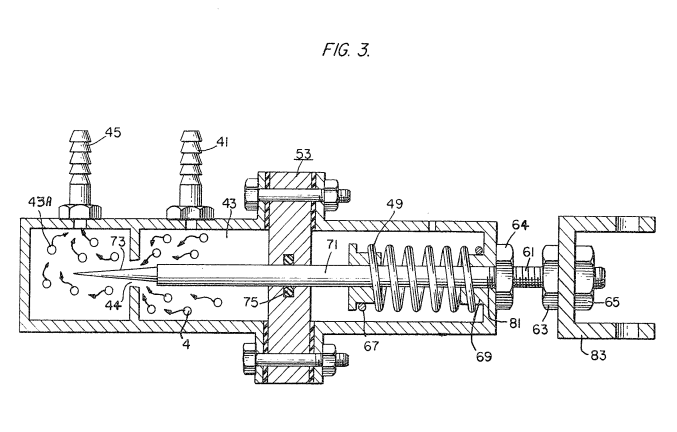
The port opening is controlled by the insertion there through the linearly tapered pin 73. The blunt end of pin 73 is fixed to rod 71. Rod 71 passes through a supporting O-ring 75 and through an opening 81 in a housing to manual adjustment mechanism 83.
How it is written
- (pin 73) 5×
Drawings 1
-
Beside the passage · Hydrogen Gas Injection for Internal Combustion Engine
Where it is named · 5
Hydrogen Gas Injection for Internal Combustion Engine 5×
-
pin (pin 73)
The port opening is controlled by the insertion there through the linearly tapered pin 73. The blunt end of pin 73 is fixed to rod 71. Rod 71 passes through a supporting O-ring 75 and through an opening 81 in a housing to manual adjustment mechanism 83.
-
pin (pin 73)
The port opening is controlled by the insertion there through the linearly tapered pin 73. The blunt end of pin 73 is fixed to rod 71. Rod 71 passes through a supporting O-ring 75 and through an opening 81 in a housing to manual adjustment mechanism 83.
-
pin (pin 73)
The spring 49 retains the rod 71 in a fixed position relative to the pin 73 and opening 42. Upon actuating the mechanism 83, the pin 73 will recede from the opening 44 thereby increasing the amount of gas passing from chamber 43 to chamber 43A.
-
pin (pin 73)
The spring 49 retains the rod 71 in a fixed position relative to the pin 73 and opening 42. Upon actuating the mechanism 83, the pin 73 will recede from the opening 44 thereby increasing the amount of gas passing from chamber 43 to chamber 43A.
-
pin (pin 73)
The stops 67 and 69 maintain spring 49 in its stable position. The position of the pin 73 in a fixed position relative to opening 44 is adjusted via threaded nut 64 on threaded rod 61. That is, the threaded adjustment controls the idle speed or permits the minimum amount of gas to pass from chamber 43 to chamber 43A for continuous operation of the combustion engine.