(47)
Trap Area
Also written area · chamber
Where it is first named
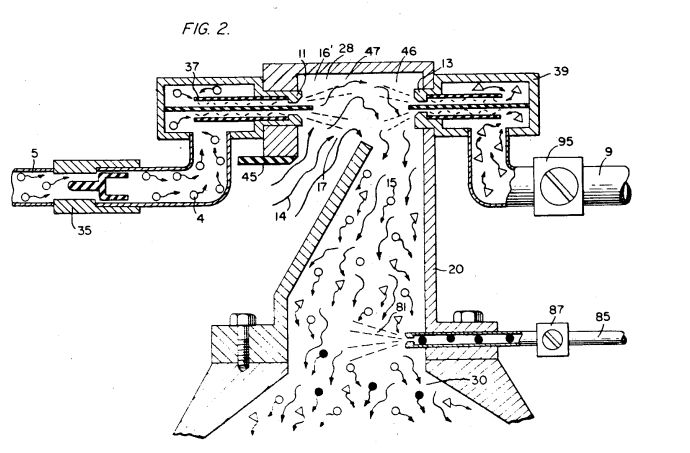
The non-combustible gas passes through nozzle 13 and is injected into the trap area 47 in the mixing chamber 20 as jet spray 17. The ignition device 39 works in conjunction with the emergency valve 37.
How it is written
- (chamber 47) 4×
- (trap area 47) 3×
- (area 47) 2×
Drawings 2
-
Carries this number · ydrogen Gas Injection Apparatus for Internal Combustion Engine
-
Carries this number · ydrogen Gas Injection Apparatus for Internal Combustion Engine
Where it is named · 9
ydrogen Gas Injection Apparatus for Internal Combustion Engine 9×
-
trap area (trap area 47)
The non-combustible gas passes through nozzle 13 and is injected into the trap area 47 in the mixing chamber 20 as jet spray 17. The ignition device 39 works in conjunction with the emergency valve 37.
-
trap area (trap area 47)
At first, oxygen and/or non-combustible gas can be supplied independently or simultaneously to ensure a constant supply. Furthermore, referring to figure 2, the trap area 47 for gas has a suitable size for the nearby section. …
-
area (area 47)
… When hydrogen gas is introduced into the air, the hydrogen rises and is captured within area 47. The size of area 47 ensures that, during the start of the combustion engine, the temporarily generated spark will collect a sufficient amount of hydrogen gas to ignite.
-
area (area 47)
… The size of area 47 ensures that, during the start of the combustion engine, the temporarily generated spark will collect a sufficient amount of hydrogen gas to ignite.
-
trap area (trap area 47)
The introduction of hydrogen gas into the trap area 47 helps prevent ignition delays. Hydrogen gas rises at a much faster rate than oxygen (or non-combustible gas), rising at a rate three times faster or even more. This allows hydrogen gas to enter the trap area (liquid section) much quicker, making it easier to rise into the air, compared to other heavier gases.
-
chamber (chamber 47)
Hydrogen gas passes through valve 43, enters chamber 43, and then goes through port 42 into chamber 47. The amount of gas flowing from chamber 43 to chamber 47 is regulated by controlling the opening of port 42.
-
chamber (chamber 47)
Hydrogen gas passes through valve 43, enters chamber 43, and then goes through port 42 into chamber 47. The amount of gas flowing from chamber 43 to chamber 47 is regulated by controlling the opening of port 42.
-
chamber (chamber 47)
Spring 49 holds rod 71 and pin 73 in place relative to the opening 42. When the mechanism 83 operates, pin 73 is pulled away from the opening 42, allowing more gas to flow from chamber 43 into chamber 47.