(62)
Electrical Voltage Field
Also written pulsating voltage field · positive voltage field · Voltage field · voltage fields · positive electrical voltage zone · voltage potential · voltage zones
Where it is first named
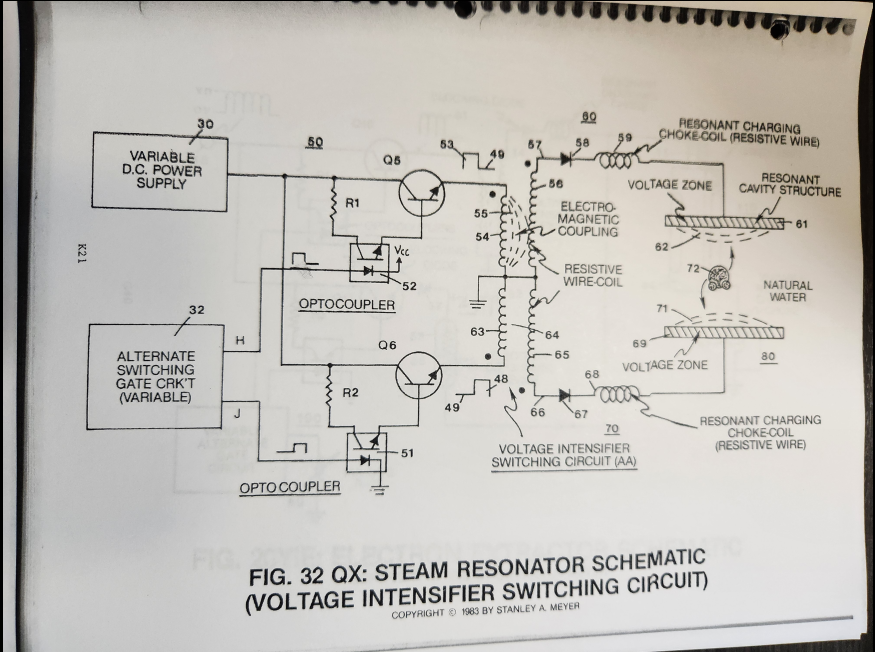
The produced voltage potential (57) now gates "ON" unidirectional diode (58)...allowing said voltage potential (57) to pass to, through, and beyond in-line charging Choke Coil (59) to Excitor Plate (61)...forming positive voltage field (62).
How it is written
- (62) 6×
- (62/71) 3× with (71) Voltage Fields
Drawings 1
-
Beside the passage · Steam Resonator
Where it is named · 9
Steam Resonator 9×
-
Voltage field (62)
Voltage field (62) ceases to exist when said duty pulse (53) is terminated or "switched-off."
-
voltage fields (62/71)
To increase the rate of steam production, simply increase the formation-rate of said voltage fields (62/71) across said voltage zones (61/69).
-
voltage potential (62)
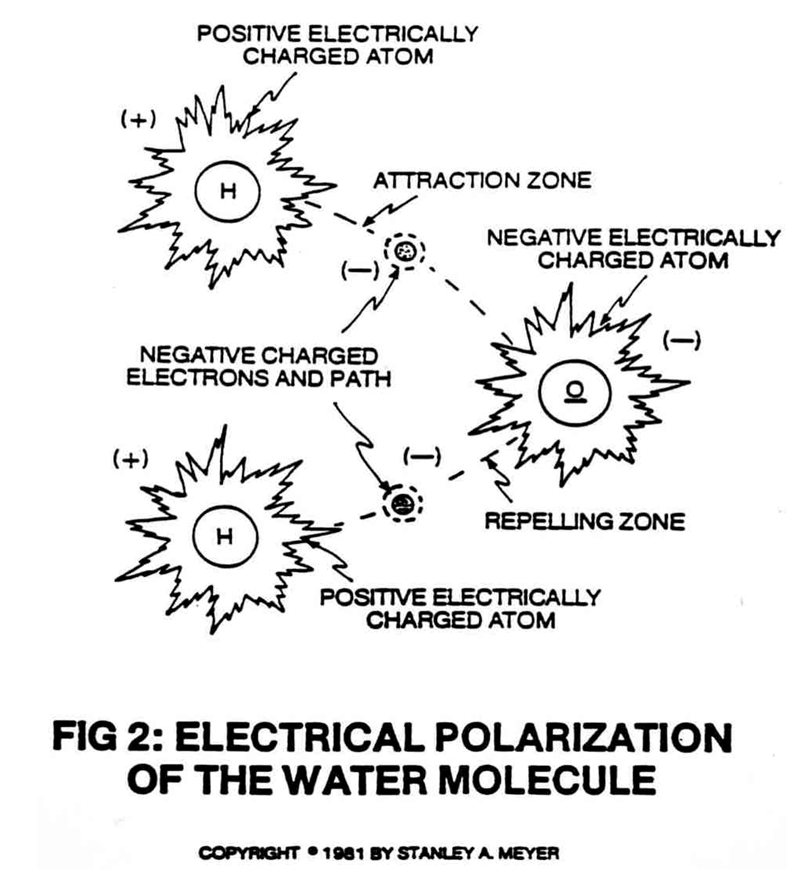
By simply applying a positive voltage potential (62) across said Excitor Plate (61) for a moment of time, the water molecule (72) of Figure (2) as to Figure (32QX) is now deflected or moved toward said voltage zone (61) due to opposite electrical attraction force between said negative charged oxygen atom of said water molecule and said positive electrical voltage zone (62).
-
positive electrical voltage zone (62)
By simply applying a positive voltage potential (62) across said Excitor Plate (61) for a moment of time, the water molecule (72) of Figure (2) as to Figure (32QX) is now deflected or moved toward said voltage zone (61) due to opposite electrical attraction force between said negative charged oxygen atom of said water molecule and said positive electrical voltage zone (62).
-
electrical voltage field (62)
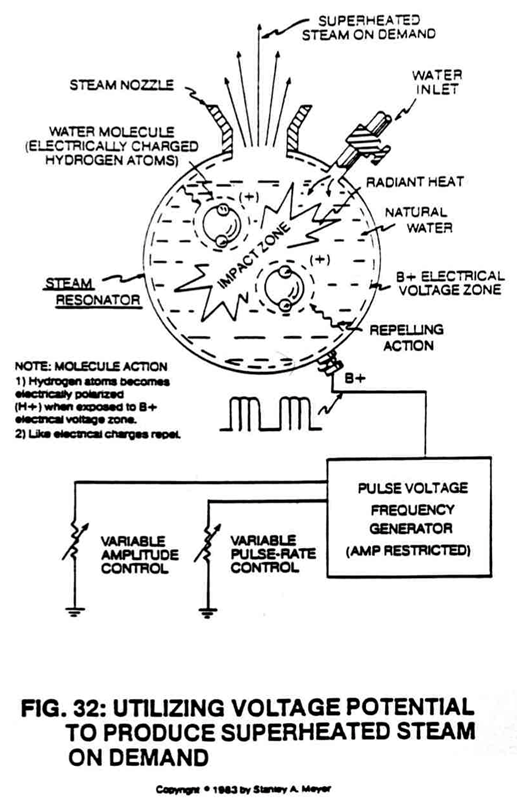
Switching "OFF" said electrical voltage field (62) while switching "ON" said positive electrical voltage field (71) now causes said water molecule (72) to "deflect or move" in opposite direction towards said voltage zone (69)...colliding with other water molecules undergoing the same voltage deflection process...generating heat due to particle impact, as illustrated in Figure 32.
-
voltage fields (62/71)
Repetitive formation of said voltage fields (62/71) on opposite sides of said water molecule oscillates the water molecules in a back-and-forth pattern between said voltage zones (62/71)...converting said natural water into superheated steam for utilization.
-
voltage zones (62/71)
Repetitive formation of said voltage fields (62/71) on opposite sides of said water molecule oscillates the water molecules in a back-and-forth pattern between said voltage zones (62/71)...converting said natural water into superheated steam for utilization.