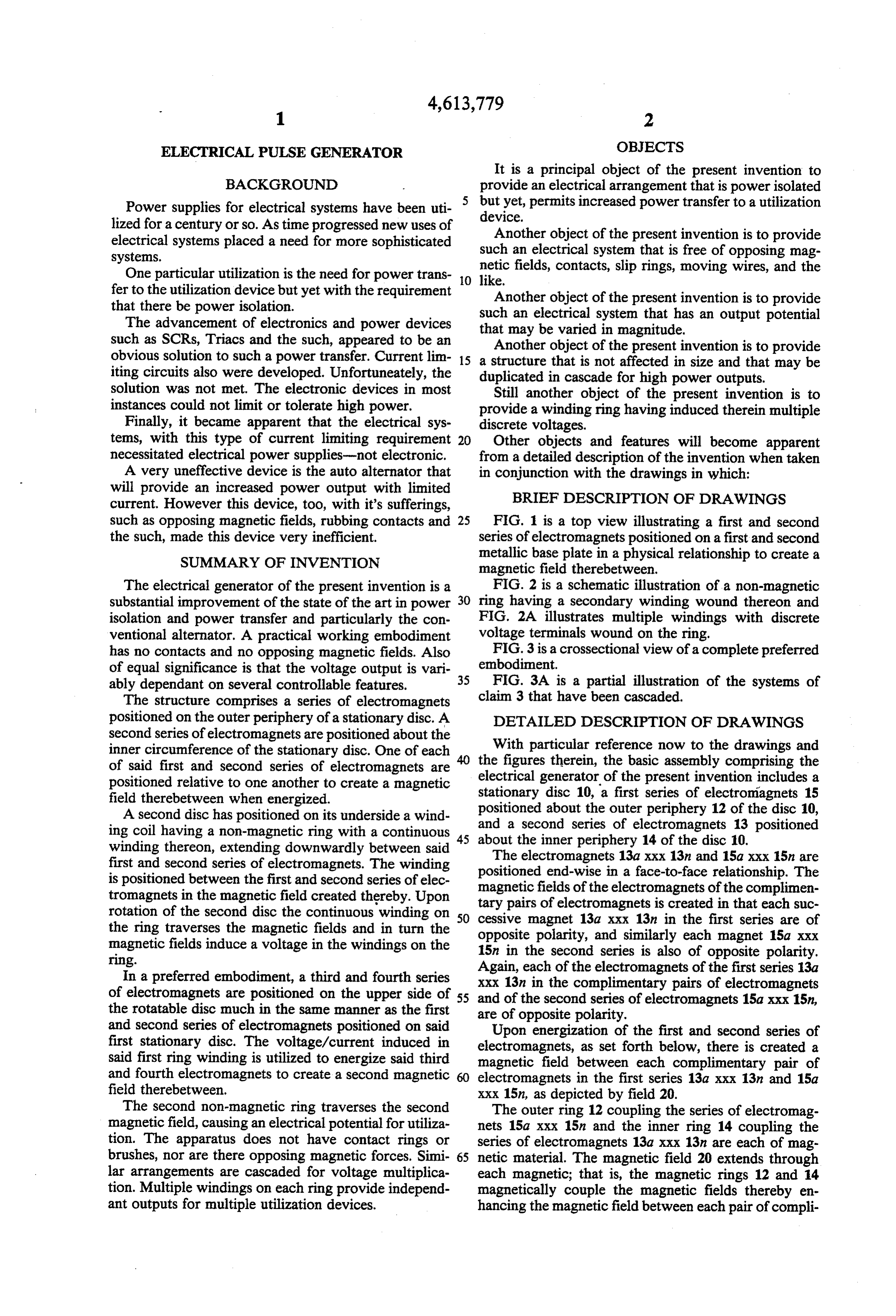
(13) · also written as a run, 13a xxx 13n
Electromagnets
Also written first series · successive magnet
Where it is first named
With particular reference now to the drawings and the figures therein, the basic assembly comprising the electrical generator of the present invention includes a stationary disc 10, a first series of electroniagnets 15 positioned about the outer periphery 12 of the disc 10, and a second series of electromagnets 13 positioned about the inner periphery 14 of the disc 10.
How it is written
- (electromagnets 13a) 7×
- (electromagnets 13) 5×
- (electromagnets 13n) 2×
- (first series 13) 2×
- (successive magnet 13n) 1×
- (first series 13a) 1×
- (first series 13n) 1×
- (successive magnet 13a) 1×
13a xxx 13n is Meyer's shorthand for a run of the same thing: 13a is the first, 13n the last, and the x's stand for however many lie between. Every stage of the run is this one numeral.
Drawings 4
-
Page 8 · Electrical Pulse Generator
-
Page 9 · Electrical Pulse Generator
-
Page 10 of the original patent document · Electrical Pulse Generator
-
Page 10 · Electrical Pulse Generator
Where it is named · 20
Electrical Pulse Generator 20×
-
electromagnets (electromagnets 13)
With particular reference now to the drawings and the figures therein, the basic assembly comprising the electrical generator of the present invention includes a stationary disc 10, a first series of electroniagnets 15 positioned about the outer periphery 12 of the disc 10, and a second series of electromagnets 13 positioned about the inner periphery 14 of the disc 10.
-
electromagnets (electromagnets 13a)
The electromagnets 13a xxx 13” and 15a xxx 15n are positioned end-wise in a face-to-face relationship. …
-
electromagnets (electromagnets 13)
The electromagnets 13a xxx 13” and 15a xxx 15n are positioned end-wise in a face-to-face relationship. …
-
successive magnet (successive magnet 13a)
… The magnetic fields of the electromagnets of the complimentary pairs of electromagnets is created in that each successive magnet 13a xxx 13n in the first series are of opposite polarity, and similarly each magnet 15a xxx 15n in the second series is also of opposite polarity. …
-
successive magnet (successive magnet 13n)
… The magnetic fields of the electromagnets of the complimentary pairs of electromagnets is created in that each successive magnet 13a xxx 13n in the first series are of opposite polarity, and similarly each magnet 15a xxx 15n in the second series is also of opposite polarity. …
-
first series (first series 13a)
… Again, each of the electromagnets of the first series 13a xxx 13n in the complimentary pairs of electromagnets and of the second series of electromagnets 15a xxx 15n, are of opposite polarity.
-
first series (first series 13n)
… Again, each of the electromagnets of the first series 13a xxx 13n in the complimentary pairs of electromagnets and of the second series of electromagnets 15a xxx 15n, are of opposite polarity.
-
first series (first series 13)
Upon energization of the first and second series of electromagnets, as set forth below, there is created a magnetic field between each complimentary pair of electromagnets in the first series 13@ xxx 13 and 15a xxx 15n, as depicted by field 20.
-
first series (first series 13)
Upon energization of the first and second series of electromagnets, as set forth below, there is created a magnetic field between each complimentary pair of electromagnets in the first series 13@ xxx 13 and 15a xxx 15n, as depicted by field 20.
-
electromagnets (electromagnets 13a)
The outer ring 12 coupling the series of electromagnets 15a xxx 15n and the inner ring 14 coupling the series of electromagnets 13a xxx 13” are each of magnetic material. The magnetic field 20 extends through each magnetic; that is, the magnetic rings 12 and 14 magnetically couple the magnetic fields thereby enhancing the magnetic field between each pair of compli-
-
electromagnets (electromagnets 13)
The outer ring 12 coupling the series of electromagnets 15a xxx 15n and the inner ring 14 coupling the series of electromagnets 13a xxx 13” are each of magnetic material. The magnetic field 20 extends through each magnetic; that is, the magnetic rings 12 and 14 magnetically couple the magnetic fields thereby enhancing the magnetic field between each pair of compli-
-
electromagnets (electromagnets 13)
mentary magnets. In this way if there are discrepancies in the structures, orientation etc., the inductive coupling rings 12 and 14 of the electromagnets 13 and 15 will integrate and average the magnetic fields. …
-
electromagnets (electromagnets 13a)
… Also secured to disc 10 is a voltage terminal 50 for applying an electrical voltage current potential to each of the - electromagnets 13a xxx 13” and 15a xxx 15n. …
-
electromagnets (electromagnets 13)
… Also secured to disc 10 is a voltage terminal 50 for applying an electrical voltage current potential to each of the - electromagnets 13a xxx 13” and 15a xxx 15n. …
-
electromagnets (electromagnets 13a)
… 3 is the winding ring 30 positioned in the gap between electromagnets 13a xxx and 15a@ xxx n. The winding ring 30 is supported by 'support 31 to the underside of rotating disc 44.
-
electromagnets (electromagnets 13a)
… The electromagnets are positioned end-wise with the inner ring of electromagnets 13a xxx 13n facing the outer ring of electromagnets 15a xxx n. …
-
electromagnets (electromagnets 13n)
… The electromagnets are positioned end-wise with the inner ring of electromagnets 13a xxx 13n facing the outer ring of electromagnets 15a xxx n. …
-
electromagnets (electromagnets 13a)
Upon energizing the electromagnets, via terminal 50, in the gap between electromagnets 13a xxx m and 15a xxx 7 there will be a magnetic field 20. …