(5) · also written as a run, 5a xxx 5n
Quenching Circuit
Also written gas port · Multiple Quenching Circuits · gas passageway
Where it is first named
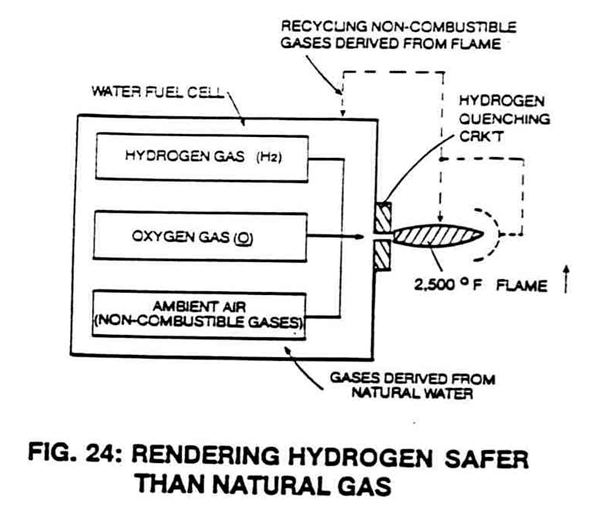
As the fuel gases (6) enter into, pass through and beyond the quenching circuit (5) of Figure 24SB, the Fuel Cell gases (6) are lengthwise distributed through a small elongated gas port (5) at least smaller than .015 inch diameter but equal to or greater than 1/8 inch length formed by Quenching Disc (7) of Figure 24SB.
How it is written
- (5) 5×
- (5a xxx 5n) 2×
5a xxx 5n is Meyer's shorthand for a run of the same thing: 5a is the first, 5n the last, and the x's stand for however many lie between. Every stage of the run is this one numeral.
Drawings 1
-
Flame projection is achievable beyond six inches while flame temperature is variable up to and beyond 5,000 degrees F. · Catalytic Block Assembly
Where it is named · 7
Catalytic Block Assembly 7×
-
quenching circuit (5)
As the fuel gases (6) enter into, pass through and beyond the quenching circuit (5) of Figure 24SB, the Fuel Cell gases (6) are lengthwise distributed through a small elongated gas port (5) at least smaller than .015 inch diameter but equal to or greater than 1/8 inch length formed by Quenching Disc (7) of Figure 24SB.
-
gas port (5)
As the fuel gases (6) enter into, pass through and beyond the quenching circuit (5) of Figure 24SB, the Fuel Cell gases (6) are lengthwise distributed through a small elongated gas port (5) at least smaller than .015 inch diameter but equal to or greater than 1/8 inch length formed by Quenching Disc (7) of Figure 24SB.
-
gas passageway (5)
The aligned gas atoms located inside this gas passageway (5) alternate regroup to support gas ignition since the non-combustible gas atoms retard the oxygen atom to unite with the hydrogen atoms, see Figure 24SD.
-
Multiple Quenching Circuits (5a xxx 5n)
Multiple Quenching Circuits (5a xxx 5n) of Figure 24SB are used to prevent flame-out when the Fuel Cell gases exceed a certain gas velocity.
-
gas port (5)
A non-oxidizing material such as alumina (a type of ceramic material) is used to form said quenching disc (7) to prevent gas port (5) enlargement due to chemical interaction and/or heat exposure or both.
-
quenching circuit (5)
The modulated gas mixture (6) near each quenching circuit (5) prior to gas ignition (9) helps keep quenching disc (7) cool to the touch.
-
To help prevent hydrogen gas leakage due to quenching circuit flame-out (Murphy's law of probability), said quenching circuits (5a xxx 5n) are prearranged in such a way as to allow an adjacent flame (9) to re-ignite the expelling fuel gas.