(9)
Hydrogen/Oxygen Flame
Also written flame temperature · adjacent flame · hydrogen flame · gas ignition
Where it is first named
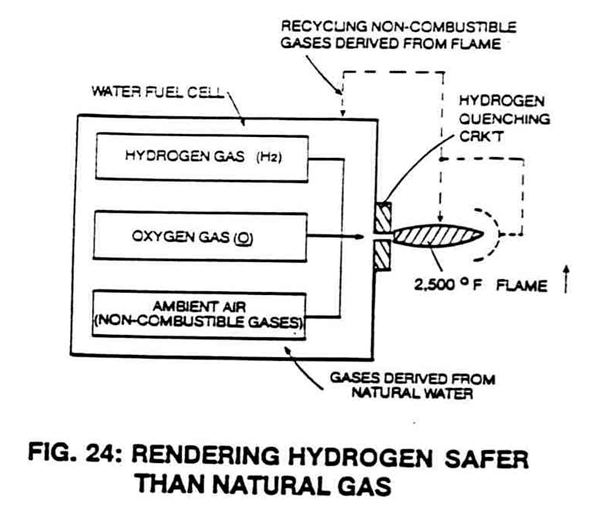
To reduce the burn-rate of the hydrogen gas still further to lower flame temperature, simply capture (1) and recycle (2) the non-combustible gases (3) being expelled from said sustained hydrogen flame (9), as illustrated in Figure 24 as to Figure 24SC.
How it is written
- (9) 5×
Drawings 2
-
Flame projection is achievable beyond six inches while flame temperature is variable up to and beyond 5,000 degrees F. · Catalytic Block Assembly
-
Beside the passage · Catalytic Block Assembly
Where it is named · 5
Catalytic Block Assembly 5×
-
hydrogen flame (9)
To reduce the burn-rate of the hydrogen gas still further to lower flame temperature, simply capture (1) and recycle (2) the non-combustible gases (3) being expelled from said sustained hydrogen flame (9), as illustrated in Figure 24 as to Figure 24SC.
-
gas ignition (9)
The modulated gas mixture (6) near each quenching circuit (5) prior to gas ignition (9) helps keep quenching disc (7) cool to the touch.
-
adjacent flame (9)
To help prevent hydrogen gas leakage due to quenching circuit flame-out (Murphy's law of probability), said quenching circuits (5a xxx 5n) are prearranged in such a way as to allow an adjacent flame (9) to re-ignite the expelling fuel gas.