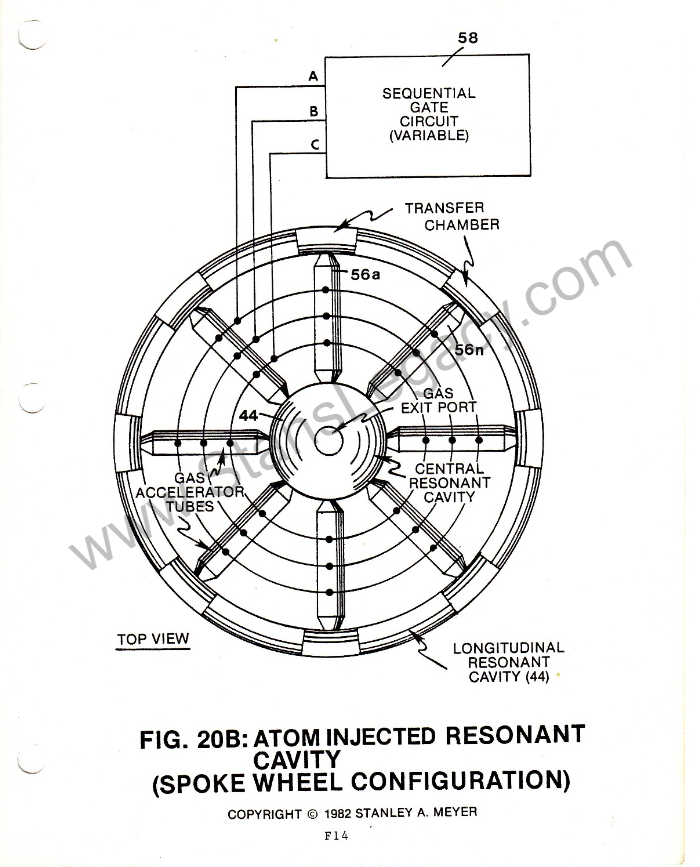
(44)
Resonant Cavity
Also written cavity · resonant-cavity
Where it is first named
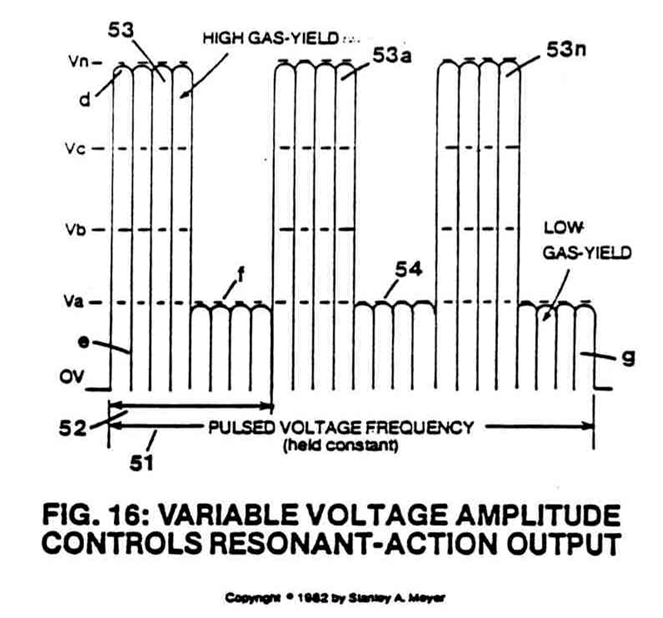
As on-time (53) increases, off-time (54) proportionally decreases, allowing more voltage pulses (53) to be applied to said resonant cavity (44).
How it is written
- (44) 9×
Drawings 4
-
Said voltage amplitude (f) is varied to sustain and compounding-action within said resonant cavity (44). · Resonant Cavity
-
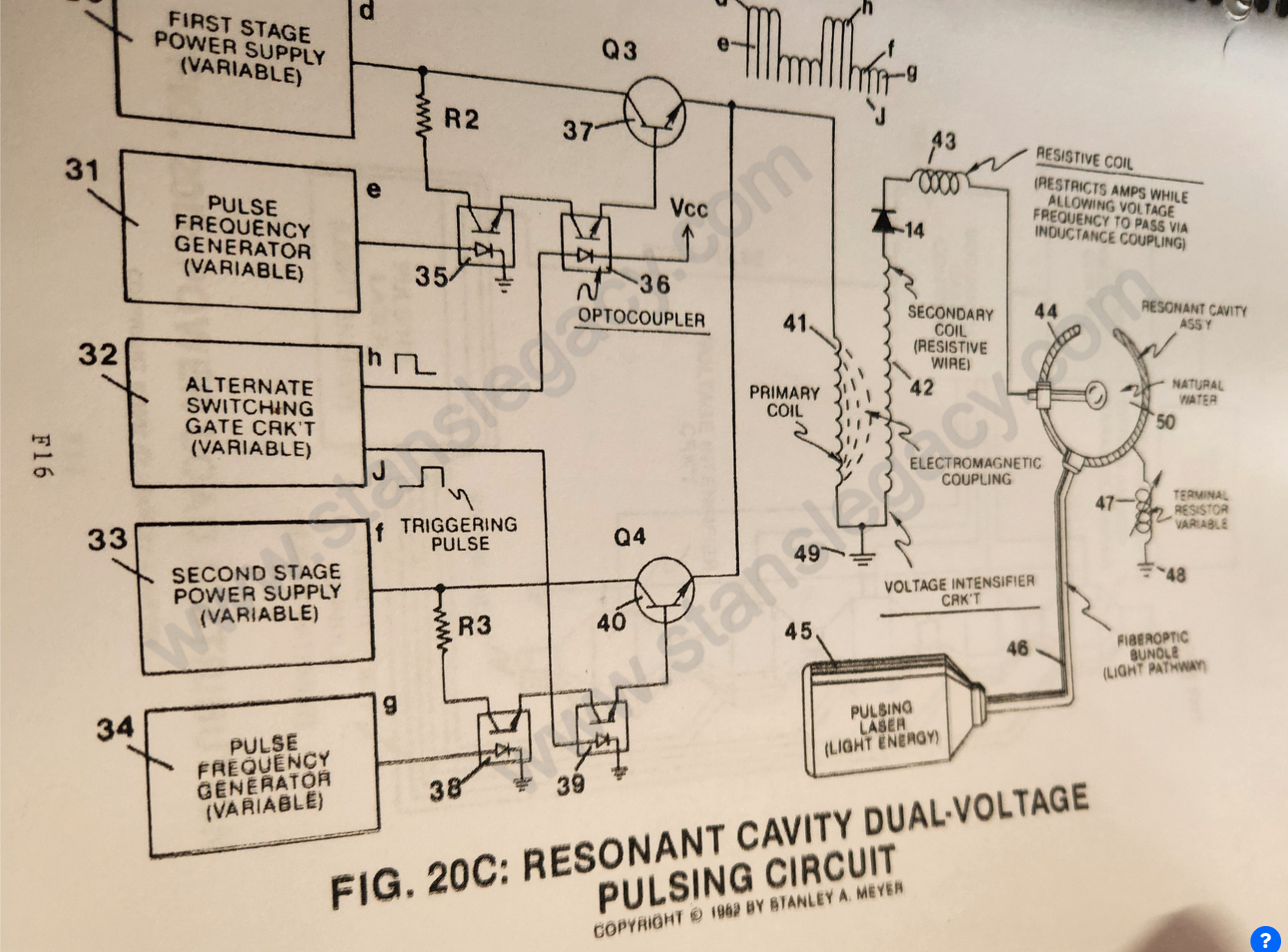
Figure 20C · Resonant Cavity
-
Carries this number · Resonant Cavity Mode of Operability
-
Beside the passage · Circuit Function
Where it is named · 9
Resonant Cavity 3×
-
cavity (44)
2. Said voltage amplitude (d) is varied to increase gas-yield. After said voltage amplitude (d) is stepped up, applied voltage range to said cavity (44) is from less than one volt to 5,000 volts or more.
-
resonant cavity (44)
Said voltage amplitude (f) is varied to sustain and compounding-action within said resonant cavity (44).
Circuit Function 3×
-
resonant-cavity (44)
Stainless steel T304 material is also used to form said resonant-cavity (44).
-
resonant cavity (44)
Said resonant cavity (44) can take on different shapes and sizes to meet a predetermined gas need. Spherical and longitudinal resonant cavities are examples.
-
resonant cavity (44)
To set up a variable pulsing circuit capable of "tuning-in" resonant action regardless of shape and dimensional size of said resonant cavity (44).
Operational Comments 1×
Resonant Cavity Mode of Operability 2×
-
resonant cavity (44)
Particle collision also causes other liberated atoms to become ionized beyond the absorption of said light radiation, liberating more electrons inside said resonant cavity (44).
-
resonant cavity (44)
9. To prevent electrical discharge of said particles of gas when said resonant cavity (44) and said gas attraction zones (57) are submerged in natural water, said fuel cell housing is composed of an electrical insulating material such as plastic or spun glass.