

(53)
Voltage Pulses
Also written high-intensity voltage pulses · Pulse-train · high intensity voltage pulse · high-intensity voltage pulse · on-time
Where it is first named
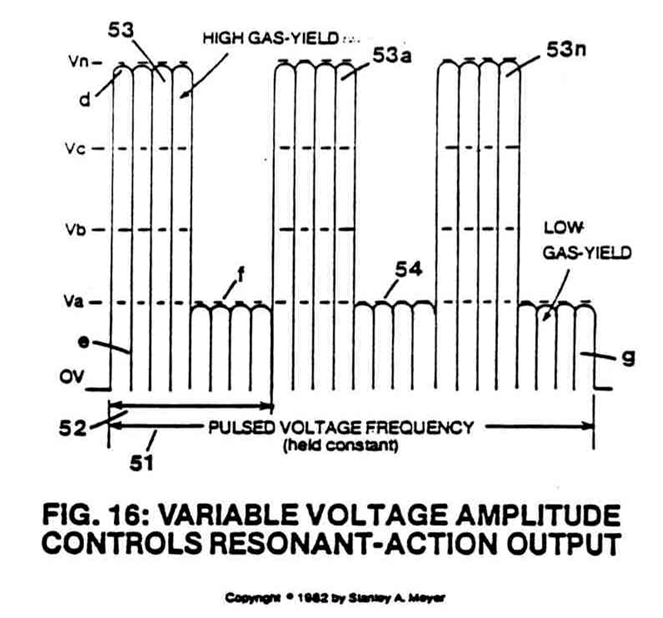
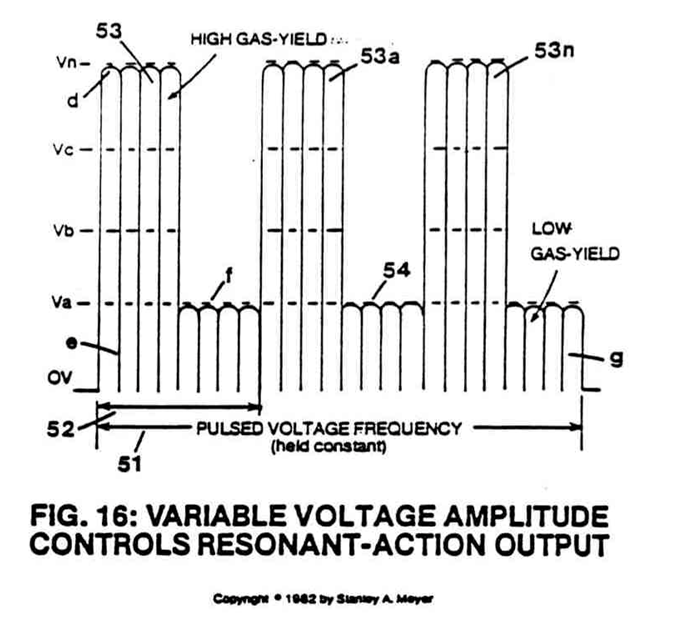
As on-time (53) increases, off-time (54) proportionally decreases, allowing more voltage pulses (53) to be applied to said resonant cavity (44).
How it is written
- (53) 7×
- (53/54) 1× with (54) Pulse-Train
Drawings 2
-
Said voltage amplitude (f) is varied to sustain and compounding-action within said resonant cavity (44). · Resonant Cavity
-
Laser assembly (45) can be any type of conventional laser that operates in the visible and/or ultraviolet region. · Operational Comments
Where it is named · 8
Resonant Cavity 5×
-
voltage pulses (53)
To reduce the number of voltage pulses (53), simply reverse the pulse-train adjustment of said gate control circuit (32).
-
Pulse-train (53)
8. Pulse-train (53) and pulse-train (54) can be of different pulse voltage frequency with different voltage amplitude adjustments, each pulse-train performing different functions.
-
Pulse-train (53)
Pulse-train (53) regulates gas production on demand; whereas, pulse-train (54) maintains compounding action while restricting amp flow.
Operational Comments 2×
-
high-intensity voltage pulse (53)
The absorbed electromagnetic energy (light-energy) (45) by said atoms forming said water molecule also helps disrupt electrical mass equilibrium of said water molecule atoms when said water molecule atoms are subjected to said high-intensity voltage pulse (53) (54) of Figure (16). (See Exhibit BX again).
Resonant Cavity Mode of Operability 1×
-
high-intensity voltage pulses (53/54)
In both cases, said formed ions are now subject to motion or deflection by said high-intensity voltage pulses (53/54). …