(60) · also written as a run, 60a xxx 60n
Resistor
Also written inhibitor resistor · inhibitor resister · circuit
Where it is first named
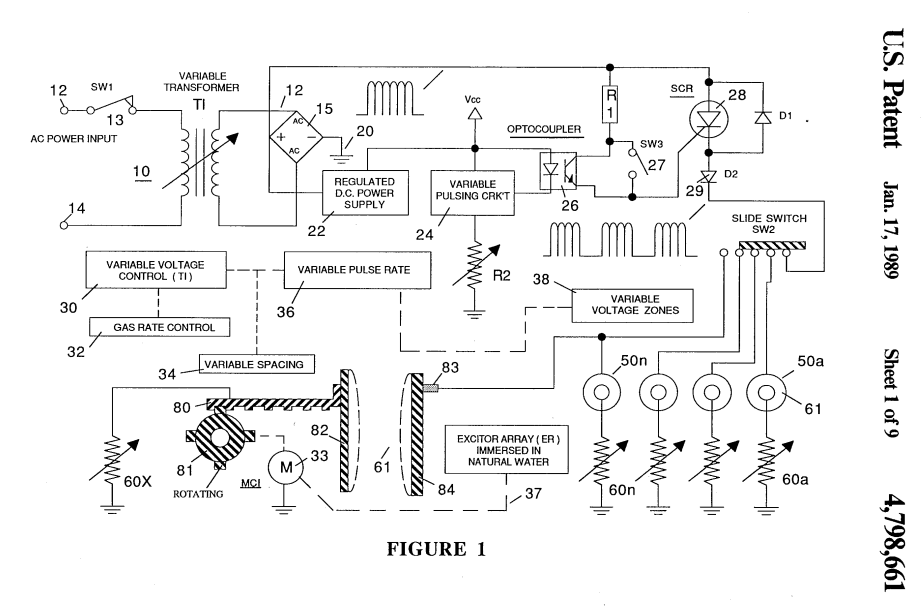
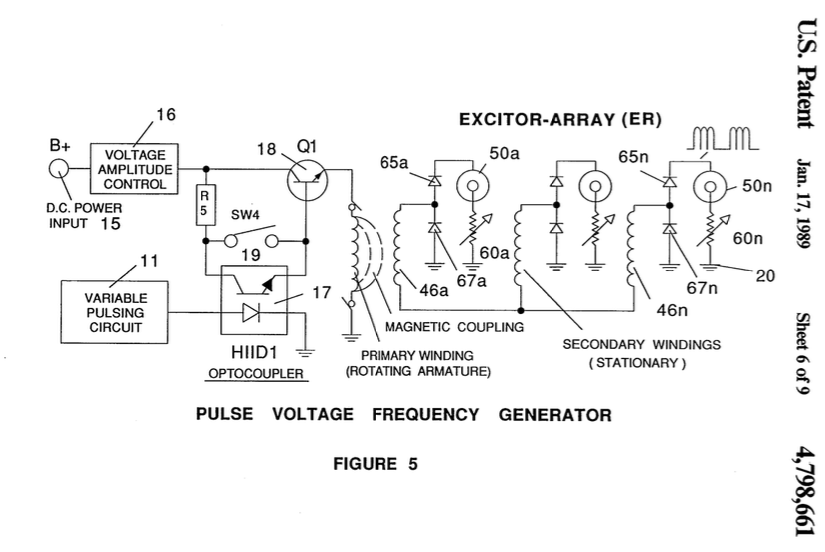
The next expediency in the sequence for inhibiting electron leakage is the current inhibitor resister 60 as shown in FIGS. …
How it is written
- (resistor 60) 5×
- (circuit 60) 1×
- (inhibitor resister 60) 1×
- (inhibitor resistor 60) 1×
- (resistor 60n) 1×
60a xxx 60n is Meyer's shorthand for a run of the same thing: 60a is the first, 60n the last, and the x's stand for however many lie between. Every stage of the run is this one numeral.
Drawings 3
-
Carries this number · Gas Generator Voltage Control Circuit
-
Carries this number · Gas Generator Voltage Control Circuit
-
In FIG. 4A and 4B, the frequency of the pulsed d.c. voltage is matched to the distance in wavelengths of the plate exciters. · Gas Generator Voltage Control Circuit
Where it is named · 9
Gas Generator Voltage Control Circuit 9×
-
inhibitor resister (inhibitor resister 60)
The next expediency in the sequence for inhibiting electron leakage is the current inhibitor resister 60 as shown in FIGS. …
-
circuit (circuit 60)
The next expediency in the sequence for inhibiting electron leakage is the current inhibitor resister 60 as shown in FIGS. 1 and 5. The circuit 60 comprises a simple resistor of the commercial type or specially made for the particular application. …
-
resistor (resistor 60)
… In that the each pair of plate exciters are connected separately, a resistor 60¢ xxx 60n is connected to each of the plates having the negative voltage connected thereto. …
-
resistor (resistor 60n)
… In that the each pair of plate exciters are connected separately, a resistor 60¢ xxx 60n is connected to each of the plates having the negative voltage connected thereto. …
-
resistor (resistor 60)
As known in electrical art the resistor will provide a complete block to electron leakage—current flow. However, since the resistor 60 is connected from ground-to-ground there is no real affect on the voltage; and since there is no connection with the positive side there is no voltage drop.
-
resistor (resistor 60)
… The electron inhibitor 70/74 is connected in the same manner as resistor 60—between the inner plate having the negative potential connected to it and ground.
-
inhibitor resistor (inhibitor resistor 60)
With reference to FIGS. 1 and 8, the pulse d.c. volt- age of a repetitive frequency and the duty cycle pulses, together with the serially connected plate exciter techniques in the sequence for limiting the electron leakage is in relation to the positive exciter outer plate. The current inhibitor resistor 60 and the current inhibitor resistor 70/74 are in the negative voltage line connected to the inner plate.
-
resistor (resistor 60)
The resistor 60 of FIGS. 1 and 5, connected between the exciter plate having the negative voltage applied thereto and ground is an effective current limiter/electron inhibitor. In simple terms the restriction to current flow to the negative plate is a restriction to the flow of current between the pair of plate exciters.