(8)
Secondary Coil
Also written high voltage multiplying component · interfacing circuit · Circuit Stage
Where it is first named
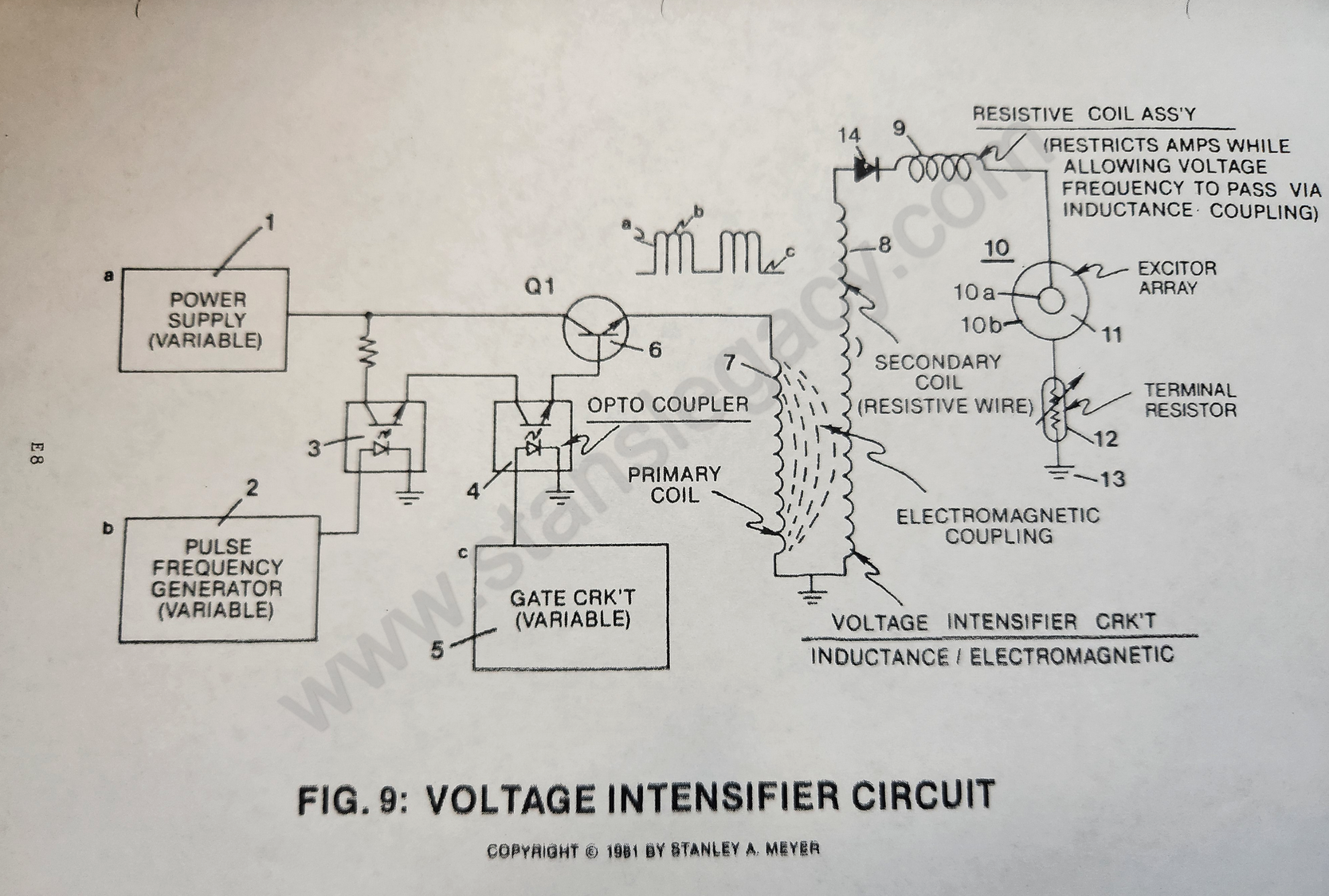
To help prevent amp leakage from occurring during gas production, said resistive wire is used to retard amp flow through said secondary coil (8) voltage potential is developed across said pick-up coil (*) leads (third stage to amp restriction and fourth-stage to voltage attenuation.)
How it is written
- (8) 4×
- (8 as to 9) 1×
Drawings 2
-
Circuit Stage: (7) (8), (14), (9), (10) as to (11), (10B), (12) and (13). · Voltage Attenuation Circuit
-
Purpose: To interface said pulsing circuit (Figure 9) with another type of power supply. · Voltage Attenuation Circuit
Where it is named · 5
Voltage Attenuation Circuit 5×
-
secondary coil (8)
To help prevent amp leakage from occurring during gas production, said resistive wire is used to retard amp flow through said secondary coil (8) voltage potential is developed across said pick-up coil (*) leads (third stage to amp restriction and fourth-stage to voltage attenuation.)
-
secondary coil (8)
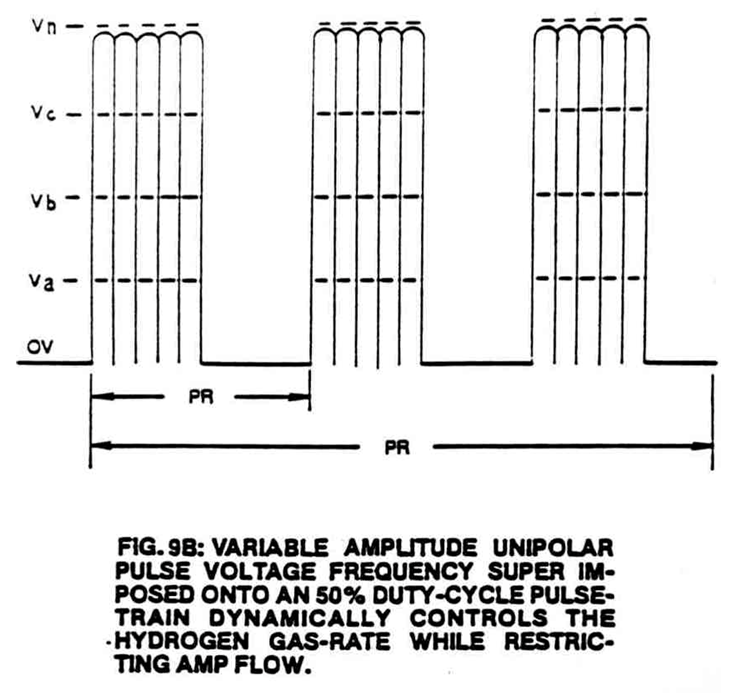
As pulse voltage potential is developed across said secondary coil (8) leads, said developed voltage pulses are now allowed to pass through and beyond said bypass coil (9) by way of electromagnetic inductance.
-
interfacing circuit (8 as to 9)
Terminal resistor (12 of Figure 9) is affixed to said excitor-array (10) on ground side (see Figure 9 again) to prevent counter electron deflection or movement within said interfacing circuit (8 as to 9).
-
high voltage multiplying component (8)
During the transient startup period, the unidirectional diode (14) is in its non-conducting state and isolates the water fuel cell from the high voltage multiplying component (8).