(9A)
Pulse Voltage Frequency
Also written pulse voltage frequency wave form · variable pulse frequency
Where it is first named
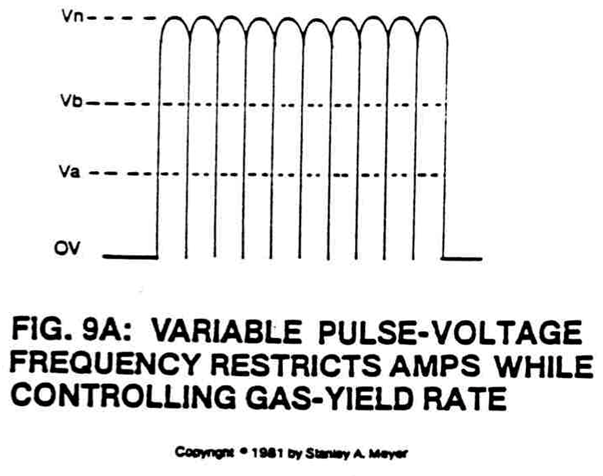
By varying the triggering rate of said pulse generator (2) from 1HZ to 1MHZ, said pulse voltage frequency (9A) is likewise varied.
How it is written
- (9A) 7×
Drawings 1
-
The figure it sits on · Voltage Attenuation Circuit
Where it is named · 7
Voltage Attenuation Circuit 7×
-
pulse voltage frequency (9A)
By varying the triggering rate of said pulse generator (2) from 1HZ to 1MHZ, said pulse voltage frequency (9A) is likewise varied.
-
pulse voltage frequency (9A)
The variable pulse voltage frequency (9A) is adjusted to keep amp flow restricted during first-stage to amp restriction by allowing said voltage amplitude (Va-Vn of Figure 9A).
-
pulse voltage frequency (9A)
To switch off and on said generated pulse voltage frequency (9A) at a variable time rate while maintaining said voltage amplitude control (Va-Vn of Figure 9A).
-
pulse voltage frequency wave form (9A)
Optocoupler (4) is another photoisolation switch that when triggered by variable gate circuit (5) (a second variable triggering circuit) causes said pulse voltage frequency wave form (9A) to be altered as shown in Figure 9B.
-
pulse voltage frequency (9A)
The adjustable pulse-train simply "concentrates" or time-regulates the applied pulse voltage frequency (9A), allowing for higher voltage amplitude (third-stage to voltage attenuation).
-
variable pulse frequency (9A)
Purpose: To step up power supply voltage (1) while maintaining said variable voltage amplitude (Va-Vn) control, said variable pulse frequency (9A) control, said variable gate (9B) control, and performing a third, fourth, and fifth step to amp restriction.