(46) · also written as a run, 46a xxx 46n
Coil-Bobbin
Also written Coil · coils
Where it is first named
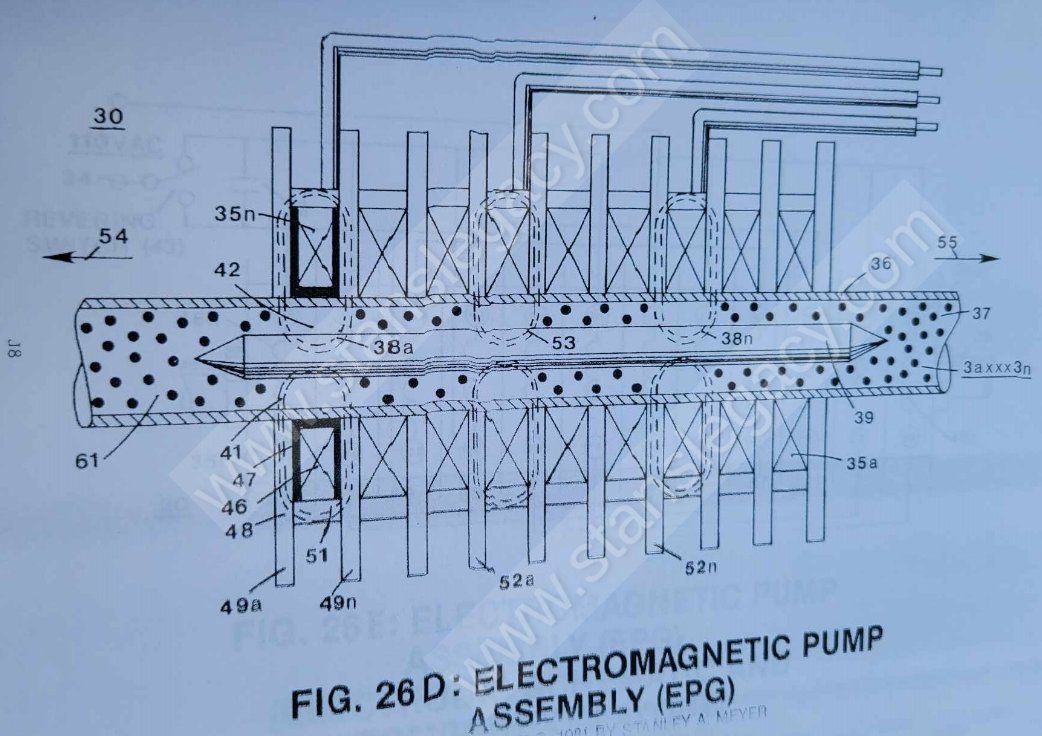
Coil (46) is wound (400 turns 30 ga. insulated wire) on molded nylon bobbin (47) that is placed inside a magnetic "shunt-assembly" (48) and slipped over said tubular bearing (36), as illustrated in Figure 26E as to Figure 26F and Figure 28.
How it is written
- (46) 2×
- (46/47) 2× with (47) Coil-Bobbin
- (46a xxx 46n) 1×
46a xxx 46n is Meyer's shorthand for a run of the same thing: 46a is the first, 46n the last, and the x's stand for however many lie between. Every stage of the run is this one numeral.
Drawings 3
-
Carries this number · ELECTRICAL PARTICLE GENERATOR
-
Carries this number · ELECTRICAL PARTICLE GENERATOR
-
The figure it sits on · ELECTRICAL PARTICLE GENERATOR
Where it is named · 5
ELECTRICAL PARTICLE GENERATOR 5×
-
coils (46a xxx 46n)
Wiring of said coils (46a xxx 46n) in proper sequence (see wiring schematic Figure 26E) with said capacitor (33) produces a sweeping magnetic wave (38a xxx 38n) across said fluid-mass (3), thus allowing said fluid-mass movement (54).